
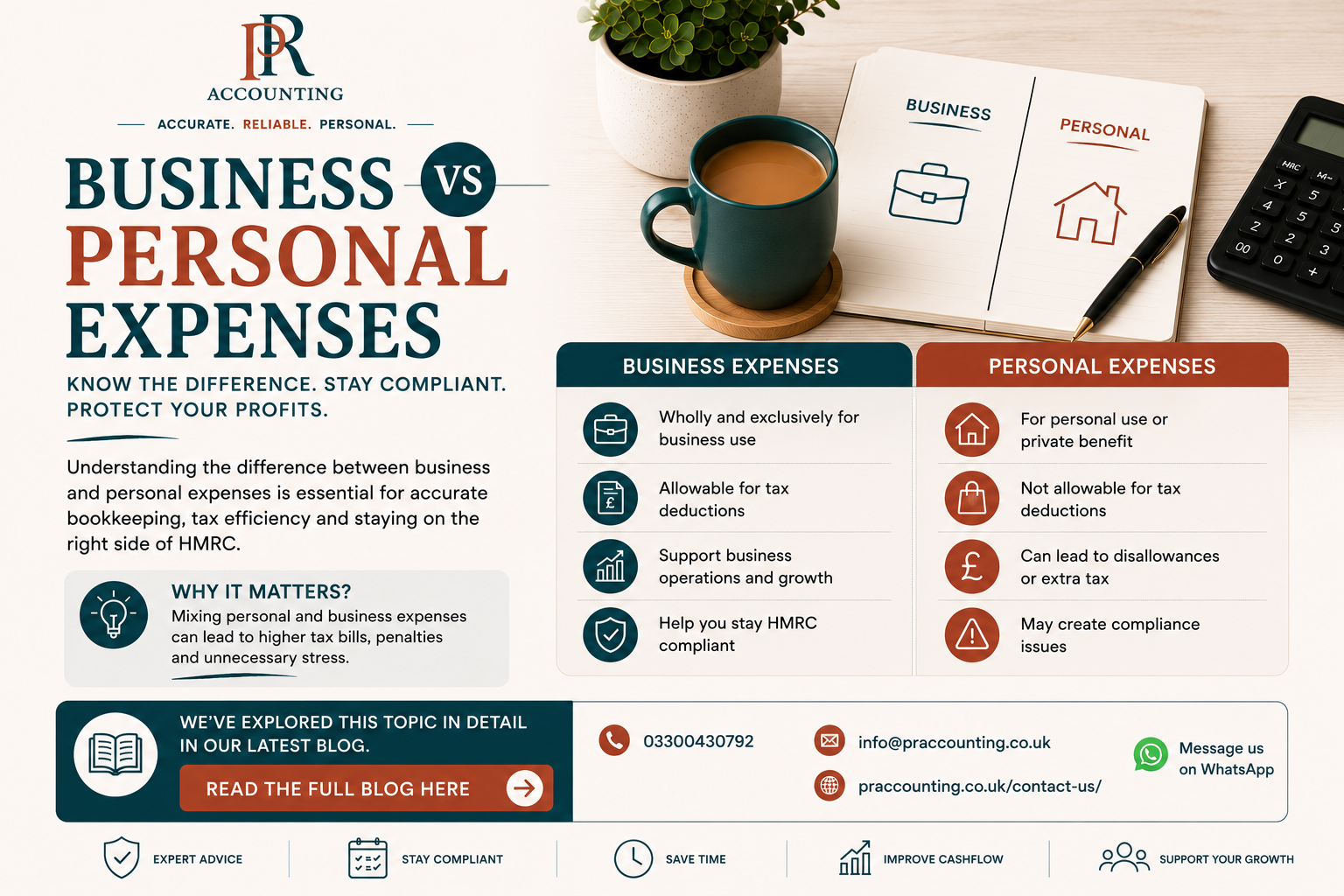
Business vs Personal Expenses: What UK Business Owners Get Wrong
One of the most common bookkeeping problems in small businesses is mixing personal and business expenses.
It usually starts innocently.
A director uses the company card for fuel.
A sole trader pays for home internet from the business account.
A business owner buys something from Amazon and forgets whether it was personal or business.
A client lunch is posted as “marketing”.
A family mobile phone bill goes through the company.
Individually, these may not seem serious. Over time, they can create:
- inaccurate bookkeeping
- disallowed expenses
- VAT errors
- director’s loan account issues
- higher accountancy fees
- HMRC enquiry risk
- poor visibility over real business profit
The key point is simple: not everything paid from a business bank account is automatically a business expense.
The Basic Rule: Is the Expense Really for the Business?
For tax purposes, an expense generally needs to be incurred for the business.
HMRC guidance refers to the “wholly and exclusively” rule. For companies, HMRC’s Business Income Manual explains that expenditure cannot be deducted when calculating trading profits unless it is incurred wholly and exclusively for the purposes of the trade, profession or vocation.
In plain English:
If the cost is genuinely for the business, it may be allowable.
If it is personal, it usually is not.
If it is partly business and partly personal, it needs careful treatment.
Why This Matters
Business owners often think the issue is only about tax.
It is bigger than that.
Mixing expenses affects:
- how accurate your profit figures are
- whether VAT has been reclaimed correctly
- whether dividends are being taken safely
- whether the director’s loan account is overdrawn
- whether management accounts are reliable
- whether mortgage or finance applications are supported by clean accounts
For limited companies, directors remain responsible for company records, accounts and performance even where they appoint an accountant or bookkeeper to help. GOV.UK confirms that directors can hire others to manage tasks day to day, but remain legally responsible for the company’s records, accounts and performance.
Business Expense vs Personal Expense: The Difference
Business Expense
A business expense is a cost incurred for the business.
Examples may include:
- accountancy fees
- bookkeeping software
- business insurance
- website costs
- business stationery
- staff wages
- business travel
- marketing costs
- professional subscriptions
- equipment used for the business
Personal Expense
A personal expense is a cost that benefits the owner, director, shareholder or their family personally.
Examples may include:
- family groceries
- personal clothing
- private holidays
- personal entertainment
- household bills with no clear business basis
- private meals
- school fees
- personal subscriptions
- ordinary commuting
Some personal costs may still be paid from the business bank account in practice, but that does not make them deductible business expenses.
Practical Example: The Company Card Problem
A director uses the company debit card for:
- fuel
- supermarket shopping
- Netflix
- personal Amazon purchases
- children’s clothing
- a client lunch
- business stationery
- accountancy software
Only some of these are likely to be valid business expenses.
The personal items may need to be:
- posted to the director’s loan account
- treated as a benefit
- repaid by the director
- disallowed for tax
- adjusted for VAT
This is why clean bookkeeping matters. The accountant cannot simply treat everything paid from the company account as tax deductible.
Common Grey Areas
1. Mobile Phones
Mobile phones often have both business and personal use.
A company mobile contract used for business can be easier to justify than claiming a percentage of a personal phone bill.
If the phone is personally owned and used partly for business, the business element needs to be considered carefully.
2. Home Internet
Home internet is another common grey area.
If the internet is used personally and for business, claiming the whole bill may not be appropriate unless there is a separate business connection or clear evidence that the cost is wholly business-related.
3. Travel
Business travel can be allowable, but ordinary commuting is not.
HMRC’s guidance on employee travel says an employee cannot have tax relief for ordinary commuting or private travel.
For example:
- travelling to visit a client may be business travel
- travelling from home to your normal office is usually ordinary commuting
- travelling for a private trip is personal travel
4. Meals
Meals are frequently misunderstood.
A business owner cannot usually claim ordinary lunch simply because they are working. Everyone needs to eat.
Meals may be allowable in some business travel situations, but the facts matter.
5. Clothing
Ordinary clothing is usually personal, even if worn for work.
A normal suit for meetings is different from branded uniform, protective clothing or safety equipment.
6. Client Entertainment
Client entertaining may be a genuine business cost commercially, but it is usually not deductible for Corporation Tax.
This is a key distinction. A cost can be paid by the business and recorded in the accounts but still disallowed when calculating taxable profits.
Limited Companies: The Director’s Loan Account Risk
For limited companies, personal expenses paid by the company often create director’s loan account issues.
A director’s loan account records money owed between the director and the company.
If the company pays personal costs for the director, and those costs are not salary, dividends, reimbursed business expenses or a taxable benefit, they may be posted to the director’s loan account.
Practical Example
A director uses the company account to pay:
- £1,200 personal holiday deposit
- £450 family shopping
- £300 personal subscriptions
- £600 personal fuel
Total personal costs: £2,550.
If not repaid or treated correctly, these amounts may increase the amount the director owes the company.
Over time, repeated small personal expenses can become a substantial overdrawn director’s loan account.
Sole Traders: Why the Issue Is Slightly Different
For sole traders, there is no separate legal company.
The business owner and the business are legally the same person.
However, this does not mean personal expenses become business expenses.
A sole trader still needs to separate business costs from personal costs when preparing accounts and tax returns.
Practical Example
A sole trader pays the following from one bank account:
- business insurance
- personal rent
- home broadband
- business travel
- family food shopping
- business software
- private gym membership
Only the business element should be included in the accounts.
This is why even sole traders should ideally use a separate business bank account.
VAT: Another Reason Personal Costs Matter
VAT adds another layer of risk.
A business may incorrectly reclaim VAT on personal or non-business expenses.
This can lead to VAT return errors and possible HMRC issues.
For example:
- claiming VAT on personal purchases is wrong
- claiming VAT without a valid VAT invoice is risky
- claiming VAT on client entertaining is restricted
- claiming VAT on mixed-use costs requires care
Good bookkeeping should not only ask:
“Was this paid by the business?”
It should also ask:
“Is this a valid business cost?”
“Is VAT recoverable?”
“Is there proper evidence?”
Expenses and Benefits: When Personal Benefit Creates Reporting Issues
Sometimes a business provides something to a director or employee that is not simply a normal business expense.
It may be an employment benefit.
GOV.UK explains that employers who provide expenses or benefits to employees or directors usually need to report them to HMRC and may need to pay tax and National Insurance. Examples include company cars, health insurance, travel and entertainment expenses.
This is why personal costs should not be casually processed as business expenses.
They may need:
- payroll treatment
- P11D reporting
- Class 1A National Insurance
- director’s loan account treatment
- repayment by the director
- disallowance for Corporation Tax
Trivial Benefits: Small Gifts Are Not Always a Problem
Some small benefits may qualify as trivial benefits.
GOV.UK states that a benefit can be exempt if it costs £50 or less, is not cash or a cash voucher, is not a reward for work or performance, and is not included in the employee’s contract.
However, trivial benefits should not be used as a way to disguise personal spending.
Example
A £40 birthday gift that meets the conditions may qualify as a trivial benefit.
But a £40 gift given as a performance reward would not qualify.
For directors of close companies, additional limits can apply, so the position should be checked carefully.
Common Mistakes Business Owners Make
1. Assuming Anything Paid by the Business Is Allowable
This is the biggest mistake.
The bank account used does not determine tax treatment.
2. Not Keeping Receipts
A bank transaction shows payment happened.
It does not always prove what was bought or why it was for the business.
3. Using One Bank Account for Everything
This makes bookkeeping harder and increases the risk of errors.
4. Claiming Personal Costs and Hoping They Go Unnoticed
This is not a strategy. It creates weak records and potential tax exposure.
5. Not Reviewing Director Withdrawals Monthly
For company directors, this can lead to unexpected director’s loan account problems.
6. Misunderstanding “Business Purpose”
A cost may feel connected to work, but still fail the tax test.
For example, ordinary clothing, daily lunches and commuting are common areas where business owners overclaim.
Practical Scenario: Clean Records
A limited company director keeps a separate company bank account.
The company pays for:
- bookkeeping software
- accountancy fees
- website hosting
- business insurance
- business phone contract
- client travel
- laptop used for business
- marketing costs
The director personally pays for:
- family groceries
- personal travel
- private meals
- household bills
- personal subscriptions
Where the director pays for a business expense personally, they submit a receipt and claim reimbursement.
This is clean, simple and much easier to support.
Practical Scenario: Messy Records
Another director uses the company account for everything.
The business bank account includes:
- childcare
- groceries
- fuel
- Amazon purchases
- personal subscriptions
- business software
- marketing costs
- private meals
- cash withdrawals
At year-end, the accountant must spend additional time identifying what is business and what is personal.
The result may be:
- higher bookkeeping fees
- disallowed expenses
- VAT corrections
- director’s loan account issues
- unreliable profit figures
This is avoidable with better habits.
How to Keep Business and Personal Expenses Separate
1. Use a Separate Business Bank Account
This is essential for limited companies and strongly recommended for sole traders.
2. Use a Dedicated Business Card
Avoid using the same card for personal and business spending.
3. Upload Receipts Promptly
Use bookkeeping software or a receipt capture app.
4. Add Notes to Unusual Transactions
For example:
- “Client meeting with X regarding project Y”
- “Travel to supplier meeting”
- “Replacement keyboard for office computer”
5. Review Transactions Monthly
Do not wait until the year-end.
6. Ask Before Claiming Grey Areas
It is easier to get advice before the transaction than fix errors afterwards.
Record Keeping Matters
Companies need to keep proper accounting records. GOV.UK states that company records must generally be kept for 6 years from the end of the last company financial year they relate to, and longer in some circumstances.
Good records should include:
- invoices
- receipts
- bank statements
- mileage logs
- contracts
- payroll records
- VAT invoices
- notes explaining business purpose
- dividend paperwork
- director’s loan account records
Strong records reduce stress, protect the business and make accounts more accurate.
Frequently Asked Questions
Can I use my business account for personal expenses?
You can physically make the payment, but that does not make it a business expense. For limited companies, personal spending may need to be posted to the director’s loan account, treated as a benefit or repaid to the company.
What happens if I accidentally pay for something personal using the company card?
It should be identified and corrected in the bookkeeping. Depending on the facts, it may be repaid, posted to the director’s loan account or treated another way.
Can I claim part of a mixed-use expense?
Sometimes. If there is a clear and reasonable basis for apportionment, the business element may be claimable. This commonly applies to costs such as phone, internet or homeworking expenses.
Can my company pay for my lunch?
Not usually if it is an ordinary working lunch. Meals may be allowable in specific business travel situations, but daily food costs are generally personal.
Can I claim business clothes?
Ordinary clothes are usually personal, even if worn for work. Uniforms, protective clothing or branded workwear may be different.
Are client meals tax deductible?
Client entertaining is usually not deductible for Corporation Tax, even where there is a genuine business reason for the meeting.
Do I need receipts for business expenses?
Yes, you should keep proper evidence. A bank statement alone may not prove the nature or business purpose of the expense.
Is this different for sole traders and limited companies?
Yes. A limited company is separate from the director, so personal expenses paid by the company can create director’s loan account or benefit issues. Sole traders are not separate legal entities, but still need to separate business and personal costs for tax purposes.
How PR Accountants Can Help
At PR Accountants, we help business owners keep clean, accurate and compliant records.
We support clients with:
- bookkeeping
- VAT returns
- payroll
- business expense reviews
- director’s loan account monitoring
- Corporation Tax
- Self Assessment
- management accounts
- tax planning
- business structure advice
Our aim is to help you understand your numbers, claim the right expenses and avoid avoidable tax problems.
Final Thoughts
Mixing business and personal expenses may seem minor, but it can create serious problems over time.
The best approach is to keep things clean from the start:
- separate bank accounts
- proper receipts
- clear bookkeeping
- monthly reviews
- careful VAT treatment
- professional advice on grey areas
Good records do more than keep HMRC satisfied. They help you understand your real profit, plan tax properly and make better business decisions.
Unsure Whether Your Expenses Are Being Treated Correctly?
Personal and business expenses can become messy quickly, especially where directors use the company account regularly.
PR Accountants can help you clean up your bookkeeping, review expense treatment and make sure your records are accurate and compliant.
👉 Contact PR Accountants today for practical, proactive accounting support for your business. Contact Us
Related Blogs: