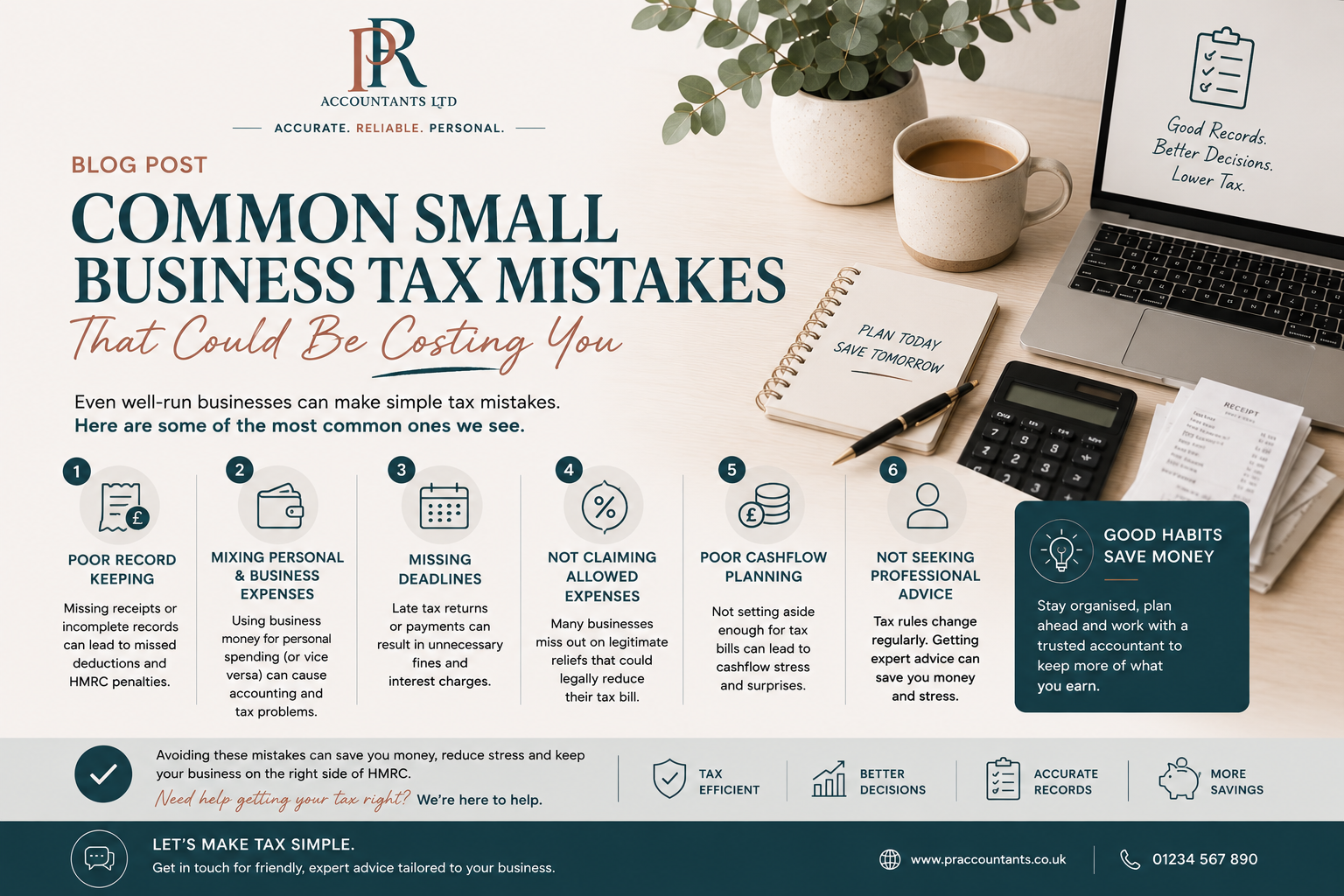
Common Small Business Tax Mistakes UK Business Owners Should Avoid
Running a small business comes with a lot of moving parts.
You are dealing with customers, suppliers, invoices, staff, cashflow, software, deadlines and day-to-day decisions. Tax can easily become something that gets dealt with later.
The problem is that “later” often becomes expensive.
Most tax problems do not start with one major mistake. They usually begin with small habits repeated over time:
- bookkeeping left too late
- VAT thresholds not monitored
- personal and business spending mixed together
- payroll not handled correctly
- tax liabilities not forecast
- dividends taken without checking profits
The good news is that most small business tax mistakes are preventable with the right systems and advice.
Below are some of the most common mistakes UK small businesses make and how to avoid them.
1. Leaving Bookkeeping Until the Last Minute
One of the biggest tax mistakes small businesses make is treating bookkeeping as a year-end task.
Bookkeeping is not just admin. It affects:
- VAT returns
- tax calculations
- profit visibility
- cashflow planning
- expense claims
- director’s loan accounts
- management decisions
If your bookkeeping is months behind, you may not know whether the business is actually profitable, whether VAT has been handled correctly, or whether you have enough money set aside for tax.
For limited companies, directors remain legally responsible for keeping proper company records, even where an accountant helps with the work. GOV.UK guidance confirms that directors are responsible for the company’s records, accounts and performance.
Practical Example
A business owner believes the company has made £70,000 profit because the bank balance looks healthy.
However, bookkeeping has not been updated for several months.
Once records are updated, the accountant identifies:
- unpaid VAT
- supplier bills not entered
- personal expenses in the business account
- software subscriptions duplicated
- Corporation Tax not provided for
The real available profit is much lower than expected.
How to Avoid This
Keep bookkeeping updated at least monthly.
For VAT-registered businesses, monthly bookkeeping is even more important because VAT errors can accumulate quickly.
2. Mixing Personal and Business Spending
This is extremely common, especially with owner-managed businesses.
Examples include:
- using the business card for personal shopping
- paying personal subscriptions from the company account
- using the company bank account for household costs
- not separating personal travel from business travel
This causes two problems.
First, it makes bookkeeping messy. Secondly, it can create tax issues.
HMRC’s general principle is that business expenses must be incurred “wholly and exclusively” for business purposes. Where there is a personal purpose, the expense may be disallowed or need proper apportionment.
Practical Example
A director uses the company card for:
- petrol
- supermarket shopping
- Amazon orders
- personal meals
- family phone costs
At the year-end, these payments may need to be posted to the director’s loan account or treated as personal costs.
This can create unexpected tax consequences and reduce the reliability of the accounts.
How to Avoid This
Use separate bank accounts and cards.
Where an expense has both business and personal use, keep notes and evidence to support the business element.
3. Claiming Expenses Incorrectly
Many small businesses either:
- miss valid expenses, or
- claim expenses they should not claim.
Both are problematic.
Missing expenses means you may overpay tax. Claiming personal or unsupported costs can increase HMRC enquiry risk.
Common allowable business expenses may include office costs, travel costs, staff costs, financial costs, business premises costs and costs of goods bought for resale, depending on the business and whether the expense is genuinely business-related. GOV.UK lists examples of allowable expenses for self-employed businesses.
Common Grey Areas
Some costs need particular care:
- clothing
- home office costs
- mobile phones
- internet
- vehicle costs
- training
- meals and travel
- entertaining
Practical Example
A sole trader buys ordinary work clothes and assumes they are claimable because they are worn for business.
In many cases, ordinary clothing is not allowable because it has a personal purpose. Uniforms, protective clothing or specialist clothing may be different.
How to Avoid This
Do not rely on guesswork.
Keep receipts, record the business purpose, and ask before claiming anything uncertain.
4. Forgetting the VAT Registration Threshold
VAT is one of the easiest areas to get wrong.
Many businesses think about VAT only at the end of the year. That is a mistake because the VAT registration threshold is based on taxable turnover over a rolling 12-month period, not simply your accounting year.
The current VAT registration threshold is more than £90,000 taxable turnover. Businesses must register if their taxable turnover for the last 12 months goes over the threshold.
Practical Example
A business has monthly sales of around £8,000.
The owner thinks:
“I am under £90,000 this year so I do not need VAT.”
But on a rolling 12-month basis, turnover has already passed the threshold.
The business should have registered earlier.
This can result in:
- backdated VAT
- penalties
- interest
- reduced profit margins
How to Avoid This
Review turnover every month, not just at the year-end.
If your business is approaching £75,000–£80,000 taxable turnover, start planning early.
5. Misunderstanding What Counts Towards VAT Turnover
Not all income is treated the same for VAT.
This is particularly important for businesses with mixed income, such as:
- property businesses
- serviced accommodation operators
- consultants with UK and overseas clients
- businesses with exempt and taxable income
VAT taxable turnover generally includes standard-rated, reduced-rated and zero-rated supplies. Some income may be exempt and may not count towards the registration threshold.
Practical Example
A landlord has:
- £60,000 residential rental income
- £40,000 serviced accommodation income
The residential rental income may be exempt, but serviced accommodation income is often taxable. The VAT position depends on the exact facts.
The key point is that the business owner should not simply add all income together or ignore VAT altogether.
How to Avoid This
Review the VAT treatment of each income stream separately.
This is especially important for property, construction, consultancy and online businesses.
6. Not Setting Aside Money for Tax
A profitable business can still run into trouble if tax cash is not set aside.
Common liabilities include:
- Corporation Tax
- VAT
- PAYE and National Insurance
- Self Assessment tax
- dividend tax
- CIS deductions
The mistake is assuming that money in the bank is available to spend.
It may already belong, in effect, to HMRC.
Practical Example
A company has £35,000 in the bank.
The director withdraws £20,000 personally.
Two months later, the company has:
- VAT due
- Corporation Tax due
- payroll liabilities
- supplier bills
The company then struggles with cashflow despite being profitable on paper.
How to Avoid This
Use a separate tax savings account.
Each month, transfer estimated amounts for VAT, Corporation Tax and payroll taxes.
7. Missing Filing or Payment Deadlines
Late filing and late payment can become expensive quickly.
For Self Assessment, GOV.UK states that late filing penalties include an initial £100 penalty, daily penalties after 3 months, and further penalties after 6 and 12 months.
For companies, missing accounts or Corporation Tax deadlines can also create penalties, interest and stress.
Common Deadlines Small Businesses Miss
- Self Assessment filing deadline
- VAT return deadlines
- PAYE payment deadlines
- Corporation Tax payment deadline
- Companies House accounts deadline
- confirmation statement deadline
How to Avoid This
Keep a tax calendar.
Set reminders at least:
- 30 days before deadline
- 14 days before deadline
- 7 days before deadline
Better still, work with an accountant who monitors compliance deadlines for you.
8. Payroll Errors
Payroll errors are common once a business starts paying directors or employees.
Mistakes include:
- not registering as an employer when required
- missing payroll submissions
- using incorrect tax codes
- not reporting benefits correctly
- confusing dividends with salary
- not accounting for employer National Insurance
HMRC guidance says employers must register before the first payday to obtain a PAYE reference, and payroll software is used to calculate pay and deductions and report to HMRC.
Practical Example
A company director takes monthly payments and assumes they can be treated as dividends later.
However, there are not enough profits to support dividends.
The payments may instead create a director’s loan account issue.
How to Avoid This
Decide in advance how directors and staff will be paid.
Separate:
- salary
- dividends
- expenses
- director’s loans
- reimbursements
Do not leave categorisation until the year-end.
9. Misunderstanding Corporation Tax
Many directors assume all companies pay Corporation Tax at 19%.
That is no longer correct for all companies.
The UK Corporation Tax small profits rate is 19% for companies with profits under £50,000, and the main rate is 25% for profits over £250,000. Marginal relief may apply between those limits.
Practical Example
A company makes £120,000 profit.
The director assumes the company tax will simply be 19%.
In reality, marginal relief and the applicable Corporation Tax rules need to be considered.
This can create a much larger tax liability than expected.
How to Avoid This
Forecast Corporation Tax throughout the year.
Do not wait until the accounts are prepared.
10. Taking Dividends Without Checking Profits
Dividends can be tax efficient, but they must be handled correctly.
A dividend is not just any payment from the company to the director.
A valid dividend generally requires:
- sufficient distributable profits
- proper documentation
- correct treatment in the accounts
- correct reporting personally
Practical Example
A company has £25,000 in the bank.
The director takes £20,000 as dividends.
However, once Corporation Tax, VAT, payroll, depreciation and year-end adjustments are considered, the company does not have enough retained profit.
This may create an illegal dividend or director’s loan account issue.
How to Avoid This
Before paying dividends, check management accounts or up-to-date bookkeeping.
Prepare dividend vouchers and minutes/resolutions.
11. Ignoring Director’s Loan Accounts
Director’s loan accounts are often misunderstood.
A director’s loan account tracks money owed between the director and the company.
Problems arise when directors withdraw money that is not:
- salary
- dividends
- reimbursed expenses
- repayment of money owed to them
An overdrawn director’s loan account can create tax charges and cashflow issues.
Practical Example
A director regularly transfers £2,000–£3,000 personally from the company account.
No payroll is run and no dividends are declared.
At the year-end, the accountant identifies a large overdrawn director’s loan account.
This may lead to additional tax implications.
How to Avoid This
Review director withdrawals monthly.
Do not treat the company bank account like a personal account.
12. Poor VAT Coding in Software
Cloud bookkeeping software is useful, but it does not replace tax knowledge.
VAT mistakes often happen because transactions are coded incorrectly.
Common VAT coding errors include:
- claiming VAT on non-VAT invoices
- reclaiming VAT on blocked expenses
- applying standard VAT where reverse charge applies
- treating exempt income as taxable
- missing import VAT or postponed VAT accounting entries
- using the wrong VAT code for property or construction transactions
Practical Example
A construction business uses the wrong VAT code on domestic reverse charge invoices.
The VAT return appears balanced, but the treatment is incorrect.
This may create problems if HMRC reviews the records.
How to Avoid This
Have VAT returns reviewed properly, especially if your business is in:
- construction
- property
- e-commerce
- hospitality
- serviced accommodation
- international services
13. Not Keeping Proper Records
Good records are not optional.
Self-employed individuals must keep records of business income and expenses for Self Assessment, and GOV.UK confirms records must generally be kept for at least 5 years after the 31 January submission deadline for the relevant tax year.
Limited companies usually need to keep records for 6 years from the end of the relevant company financial year.
VAT records are also generally required to be kept for at least 6 years.
Records You Should Keep
Depending on the business, this may include:
- invoices
- receipts
- bank statements
- sales reports
- payroll records
- VAT records
- mileage logs
- dividend paperwork
- loan agreements
- supplier bills
- contracts
How to Avoid This
Use cloud storage and keep records organised by year and category.
Do not rely on bank transactions alone.
14. Ignoring Making Tax Digital
Making Tax Digital is no longer something to think about later for many sole traders and landlords.
From 6 April 2026, sole traders and landlords with qualifying income over £50,000 must use Making Tax Digital for Income Tax. The threshold then reduces to £30,000 from April 2027 and £20,000 from April 2028.
This means affected taxpayers need to use compatible software, keep digital records and send quarterly updates to HMRC.
Practical Example
A landlord earns £55,000 gross rental income.
They keep records on spreadsheets and send everything to their accountant once a year.
Under MTD, this approach may no longer be sufficient unless the spreadsheet process is compatible and digitally linked.
How to Avoid This
Move to proper bookkeeping software early.
Do not wait until the first quarterly submission is due.
15. Not Getting Advice Before Making Big Decisions
Some tax mistakes happen because the business owner makes a decision first and asks the accountant afterwards.
This is risky.
Advice should be taken before:
- buying a company car
- transferring property
- changing business structure
- taking large dividends
- hiring staff
- registering for VAT
- deregistering from VAT
- purchasing expensive equipment
- taking money from the company
- selling business assets
Practical Example
A director buys a car through the company assuming it will save tax.
Later, they discover there are benefit-in-kind charges, VAT restrictions and capital allowance issues.
The purchase may have been less efficient than buying personally and claiming mileage.
How to Avoid This
Ask before acting.
Tax planning is far more effective before the transaction happens.
16. Choosing the Wrong Business Structure
Sole trader, partnership and limited company structures have different tax and legal consequences.
A structure that worked when the business was small may not be suitable once profits increase, staff are hired, VAT applies or external funding is needed.
Practical Example
A sole trader grows to £100,000+ profit but continues operating without reviewing structure.
They may be missing opportunities around:
- limited company planning
- profit retention
- pension contributions
- liability protection
- tax-efficient remuneration
However, incorporation is not always the right answer. It should be modelled properly.
How to Avoid This
Review your structure at least annually, especially if profits, risk, borrowing or long-term plans have changed.
17. Relying Too Heavily on Software Alone
Accounting software is helpful, but it is not a substitute for professional judgement.
Software may not know:
- whether VAT has been applied correctly
- whether an expense is allowable
- whether dividends are legal
- whether a director’s loan issue exists
- whether the business structure is still appropriate
- whether cashflow is likely to become tight
How to Avoid This
Use software as the system, not the adviser.
The value comes from combining good software with proper review, tax knowledge and proactive planning.
18. Failing to Review Tax Throughout the Year
The worst time to plan tax is after the year has ended.
By then, options may be limited.
Year-round tax planning allows you to review:
- salary and dividend mix
- pension contributions
- VAT exposure
- cashflow
- capital expenditure
- director’s loan balances
- profit forecasts
- tax liabilities
Practical Example
A company waits until year-end before checking profits.
It then discovers there was scope for better pension planning, salary planning or dividend timing earlier in the year.
That opportunity may now be restricted.
How to Avoid This
Schedule tax reviews during the year, not just at the filing deadline.
For growing businesses, quarterly reviews are often sensible.
Frequently Asked Questions
What is the most common tax mistake small businesses make?
The most common mistake is poor record keeping. When bookkeeping is not kept up to date, VAT, payroll, expenses, dividends and tax forecasts can all become unreliable.
Do small businesses need an accountant?
Not legally in every case, but professional support can reduce errors, improve tax planning and help business owners stay compliant.
Can HMRC check my business records?
Yes. HMRC can ask to see records supporting tax returns, VAT returns, payroll submissions and expense claims.
How often should bookkeeping be updated?
Monthly is a good minimum for most businesses. VAT-registered businesses and growing companies may need more frequent review.
Should I keep money aside for tax?
Yes. Businesses should usually set aside money regularly for VAT, Corporation Tax, PAYE, National Insurance and Self Assessment liabilities.
Can I claim all business expenses?
No. Expenses must be genuinely business-related and properly evidenced. Some costs are disallowed or need apportionment.
What happens if I register for VAT late?
You may need to account for VAT from the date you should have registered. This can create backdated VAT, penalties and cashflow pressure.
Is tax planning only for large businesses?
No. Small businesses often benefit significantly from practical tax planning, especially around VAT, payroll, dividends, pensions, expenses and business structure.
How PR Accountants Can Help
At PR Accountants, we help small businesses stay compliant, organised and tax efficient.
We support clients with:
- bookkeeping
- VAT returns and VAT planning
- payroll
- Corporation Tax
- Self Assessment
- director salary and dividend planning
- management accounts
- cashflow forecasting
- business structure reviews
- property and serviced accommodation accounting
Our aim is not just to file returns. It is to help you understand your numbers, avoid avoidable mistakes and make better decisions.
Final Thoughts
Small business tax mistakes are usually preventable.
The key is to avoid treating tax as a once-a-year task.
Good habits make a significant difference:
- update bookkeeping regularly
- separate business and personal spending
- monitor VAT turnover
- plan for tax liabilities
- document dividends properly
- review payroll and director withdrawals
- get advice before major decisions
The businesses that stay ahead are usually the ones with better systems, clearer records and proactive advice.
Worried Your Business Tax Records Are Not as Clean as They Should Be?
Small mistakes can become expensive if they are left too long.
Whether you need help with bookkeeping, VAT, payroll, Corporation Tax, Self Assessment or director tax planning, PR Accountants can help you get things under control.
We provide practical, proactive accounting support for UK small businesses, property businesses and growing limited companies.
👉 Contact PR Accountants today for clear advice and reliable accounting support. Contact Us
Related Articles:
Dividends Explained for UK Company Directors (2026 Guide)
Do I Need to Register for VAT? A Practical Guide for Small Businesses
Director’s Loan Account Explained for UK Company Directors (2026 Guide)
Tax Efficient Profit Extraction for UK Directors (2026)