
How CIS Works for Subcontractors and Construction Companies
The Construction Industry Scheme, commonly known as CIS, is a major part of tax compliance in the UK construction industry.
It affects how construction businesses:
- invoice clients
- get paid
- deduct tax from subcontractors
- claim CIS suffered
- manage payroll
- deal with HMRC
- record income and deductions in bookkeeping software
- plan cashflow
For subcontractors, CIS can reduce the amount received from contractors because tax is deducted before payment is made.
For construction companies, CIS can apply in two directions:
- The company may suffer CIS deductions when paid by a contractor.
- The company may also need to deduct CIS when paying its own subcontractors.
This is where many businesses get confused.
CIS is not the same as VAT. It is not the same as PAYE. It is also not optional where the rules apply.
This guide explains how CIS works in practice and what subcontractors and construction companies need to understand.
What Is CIS?
CIS is a tax deduction scheme for the construction industry.
Under the scheme, contractors deduct tax from payments made to subcontractors and pay those deductions to HMRC.
The deductions count as advance payments towards the subcontractor’s tax position.
In simple terms:
- the subcontractor carries out construction work
- the subcontractor invoices the contractor
- the contractor checks the subcontractor with HMRC
- HMRC tells the contractor which deduction rate to use
- the contractor deducts CIS from the labour element
- the contractor pays the net amount to the subcontractor
- the contractor pays the CIS deduction to HMRC
- the subcontractor claims or offsets the deduction later
CIS is designed to make sure tax is collected from construction work throughout the year, rather than only after the year-end tax return or company accounts.
Who Does CIS Apply To?
CIS applies to many businesses involved in construction work.
This may include:
- builders
- electricians
- plumbers
- plasterers
- roofers
- decorators
- groundworkers
- civil engineering businesses
- property developers
- construction labour suppliers
- limited company subcontractors
- sole trader subcontractors
- partnerships in the construction sector
A business can be a subcontractor, a contractor, or both.
What Is a Subcontractor Under CIS?
A subcontractor is a person or business that carries out construction work for a contractor.
A subcontractor may be:
- a sole trader
- a limited company
- a partnership
- another construction business
For example, a limited company electrician working for a main contractor may be treated as a subcontractor under CIS.
A subcontractor does not have to register for CIS, but if they do not register, deductions are usually taken at a higher rate.
What Is a Contractor Under CIS?
A contractor is a person or business that pays subcontractors to carry out construction work.
A construction company may become a contractor if it pays other subcontractors.
For example, a building company that hires:
- electricians
- plumbers
- plasterers
- decorators
- roofers
may need to operate CIS as a contractor.
This means the company must verify subcontractors, deduct CIS where required, submit monthly CIS returns and pay the deductions to HMRC.
A Construction Company Can Be Both Contractor and Subcontractor
This is one of the most important points.
A construction company may suffer CIS deductions from its customers while also deducting CIS from subcontractors it pays.
Practical Example
ABC Building Ltd is hired by a main contractor to carry out building work.
The main contractor deducts CIS from ABC Building Ltd’s payment.
ABC Building Ltd then hires self-employed tradespeople to help complete the job.
ABC Building Ltd may need to:
- record CIS suffered from the main contractor
- verify its own subcontractors
- deduct CIS from labour payments
- file monthly CIS returns
- pay deductions to HMRC
- claim CIS suffered through payroll reporting
This is why construction bookkeeping needs to be handled carefully.
CIS Deduction Rates
There are three main CIS deduction rates:
20% Standard Rate
This usually applies where the subcontractor is registered for CIS.
30% Higher Rate
This usually applies where the subcontractor is not registered or cannot be verified correctly.
0% Gross Payment Status
This applies where the subcontractor has gross payment status and can be paid without CIS deduction.
Gross payment status can improve cashflow, but HMRC expects the business to meet certain compliance and turnover conditions.
What CIS Is Deducted From
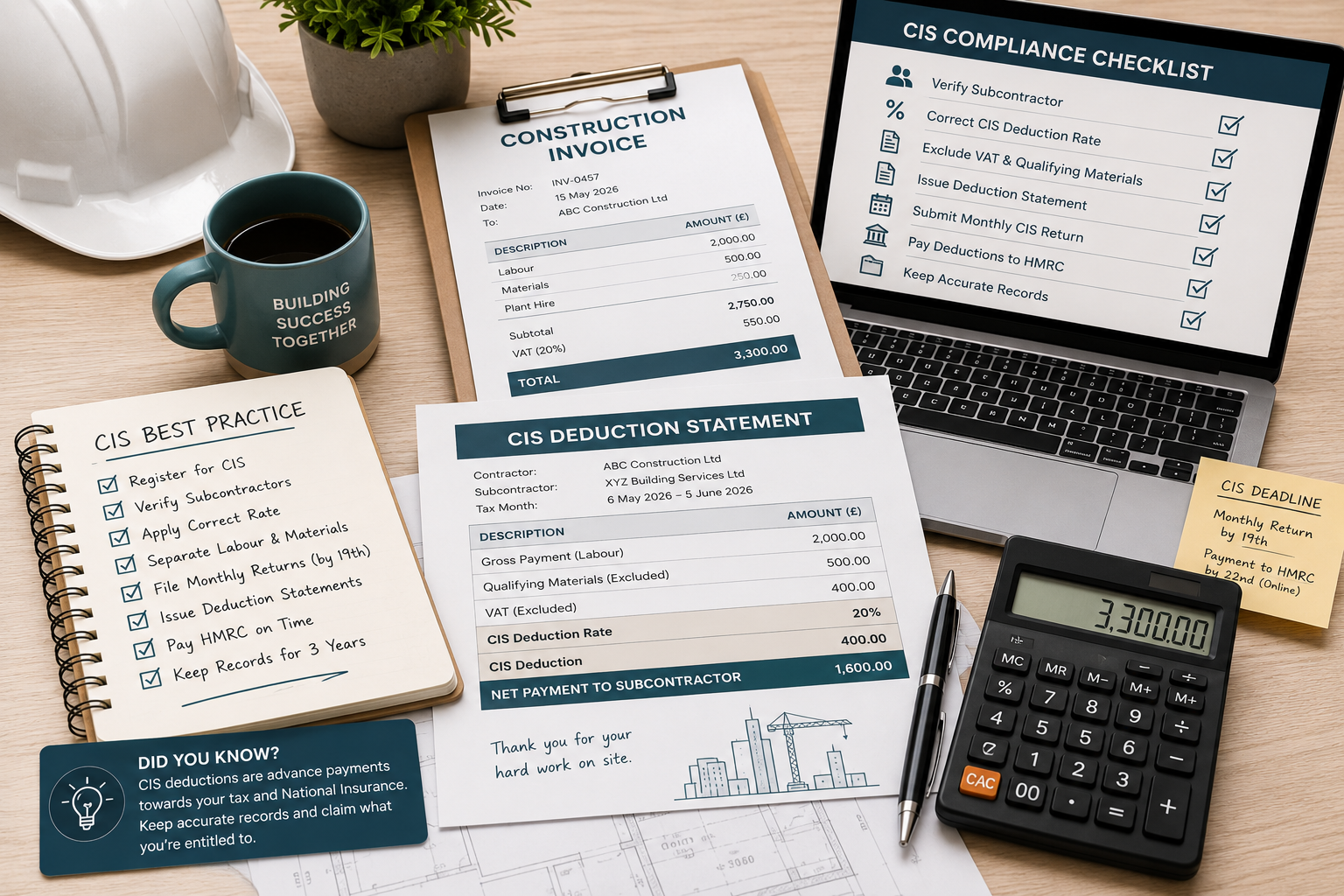
CIS is usually deducted from the labour element of a subcontractor’s payment.
It is not normally deducted from:
- VAT
- qualifying materials paid for by the subcontractor
- certain consumables
- plant hire in some cases
- other excluded amounts depending on the facts
This means the invoice breakdown is very important.
Practical Example
A subcontractor invoices:
- Labour: £2,000
- Materials: £500
- VAT: £500
If the subcontractor is registered for CIS, the 20% deduction is usually calculated on the labour element, not the full invoice including VAT.
So the CIS deduction may be based on £2,000 rather than £3,000.
Incorrectly calculating CIS on the full invoice can cause over-deductions and cashflow problems.
Why Invoice Breakdown Matters
A vague invoice can create CIS problems.
For example:
“Building work completed: £3,000”
This does not clearly separate labour, materials and VAT.
A better invoice would show:
- Labour
- Materials
- VAT, if applicable
- Total invoice amount
- CIS deduction, where relevant
- Net amount payable
This helps both parties record the transaction correctly.
How CIS Works for Subcontractors
If you are a subcontractor, CIS affects how you get paid.
Your contractor may deduct tax before paying you.
This means the money received into your bank account may be less than the invoice total.
Example
You invoice a contractor:
- Labour: £2,000
- CIS deduction at 20%: £400
- Net payment received: £1,600
The £400 is not lost.
It is treated as tax deducted in advance and should be claimed or offset correctly.
Subcontractors Must Record Gross Income
A very common mistake is recording only the net amount received.
Using the example above, the subcontractor should not simply record income as £1,600.
The correct approach is usually:
- Gross income: £2,000
- CIS suffered: £400
- Bank receipt: £1,600
This distinction is important because your accounts and tax return should reflect the full income earned, with the CIS deduction recorded separately.
CIS for Sole Trader Subcontractors
For sole trader subcontractors, CIS deductions are usually dealt with through Self Assessment.
The subcontractor reports:
- gross income
- allowable expenses
- CIS deductions suffered
HMRC then calculates the final tax and National Insurance position.
If too much CIS has been deducted, the subcontractor may be due a refund.
If not enough tax has been paid overall, further tax may be payable.
CIS for Limited Company Subcontractors
Limited company subcontractors are different.
A limited company that suffers CIS deductions should normally claim them through its PAYE payroll scheme using HMRC payroll reporting.
This is a very important point.
A company should not simply claim CIS suffered through its Corporation Tax return.
Practical Example
XYZ Electrical Ltd suffers £8,000 CIS deductions during the year.
The company also runs payroll.
The CIS suffered should usually be reported through payroll submissions so it can be offset against PAYE liabilities or reclaimed from HMRC where appropriate.
This is where many limited company subcontractors make mistakes.
Why Limited Company CIS Can Affect Cashflow
CIS can create cashflow pressure for limited companies.
A company may have tax deducted from its income before it receives payment, while still needing to pay:
- wages
- suppliers
- VAT
- fuel
- materials
- insurance
- subcontractors
- Corporation Tax
If CIS suffered is not claimed correctly and promptly, cashflow can become unnecessarily tight.
Good bookkeeping and payroll reporting are essential.
How CIS Works for Construction Companies Paying Subcontractors
If your construction company pays subcontractors, you may have contractor responsibilities under CIS.
This usually means you need to:
- register as a CIS contractor
- verify subcontractors before paying them
- apply the correct deduction rate
- deduct CIS from relevant payments
- issue deduction statements
- submit monthly CIS returns
- pay CIS deductions to HMRC
- keep proper records
This applies even if your company is also suffering CIS deductions from its own customers.
Verifying Subcontractors
Before paying a new subcontractor, contractors must verify them with HMRC.
HMRC will confirm:
- whether the subcontractor is registered
- whether CIS should be deducted at 20%
- whether CIS should be deducted at 30%
- whether the subcontractor can be paid gross
To verify properly, you need accurate subcontractor details.
For a sole trader, this may include:
- full name
- trading name, if applicable
- Unique Taxpayer Reference
- National Insurance number
For a company, this may include:
- company name
- company UTR
- company registration number
If the details do not match HMRC’s records, verification may fail or the wrong rate may apply.
Monthly CIS Returns
Contractors must usually submit monthly CIS returns to HMRC.
These returns report payments made to subcontractors and CIS deducted.
The return is normally due by the 19th of each month following the tax month.
For example, the CIS month from 6 May to 5 June is reported by 19 June.
Missing CIS returns can lead to penalties.
Deduction Statements
Where CIS is deducted, the contractor must give the subcontractor a deduction statement.
This statement should show:
- contractor details
- subcontractor details
- payment amount
- materials, where relevant
- CIS deduction
- net payment
- tax month
Subcontractors need these statements to support tax returns, company payroll claims and HMRC queries.
A subcontractor should never rely only on bank receipts.
CIS and VAT Are Not the Same Thing
CIS and VAT are separate systems.
CIS deals with tax deductions from construction payments.
VAT deals with tax on supplies of goods and services.
A construction invoice may involve both CIS and VAT.
In many cases:
- VAT is calculated separately
- CIS is not deducted from VAT
- domestic reverse charge VAT may also apply
This can become complicated quickly.
Practical Example
A VAT-registered subcontractor issues an invoice for construction services.
Depending on the facts, the invoice may be subject to:
- CIS deductions
- VAT
- domestic reverse charge VAT
The subcontractor and contractor need to understand the correct treatment before posting the invoice in bookkeeping software.
CIS and Domestic Reverse Charge VAT
Many construction businesses also need to consider domestic reverse charge VAT.
This is separate from CIS, but often applies to construction services between VAT-registered businesses where CIS also applies.
This is a common area for errors.
A business may correctly deduct CIS but still get the VAT treatment wrong.
Examples of common issues include:
- charging VAT when reverse charge should apply
- using the wrong VAT code
- claiming input VAT incorrectly
- misunderstanding end user rules
- failing to update bookkeeping software
Construction businesses should review CIS and VAT together, not in isolation.
CIS and Payroll
CIS is not payroll in the normal employee sense.
However, CIS interacts with payroll in two important ways.
1. Contractors Paying CIS to HMRC
If a contractor also has employees, PAYE and CIS may be managed through related HMRC payment processes.
2. Limited Company Subcontractors Claiming CIS Suffered
Limited companies that suffer CIS deductions normally claim those deductions through payroll reporting.
This means construction companies often need payroll support even if they mainly think of themselves as subcontractors.
CIS and Employment Status
Being paid under CIS does not automatically mean someone is genuinely self-employed.
This is a major risk area.
A business should still consider whether the subcontractor is truly self-employed or should be treated as an employee.
Factors may include:
- control over how work is done
- ability to send a substitute
- financial risk
- provision of tools and equipment
- whether the worker works for multiple clients
- whether the relationship looks like employment in practice
Contractors should not use CIS as a way to avoid payroll where the working arrangement is really employment.
Common Mistakes Subcontractors Make
1. Not Registering for CIS
Unregistered subcontractors usually suffer deductions at a higher rate.
2. Recording Only Net Receipts
Subcontractors should record gross income and CIS deducted separately.
3. Losing Deduction Statements
Without deduction statements, it can be harder to support CIS claims.
4. Assuming CIS Means No More Tax Is Due
CIS is only an advance deduction. Final tax still needs to be calculated.
5. Not Reconciling CIS Suffered
CIS suffered should be reconciled against contractor statements, bookkeeping records and HMRC claims.
Common Mistakes Construction Companies Make
1. Forgetting They Are Also Contractors
A company may focus on CIS suffered from customers but forget CIS obligations when paying its own subcontractors.
2. Failing to Verify Subcontractors
This can lead to wrong deduction rates.
3. Deducting CIS From Materials or VAT Incorrectly
Incorrect deduction calculations can cause disputes and errors.
4. Missing Monthly Returns
CIS returns are monthly, not annual.
5. Not Issuing Deduction Statements
Subcontractors need statements for their own tax records.
6. Claiming Limited Company CIS Suffered Incorrectly
Companies should be careful to claim CIS suffered through the correct HMRC process.
7. Getting VAT Codes Wrong
Construction invoices often involve both CIS and VAT, so software coding must be reviewed carefully.
Example: Construction Company Acting as Both Contractor and Subcontractor
A limited company roofing business is paid by a main contractor.
During the month, it raises invoices of:
- Labour: £20,000
- Materials: £5,000
The main contractor deducts CIS from the labour element.
The roofing company receives less than the gross invoice amount.
During the same month, the roofing company pays two subcontractors for labour.
The roofing company must:
- verify the subcontractors
- deduct CIS where required
- issue deduction statements
- submit a monthly CIS return
- pay deductions to HMRC
- record CIS suffered from its customer
- claim CIS suffered correctly through payroll reporting
This is why CIS bookkeeping must be structured properly.
Example: Sole Trader Subcontractor
A self-employed plasterer works for several contractors.
Each contractor deducts CIS at 20%.
The plasterer receives monthly CIS deduction statements.
At the end of the tax year, the plasterer prepares Self Assessment records showing:
- gross sales income
- CIS deductions suffered
- allowable business expenses
- final tax and National Insurance position
If the CIS deductions exceed the final tax liability, the plasterer may be due a refund.
If income is high or expenses are low, further tax may still be payable.
Example: Limited Company Subcontractor
A limited company electrician suffers CIS deductions throughout the year.
The company has payroll, VAT and Corporation Tax obligations.
The company should:
- record gross sales correctly
- record CIS suffered separately
- submit payroll reports correctly
- offset or claim CIS suffered through PAYE processes
- reconcile CIS suffered to deduction statements
- ensure Corporation Tax accounts are not used incorrectly to reclaim CIS
This requires joined-up bookkeeping and payroll support.
Why CIS Cashflow Planning Matters
CIS deductions can cause serious cashflow issues.
Subcontractors may invoice large amounts but receive less cash after deductions.
At the same time, they may still need to pay:
- wages
- materials
- fuel
- insurance
- van costs
- VAT
- subcontractors
- tools
- equipment
- finance costs
This is why construction businesses need to forecast cashflow properly.
A profitable construction business can still struggle if CIS deductions, VAT bills and supplier payments are not planned.
How to Keep CIS Records Properly
Good CIS records should include:
- contractor invoices
- subcontractor invoices
- CIS deduction statements
- verification records
- material cost evidence
- bank receipts
- monthly CIS returns
- HMRC payment confirmations
- payroll submissions
- VAT records
- bookkeeping reconciliations
The stronger the records, the easier it is to deal with HMRC, prepare accounts and resolve payment disputes.
Best Practice for Subcontractors
Subcontractors should:
- register for CIS
- give contractors accurate business details
- invoice labour and materials separately
- keep all deduction statements
- record gross income, not just net receipts
- reconcile CIS suffered regularly
- keep receipts for expenses
- plan for tax and VAT liabilities
- seek advice before applying for gross payment status
Best Practice for Construction Companies
Construction companies should:
- know whether they are contractor, subcontractor or both
- register for CIS where required
- verify subcontractors before payment
- use correct CIS deduction rates
- separate labour, materials and VAT clearly
- submit monthly CIS returns on time
- issue deduction statements
- reconcile CIS suffered and CIS deducted
- use appropriate bookkeeping software
- review VAT reverse charge treatment
- check employment status before treating workers as subcontractors
Frequently Asked Questions
Is CIS only for sole traders?
No. CIS can apply to sole traders, partnerships and limited companies working in construction.
Can a limited company suffer CIS deductions?
Yes. Limited company subcontractors can suffer CIS deductions from contractors.
How does a limited company claim back CIS suffered?
A limited company normally claims CIS suffered through its PAYE payroll scheme, not through the Corporation Tax return.
Do subcontractors have to register for CIS?
Subcontractors do not have to register, but if they are not registered, deductions are usually taken at a higher rate.
Can a company be both a contractor and subcontractor?
Yes. This is common in construction. A company may suffer CIS from its customers and deduct CIS from subcontractors it pays.
Is CIS deducted from VAT?
CIS is not normally deducted from VAT. VAT should be dealt with separately.
Are materials subject to CIS?
Qualifying materials paid for by the subcontractor are usually excluded before calculating the CIS deduction, but records and invoice breakdowns are important.
Does CIS mean a worker is self-employed?
No. Employment status still needs to be reviewed. CIS does not automatically prove self-employment.
What happens if a contractor files CIS returns late?
Late CIS returns can lead to penalties, so monthly filing deadlines should be monitored carefully.
How PR Accountants Can Help
At PR Accountants, we support subcontractors, contractors and construction companies with practical CIS and accounting support.
We can help with:
- CIS registration
- subcontractor verification
- monthly CIS returns
- CIS deduction statements
- CIS bookkeeping
- limited company CIS recovery
- payroll and EPS submissions
- VAT and domestic reverse charge support
- Self Assessment tax returns
- Corporation Tax
- management accounts
- cashflow planning
We help construction businesses keep their records accurate, stay compliant and avoid unnecessary CIS mistakes.
Final Thoughts
CIS can be straightforward once the process is understood, but it becomes risky when bookkeeping, payroll and VAT are not aligned.
Subcontractors need to understand how deductions affect income, tax and cashflow.
Construction companies need to understand whether they are acting as contractors, subcontractors or both.
The businesses that manage CIS well usually have:
- clear invoices
- accurate bookkeeping
- regular reconciliations
- proper payroll reporting
- strong cashflow planning
- timely HMRC submissions
CIS is not just a tax deduction. It is a system that affects how construction businesses get paid, report income and manage compliance.
Need Help Managing CIS for Your Construction Business?
CIS mistakes can affect cashflow, tax refunds, payroll, VAT and HMRC compliance.
PR Accountants provides practical accounting and CIS support for subcontractors, contractors and construction companies across the UK.
👉 Contact PR Accountants today for clear, reliable CIS and construction accounting support. Contact Us
Related Articles: