
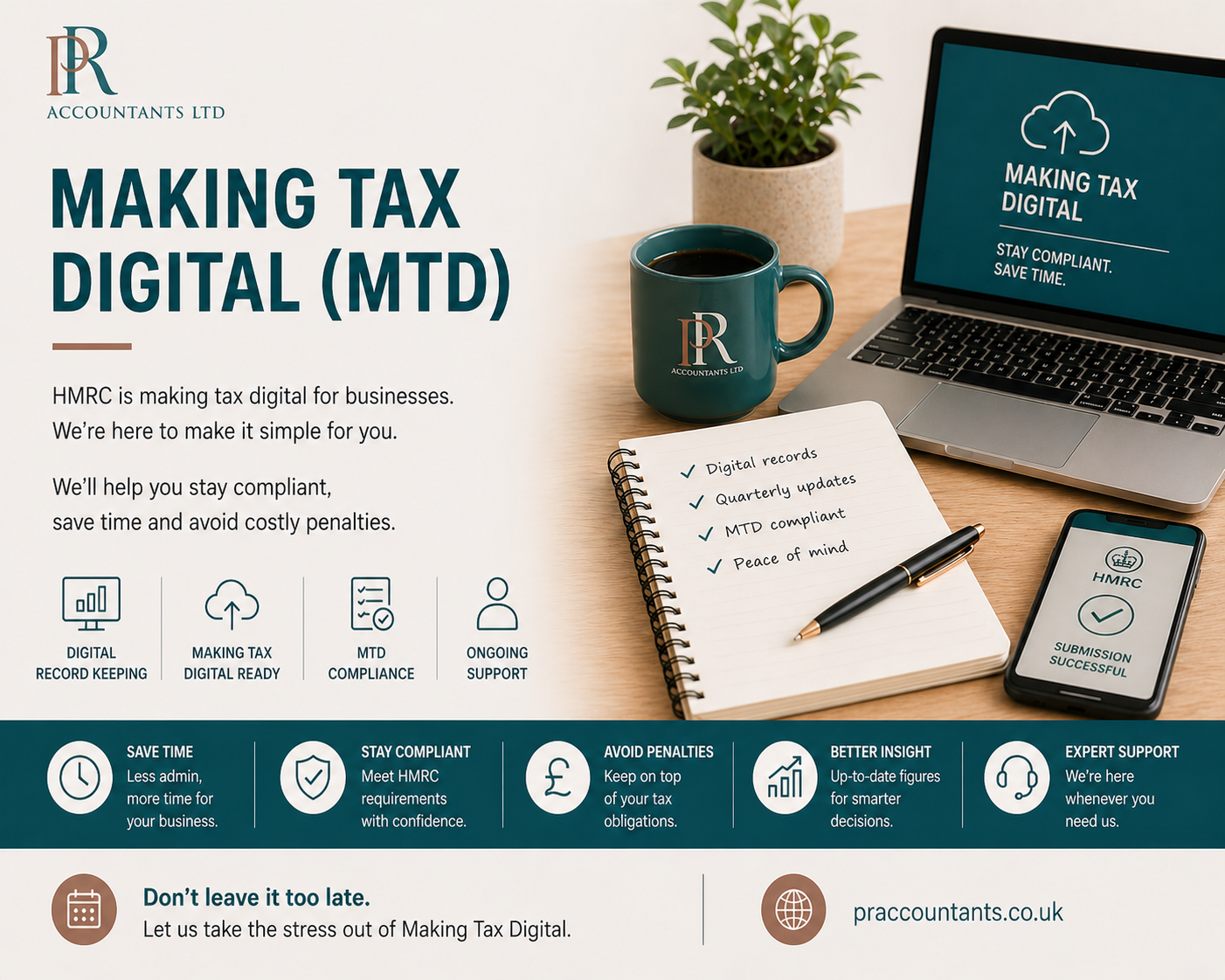
Making Tax Digital for Landlords and Sole Traders: What You Need to Do Now
Making Tax Digital for Income Tax is no longer something landlords and sole traders can ignore. For many people, it is already here, and it will affect how records are kept and how information is sent to HMRC.
Under HMRC’s current timetable, sole traders and landlords with qualifying income over £50,000 in the 2024/25 tax year must start using Making Tax Digital for Income Tax from 6 April 2026. Those with qualifying income over £30,000 in the 2025/26 tax year will join from 6 April 2027, and those over £20,000 in the 2026/27 tax year will join from 6 April 2028.
What does this actually mean?
It means affected landlords and sole traders will need to:
- keep digital records;
- use compatible software;
- send quarterly updates to HMRC;
- and then complete a final year-end process through software.
HMRC’s current guidance says the new process involves digital records, quarterly updates every 3 months, and finalising the return through compatible software. HMRC’s guidance also makes clear that you still submit one tax return each tax year and still pay tax by 31 January as usual.
Who is likely to be affected first?
The first group is landlords and sole traders with qualifying income above £50,000 based on the 2024/25 tax year. HMRC has said that even if you do not receive a letter, it is still your responsibility to check whether the rules apply and be ready in time.
This matters because some people are still waiting for HMRC correspondence before taking action. That is risky. The obligation depends on whether the rules apply to you, not just on whether a letter arrives.
What is “qualifying income”?
For MTD for Income Tax, qualifying income means your gross self-employment and property income before expenses, based on the relevant tax year’s Self Assessment return. That point is important because many people instinctively look at profit instead of gross income.
For example, a landlord or sole trader may think they are below the threshold because profits are lower after expenses, but the test is based on income before those expenses are deducted.
Why businesses should prepare early
The biggest risk is leaving it too late. Many landlords and sole traders still rely on spreadsheets, paper records or incomplete bookkeeping. That can create problems once quarterly reporting and digital record-keeping become compulsory.
Preparing early allows you to:
- choose software properly;
- clean up your bookkeeping;
- separate business and personal transactions more clearly;
- and avoid a rushed setup close to the deadline.
What should you do now?
If you think MTD for Income Tax may affect you, now is a good time to:
- review your income levels;
- check whether your records are digital enough;
- decide what software to use;
- and get support setting up the process properly.
This is especially important for landlords with multiple properties and sole traders with irregular records.
When are the quarterly deadlines?
If you are using the standard quarterly update periods, HMRC says the deadlines are:
- 7 August 2026
- 7 November 2026
- 7 February 2027
- 7 May 2027
Those deadlines are important because the service is now live, so the focus has moved from “getting ready” to actually building a workable reporting routine.
Are there penalties?
HMRC has given some transitional easement here, but it is important not to misunderstand it.
HMRC says there are no penalty points for missing quarterly update deadlines in the 2026/27 tax year for those required to join from 6 April 2026. However, HMRC also says you still need to keep digital records and send quarterly updates before you can submit your tax return, and penalties can still apply for late tax returns or late payment.
So the first year is not a free pass. It is better seen as a softer landing on quarterly update penalties, while the wider compliance obligations still remain.
Why this matters for landlords and sole traders
For many landlords and sole traders, the real challenge is not the concept of quarterly updates. It is whether the records are good enough to support them.
If your records are still largely paper-based, spreadsheet-based, or only updated near the January deadline, Making Tax Digital will usually feel like a bigger change. On the other hand, if your records are already digital and kept reasonably up to date, the transition is much more manageable. HMRC’s guidance is built around ongoing digital record-keeping through software, not year-end reconstruction.
This is why now is the right time to review:
- whether your bookkeeping is up to date;
- whether personal and business transactions are properly separated;
- whether your software is suitable;
- whether your current process is realistic for quarterly reporting.
Common mistakes to avoid
A few common mistakes are already becoming clear:
- assuming MTD is still “coming later” when it is already live for the first group;
- looking at profit instead of qualifying income;
- waiting for a letter instead of checking the rules;
- choosing software too late;
- and assuming the first year carries no real consequences because of the quarterly update penalty easement.
Final thought
Making Tax Digital for Income Tax is now part of the compliance landscape for many landlords and sole traders. The key question is no longer whether it is coming, but whether your records, software and processes are ready now that it has started.
Those who get set up properly are likely to find it manageable. Those who delay are far more likely to face rushed software decisions, messy record-keeping and avoidable compliance stress.
Need help preparing for Making Tax Digital? PR Accountants Ltd supports landlords and sole traders with bookkeeping setup, software support and ongoing compliance. Contact us