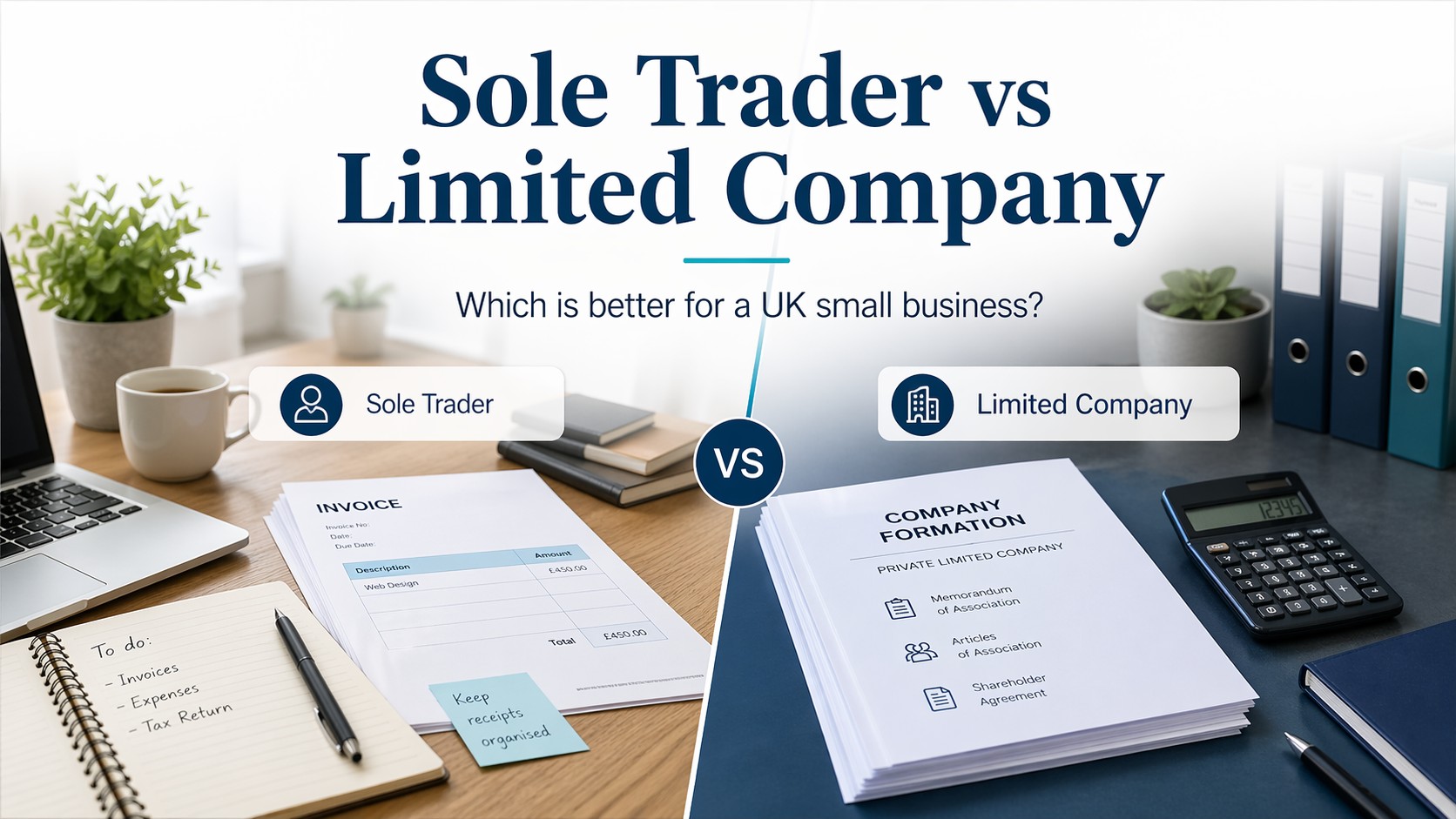
Sole Trader vs Limited Company: Which Is Better for a UK Small Business?
Starting a business often comes with one big early question: should you stay as a sole trader, or should you set up a limited company?
There is no one answer that fits everyone. The right choice depends on your profit level, the type of work you do, the level of risk in the business, and how you want to take money out. In the UK, you can usually start trading straight away as a sole trader, but if you earn more than £1,000 in a tax year you generally need to register for Self Assessment. If you want to trade through a company, the company needs to be set up before it starts trading.
What is the main difference?
As a sole trader, you and the business are legally the same person. That usually means simpler administration, but it also means the business is not separate from you personally. A limited company is different because it is its own legal entity, with its own responsibilities, tax position and filing obligations. GOV.UK’s company guidance makes clear that limited companies have ongoing responsibilities including annual accounts, corporation tax obligations and Companies House filings.
Why some people stay as sole traders
For many small businesses, staying as a sole trader is perfectly sensible. It is usually easier to get started, the admin is lighter, and there is often less formality in the early stages. If your profits are still modest, or the business is just finding its feet, simplicity can be a real advantage. You still need proper records and a correctly prepared tax return, but the compliance burden is normally lighter than running a company.
Why some people move to a limited company
A limited company may become more attractive where profits are growing, where the business is taking on more risk, where clients expect a company structure, or where the owners want to keep profits in the business rather than drawing everything personally. But it is important not to treat “limited company” as automatically better. A company brings more compliance: first accounts are usually due 21 months after incorporation, annual accounts are usually due 9 months after the year end, corporation tax is usually due 9 months and 1 day after the accounting period ends, and the Company Tax Return is usually due 12 months after the accounting period ends.
Is a limited company always more tax-efficient?
No. That is one of the most common misunderstandings. In some cases, a limited company can work well from a tax planning perspective. In other cases, the extra compliance, bookkeeping discipline and accountancy costs reduce or even outweigh the tax benefit. The better question is not “Which is best in general?” but “Which is best for my circumstances?”
When should you review your current structure?
It is worth reviewing your structure if profits have increased, if you are taking on more business risk, if you want to bring someone else into the business, or if you think your current setup is no longer working well from either a tax or admin point of view.
Final thoughts
Choosing between sole trader and limited company should be based on your actual figures and plans, not on social media soundbites or what worked for someone else.
If you are unsure whether to stay self-employed or move into a company, it is worth getting advice before making the switch.
Need help deciding which structure is right for you?
PR Accountants Ltd supports UK small businesses, sole traders and limited companies with practical advice based on real numbers and real circumstances.