VAT Cash Accounting Scheme: Could It Improve Cashflow?
VAT timing can create a cashflow problem
Under normal VAT accounting, a business may have to pay output VAT to HM Revenue and Customs before the customer has paid the invoice.
This can be particularly difficult where customers have 30, 60 or 90-day payment terms, invoices are disputed or a small number of customers account for a large share of sales.
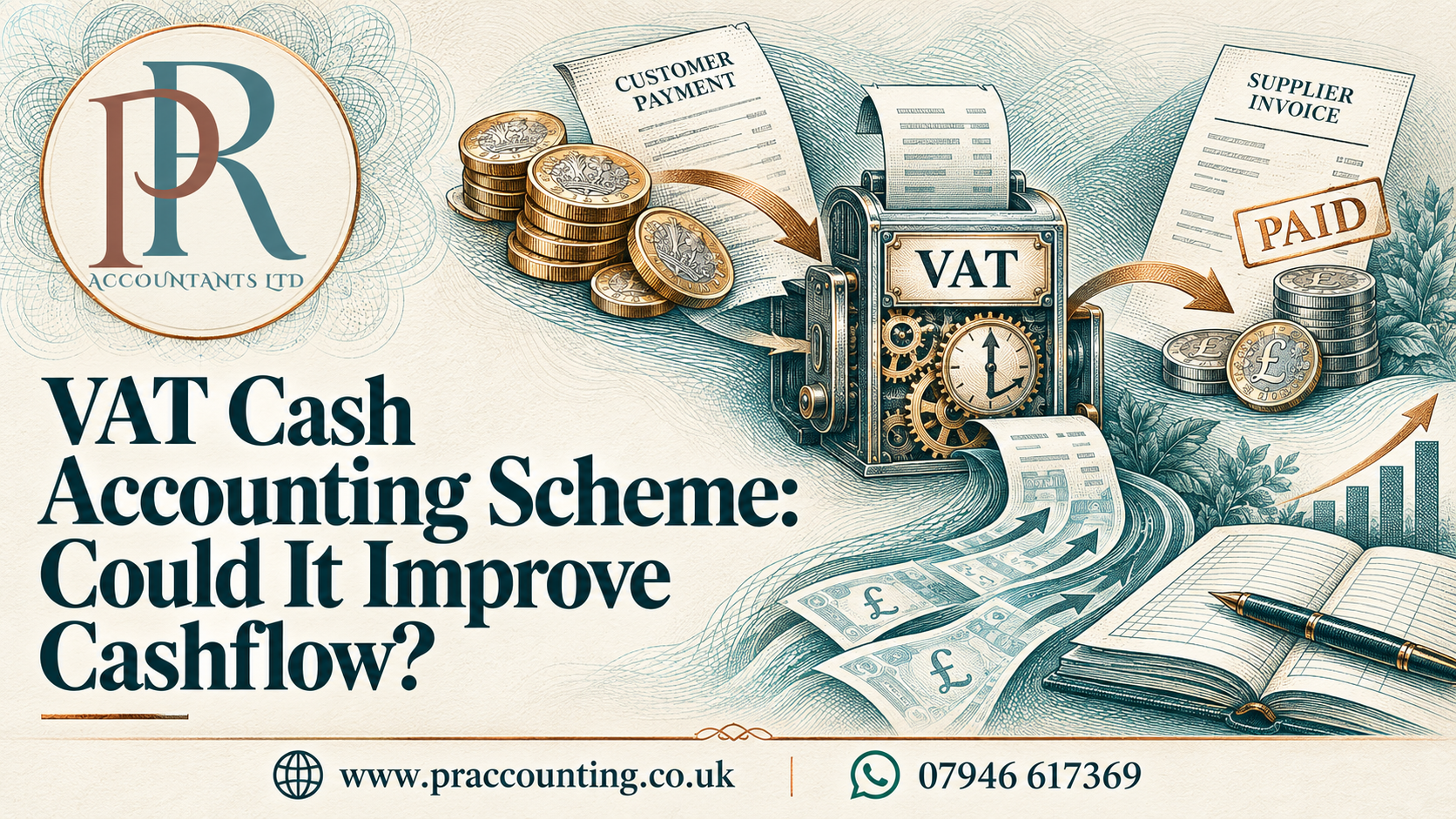
The VAT Cash Accounting Scheme changes the timing for many transactions.
Instead of accounting for output VAT when an invoice or another tax point arises, an eligible business normally accounts for VAT when the customer pays. In return, the business normally reclaims input VAT only when it pays its suppliers.
The scheme can therefore improve cashflow for a business that waits a long time for customer payments but pays suppliers relatively quickly.
It can be less helpful for a business that collects sales immediately, delays supplier payments or regularly receives VAT repayments.
The right answer depends on the payment cycle, not simply the turnover figure.
What is the VAT Cash Accounting Scheme?
The scheme is an optional method of accounting for VAT based primarily on payments.
Under the normal invoice method:
- Output VAT is normally declared according to the VAT tax point, often before the customer pays
- Input VAT can normally be reclaimed when the business holds the required invoice, even if the supplier has not yet been paid
Under cash accounting:
- Output VAT is normally declared when the customer payment is received
- Input VAT is normally reclaimed when the supplier payment is made
The scheme changes timing. It does not change the VAT rate, turn taxable sales into exempt sales or remove the need for valid VAT invoices and records.
The main cashflow benefit
The main benefit is avoiding the need to fund output VAT on qualifying unpaid sales.
Suppose a consultancy issues a standard-rated invoice for £60,000, consisting of £50,000 net and £10,000 VAT. The customer pays 90 days later.
Under normal VAT accounting, the £10,000 could be due on a VAT Return before the customer has paid.
Under cash accounting, the output VAT is normally declared when the payment is received.
The scheme has effectively aligned the VAT payment more closely with the related cash receipt.
The business still owes the VAT. The benefit is timing, not a permanent tax saving.
The trade-off: input VAT is also delayed
Cash accounting applies to purchases as well as sales.
If the business has not paid a supplier, it normally cannot reclaim the input VAT yet.
Suppose the same consultancy receives a supplier invoice for £24,000, including £4,000 VAT, but pays it after 60 days.
Under normal VAT accounting, the £4,000 might be reclaimable in the earlier VAT period, provided the normal evidence and deduction conditions are met.
Under cash accounting, the consultancy normally waits until it pays the supplier.
The overall result depends on both sides of the ledger.
A business that collects customers after 90 days but pays suppliers after 30 days may benefit. A business that receives immediate card payments but pays suppliers after 90 days may lose a useful timing advantage.
Who can join the scheme?
HMRC's VAT Notice 731 sets out the detailed rules.
A business can normally join if it:
- Is registered for VAT
- Expects the value of taxable supplies in the next year to be no more than £1.35 million, excluding VAT
- Is up to date with VAT Returns
- Has not been convicted of a VAT offence in the previous year
- Has not accepted a penalty for VAT evasion in the previous year
- Is not subject to a direction from HMRC preventing use of the scheme
Taxable supplies generally include standard-rated, reduced-rated and zero-rated sales, but not exempt supplies.
The forecast should be reasonable and based on the information available when the business considers joining.
The £1.35 million entry test is forward-looking
The entry limit is based on expected taxable turnover for the next twelve months, excluding VAT.
It is not simply the turnover shown in the last annual accounts.
A business should consider:
- Signed contracts
- Current order book
- Expected price increases
- New locations
- Planned acquisitions
- Seasonal patterns
- One-off projects
- Loss of a major customer
- Changes in VAT liability
If expected taxable supplies exceed £1.35 million, the business should not join merely because the previous year's turnover was below the threshold.
When must a business leave?
Once using cash accounting, a business can normally remain until the annual value of taxable supplies exceeds £1.6 million, excluding VAT.
It must usually leave at the end of the VAT period in which that limit is exceeded.
There can be an exception where the increase is temporary and the business expects taxable turnover in the next twelve months not to exceed £1.35 million. The detailed conditions and any HMRC agreement should be checked.
The business should monitor turnover during the year. Discovering the breach only when annual accounts are prepared can lead to incorrect VAT Returns and a difficult transition.
How does a business join?
An eligible business does not normally need to apply to HMRC in advance.
It can begin using the scheme from the start of a VAT accounting period.
The business should document:
- The date it starts
- The turnover forecast supporting eligibility
- Confirmation that compliance conditions were met
- How pre-scheme invoices will be identified
- How the software has been configured
- How receipts and payments will be matched
The scheme cannot be applied retrospectively to earlier VAT periods.
Why the start date matters
The business must avoid accounting for VAT twice or omitting it during the transition.
Sales invoices issued before joining may already have been included under normal accounting. If customers pay those invoices after the business enters the scheme, the receipts should not create output VAT a second time.
Similarly, input VAT on supplier invoices already reclaimed before joining should not be reclaimed again when the supplier is later paid.
The bookkeeping system therefore needs a clear distinction between:
- Transactions already accounted for under the normal method
- Transactions falling within cash accounting
- Transactions specifically excluded from the scheme
A start-date reconciliation should be retained as part of the VAT working papers.
Worked example: slow-paying customer and prompt supplier payment
Bright Services Ltd prepares quarterly VAT Returns.
During the quarter, it issues a sales invoice for:
- Net sale: £50,000
- VAT: £10,000
- Total: £60,000
The customer does not pay until the next VAT quarter.
Bright Services also receives and pays a supplier invoice during the first quarter for:
- Net cost: £18,000
- VAT: £3,600
- Total: £21,600
Under normal VAT accounting, the first quarter includes £10,000 output VAT and £3,600 input VAT. The net VAT due is £6,400, subject to any other transactions.
Under cash accounting, the customer has not paid, so no output VAT is included for that sale in the first quarter. The supplier has been paid, so the £3,600 input VAT can normally be reclaimed. The business may have a £3,600 repayment position for those transactions.
When the customer pays in the next quarter, the £10,000 output VAT becomes due.
The scheme has not changed the total VAT. It has moved the payment to a period in which the customer cash has been received.
Worked example: immediate sales and delayed supplier payments
Now consider a retailer whose customers pay immediately by card.
During the quarter, it receives £60,000 of standard-rated sales, including £10,000 VAT. It also receives supplier invoices containing £6,000 input VAT but pays them in the next quarter.
Under cash accounting, the £10,000 output VAT is due because the customers have paid. The £6,000 input VAT is delayed because the suppliers have not been paid.
Under normal VAT accounting, the retailer may have been able to reclaim the £6,000 in the current quarter, assuming it held valid invoices and met the normal conditions.
Cash accounting could therefore worsen the VAT cash position for that quarter.
Part payments
Cash accounting applies proportionately where an invoice is paid in instalments.
Suppose a customer pays £3,000 towards a wholly standard-rated VAT-inclusive invoice of £12,000.
The £3,000 receipt contains £500 VAT using the one-sixth VAT fraction.
The business normally declares £500 output VAT for that receipt. The remaining VAT becomes due as later payments are received.
The same principle applies to supplier payments. A part payment normally permits a proportionate input VAT claim, subject to the normal evidence and business-use rules.
Mixed-rate invoices require a reasonable allocation. The business should not automatically apply all receipts to the lowest-rated element.
Which date counts as payment?
The correct payment date depends on the method used.
Bank payments
The relevant date is generally when payment is received into or made from the bank account, subject to the detailed rules and evidence.
Cash
The payment date is when the cash is received or paid.
Cheques
The payment date is generally when the cheque is received, or the date shown if it is post-dated, provided it is later honoured. A dishonoured cheque requires correction.
Credit and debit cards
For card sales, HMRC generally treats the date of the sales voucher or equivalent transaction as the payment date, rather than the later date on which the card provider transfers funds to the business.
Contra entries and set-off
Where debts are formally offset, the accounting entry can represent payment. The agreement and date should be documented.
Platform wallets
A customer may pay a platform before the net settlement reaches the business bank account. The VAT payment date cannot always be inferred from the bank deposit alone. Platform transaction reports should be retained.
Records needed for cash accounting
The business must be able to link each receipt or payment to the relevant VAT invoice.
Records should include:
- Sales and purchase invoices
- Customer receipts
- Supplier payments
- Bank statements
- Merchant and platform statements
- Remittance advice
- Part-payment allocations
- Credit and debit notes
- Refunds
- Contra arrangements
- Cheque records
- Start and leaving-date reconciliations
The accounting system should show which VAT has been declared or reclaimed and which amounts remain outstanding.
A simple list of bank movements is not enough where receipts combine several invoices, platform fees are deducted or customer balances contain mixed VAT rates.
Transactions excluded from the scheme
Cash accounting does not cover every transaction.
HMRC identifies exclusions including:
- Goods supplied under lease purchase, hire purchase, conditional sale or certain credit-sale arrangements
- Imports, acquisitions and certain goods entered into or removed from customs warehouses or free zones
- Transactions subject to the domestic reverse charge
- Supplies where a VAT invoice is issued in advance of the supply
- Supplies where payment is not due in full within six months of the invoice date
The precise rules should be reviewed because one business can have a mixture of cash-accounting transactions and transactions dealt with under normal VAT rules.
Software must be configured to distinguish them.
Long payment terms can create an exclusion
The scheme is designed for ordinary business credit, not every long-term financing arrangement.
If an invoice is not due to be paid in full within six months, the transaction may be excluded from cash accounting.
This can affect businesses with:
- Extended instalment plans
- Long-dated payment schedules
- Retention arrangements
- Deferred consideration
- Bespoke commercial finance terms
The business should review contract terms before assuming that VAT will wait for the final cash receipt.
Cash accounting and advance payments
Cash accounting does not defer VAT after cash has been received.
If a customer pays a deposit or advance, output VAT is generally due on that receipt because payment has occurred.
This means the scheme mainly helps where an invoice precedes payment. It does not make customer deposits VAT-free.
Read VAT on Deposits, Advance Payments and Cancellations Explained for the wider tax point rules.
Cash accounting and bad debts
Businesses using cash accounting normally do not need VAT Bad Debt Relief for scheme sales.
If the customer never pays, the business normally never declares the related output VAT.
This is an administrative benefit as well as a cashflow benefit. The business avoids paying output VAT and later waiting for the six-month Bad Debt Relief conditions.
However, old invoices accounted for before joining the scheme and excluded transactions require separate review.
Read VAT Bad Debt Relief: Can You Reclaim VAT on Unpaid Invoices? for the normal relief conditions.
Cash accounting and the construction domestic reverse charge
Domestic reverse charge transactions are excluded from the Cash Accounting Scheme.
This is especially important for construction businesses.
Where a subcontractor makes a reverse-charge supply, it does not charge output VAT to the contractor. The contractor accounts for the VAT through its own return.
If most of a subcontractor's sales are reverse charged, cash accounting may provide limited output-tax timing benefit. At the same time, using the scheme could delay input VAT recovery on ordinary purchases until suppliers are paid.
The subcontractor might therefore move into more frequent repayment positions but wait longer to reclaim purchase VAT.
The interaction should be modelled before joining.
Read Domestic Reverse Charge VAT in Construction Explained for more detail.
Can cash accounting be used with the Flat Rate Scheme?
A business cannot use the VAT Cash Accounting Scheme and the Flat Rate Scheme at the same time.
The Flat Rate Scheme has its own cash-based turnover method that eligible businesses may choose.
The schemes have different calculations, thresholds and consequences. A business considering a change should compare its likely VAT cost, administration and cashflow rather than looking only at the payment date.
Can cash accounting be used with Annual Accounting?
Yes, the Cash Accounting Scheme can generally be used with the Annual Accounting Scheme if the business meets the relevant conditions for both.
Annual Accounting changes the return and payment cycle. Cash accounting changes the timing of when transactions enter the VAT calculation.
Using both can help some businesses, but it can also make current visibility more important because the final balancing payment may be material.
Businesses that may benefit
Cash accounting may suit a business that:
- Gives customers significant credit
- Regularly experiences late payment
- Has low levels of unpaid supplier invoices
- Is not normally a VAT repayment trader
- Has stable taxable turnover below the limits
- Can match every receipt and payment accurately
- Has few excluded transactions
Examples might include professional services firms, wholesalers offering customer credit, agencies, consultancies and some trades businesses.
The sector label does not decide the answer. Actual payment behaviour does.
Businesses that may not benefit
The scheme may be less suitable where the business:
- Receives most sales immediately
- Pays suppliers slowly
- Makes large purchases before generating sales
- Regularly receives VAT repayments
- Exports or makes many zero-rated supplies
- Has substantial excluded transactions
- Is growing towards the turnover limits
- Uses long-term credit agreements
- Has poor payment allocation records
- Is heavily affected by the construction domestic reverse charge
A repayment trader may prefer normal accounting because it can reclaim input VAT before suppliers are paid, subject to the usual rules.
How to assess the likely cashflow effect
A useful review should use real ledger data.
1. Measure customer payment days
Calculate how long customers actually take to pay, not merely the stated credit terms.
2. Measure supplier payment days
Identify when supplier invoices are paid and whether large invoices are regularly deferred.
3. Review VAT repayment history
Establish whether the business usually pays VAT or receives repayments.
4. Identify excluded transactions
Separate domestic reverse charge, hire purchase, imports, long-term credit and advance invoice situations.
5. Model at least four VAT periods
Seasonality can make one quarter misleading. Model receipts, payments, output VAT and input VAT across a full year where possible.
6. Include the transition
Allow for invoices already declared or reclaimed before the start date.
7. Stress-test late payment
Consider what happens if a major customer pays 30 or 60 days later than expected.
8. Consider administration
Assess whether the software and bookkeeping process can match receipts and payments accurately.
The result should show both the expected cash benefit and the points at which that benefit reverses.
Software configuration matters
Most mainstream accounting packages offer a cash VAT basis, but selecting a setting does not guarantee correct VAT Returns.
The opening configuration should be checked for:
- Correct scheme start date
- Treatment of pre-scheme invoices
- Outstanding sales and purchases
- Part payments
- Customer refunds
- Supplier credits
- Card and platform clearing accounts
- Reverse charge transactions
- Hire purchase and asset finance
- Imports and postponed import VAT
- Mixed VAT rates
- Bad debts from earlier periods
Changing the VAT basis without reconciling outstanding transactions can create duplicate or missing VAT.
The first return under the scheme and the first return after leaving deserve particular review.
What happens when the business leaves?
A business can choose to leave, or it may be required to leave because it no longer meets the conditions.
It normally leaves at the end of a VAT accounting period, not part way through one.
Outstanding cash-accounting transactions must then be brought into the VAT records under the leaving rules.
In many cases, VAT on outstanding sales and purchases must be accounted for on the return covering the date of leaving. HMRC may permit an additional period of up to six months for certain outstanding amounts, provided the conditions are met.
The leaving process can create a cashflow spike because output VAT on unpaid customer invoices may become due before collection.
A growing business should forecast that liability before it crosses the exit threshold or voluntarily leaves.
Common cash accounting mistakes
Joining retrospectively
The scheme starts from the beginning of a VAT period. It cannot be applied backwards simply because an earlier invoice remains unpaid.
Using turnover from the last accounts only
Eligibility is based on expected taxable supplies for the next year.
Reclaiming input VAT before paying suppliers
Cash accounting generally delays the input VAT claim until payment.
Using the bank settlement date for card sales
The card transaction date may be the relevant receipt date, not the later merchant payout.
Accounting for pre-scheme receipts twice
If output VAT was already declared under normal accounting, a later receipt should not generate it again.
Applying the scheme to excluded transactions
Domestic reverse charge and other exclusions must remain under their specific rules.
Ignoring part payments
Each part receipt or supplier payment can create a proportionate VAT entry.
Failing to monitor the £1.6 million exit limit
Rapid growth can require the business to leave, even if it entered legitimately.
Assuming the scheme permanently reduces VAT
It changes timing, not the underlying VAT due.
Leaving without forecasting the catch-up liability
Outstanding output VAT can become payable before customers settle their invoices.
A pre-joining checklist
Before switching, confirm:
- Expected taxable supplies are no more than £1.35 million
- VAT Returns and payments are up to date
- No offence, evasion penalty or HMRC direction prevents entry
- Customer payment days have been measured
- Supplier payment days have been measured
- Repayment history has been reviewed
- Excluded transactions have been identified
- The expected cashflow effect has been modelled
- The start date is the first day of a VAT period
- Pre-scheme invoices are separately marked
- Software settings have been tested
- Staff understand how to allocate part payments
- Merchant and platform transactions can be reconciled
- Turnover monitoring is in place
- A future leaving process has been considered
Frequently asked questions
Does the scheme reduce the amount of VAT I pay?
Usually no. It changes when output VAT is declared and input VAT is reclaimed. The long-term total is generally unchanged.
Do I need HMRC's permission to join?
An eligible business does not normally need to apply. It can start at the beginning of a VAT period, but it should document eligibility and configure its records correctly.
What is the turnover limit?
Expected taxable supplies for the next year must normally be no more than £1.35 million excluding VAT when joining. Once in the scheme, the usual exit limit is £1.6 million.
Can I use the scheme if customers pay immediately?
You may be eligible, but it may provide little benefit. If supplier payments are delayed, it could make the VAT position worse.
Can I reclaim VAT as soon as I receive a supplier invoice?
Normally not under cash accounting. The supplier must generally be paid and the usual input-tax conditions must be met.
What happens if a customer never pays?
For a transaction within the scheme, output VAT is normally never declared. Separate rules apply to pre-scheme and excluded transactions.
Can I use cash accounting for domestic reverse charge construction sales?
Domestic reverse charge transactions are excluded. Construction businesses should review the interaction carefully.
Can I use cash accounting with the Flat Rate Scheme?
Not as the separate Cash Accounting Scheme. The Flat Rate Scheme has its own cash-based turnover option.
Can I leave voluntarily?
Yes, normally from the end of a VAT period. Outstanding transactions and the resulting catch-up VAT must be dealt with correctly.
Is cash accounting the same as preparing accounts on the cash basis?
No. VAT cash accounting is a specific VAT scheme. The accounting and direct-tax basis used for annual accounts may follow different rules.
The scheme should be chosen with figures, not assumptions
VAT cash accounting can be an effective cashflow tool, especially where the business routinely pays VAT before slow-paying customers settle.
It is not automatically beneficial.
The scheme delays input VAT as well as output VAT, excludes certain transactions and can create a catch-up liability when the business leaves. Growth can also bring the business closer to the £1.6 million exit point.
The strongest decision is based on a payment-timing model using the business's actual sales ledger, purchase ledger and VAT history.
Speak to PR Accountants Ltd
PR Accountants Ltd helps businesses assess whether VAT cash accounting is likely to improve cashflow and implement the scheme without losing control of outstanding VAT.
We can assist with:
- Cash Accounting Scheme eligibility reviews
- VAT cashflow modelling
- Scheme entry and exit reconciliations
- Accounting software configuration
- VAT Return preparation and review
- Aged debtor and creditor analysis
- VAT Bad Debt Relief
- Construction domestic reverse charge reviews
- VAT registrations and deregistrations
- Bookkeeping, management accounts and cashflow forecasts
If customer payment delays are forcing your business to fund VAT from working capital, a scheme review can show whether cash accounting would genuinely help.
PR Accountants Ltd
Email: info@praccounting.co.uk
Telephone: 0330 043 0792
WhatsApp: 07946 617369
Website: www.praccounting.co.uk
Facebook: PR Accountants Ltd
LinkedIn: PR Accountants Ltd
Instagram: @praccountantsuk
TikTok: @praccountants
Related articles
- VAT Bad Debt Relief: Can You Reclaim VAT on Unpaid Invoices?
- VAT on Deposits, Advance Payments and Cancellations Explained
- Domestic Reverse Charge VAT in Construction Explained
- Construction Business Cashflow: Why CIS, VAT and Materials Matter
- Why Every Growing Business Needs a Tax Forecast
Official guidance
This article provides general information and does not constitute personalised accounting, tax or legal advice. Eligibility and VAT treatment depend on the business's turnover, transactions, payment terms and records. HMRC guidance and legislation can change.