What Expenses Can You Claim as a Sole Trader?
When you run a business as a sole trader, you pay tax on the profit your business makes, not simply the money paid into your bank account.
Your taxable profit is usually calculated by taking your business income and deducting allowable business expenses. The higher your genuine business expenses, the lower your taxable profit may be.
However, not every payment made from your business account is tax deductible. HMRC expects expenses to relate to your business, and private costs must be excluded.
This guide explains the main expenses sole traders can claim, the areas that often cause confusion and the records you should keep.
The basic rule for claiming expenses
To claim an expense against your business income, it must be incurred wholly and exclusively for the purpose of your trade.
In practical terms, this means the cost must be connected to running your business or generating business income.
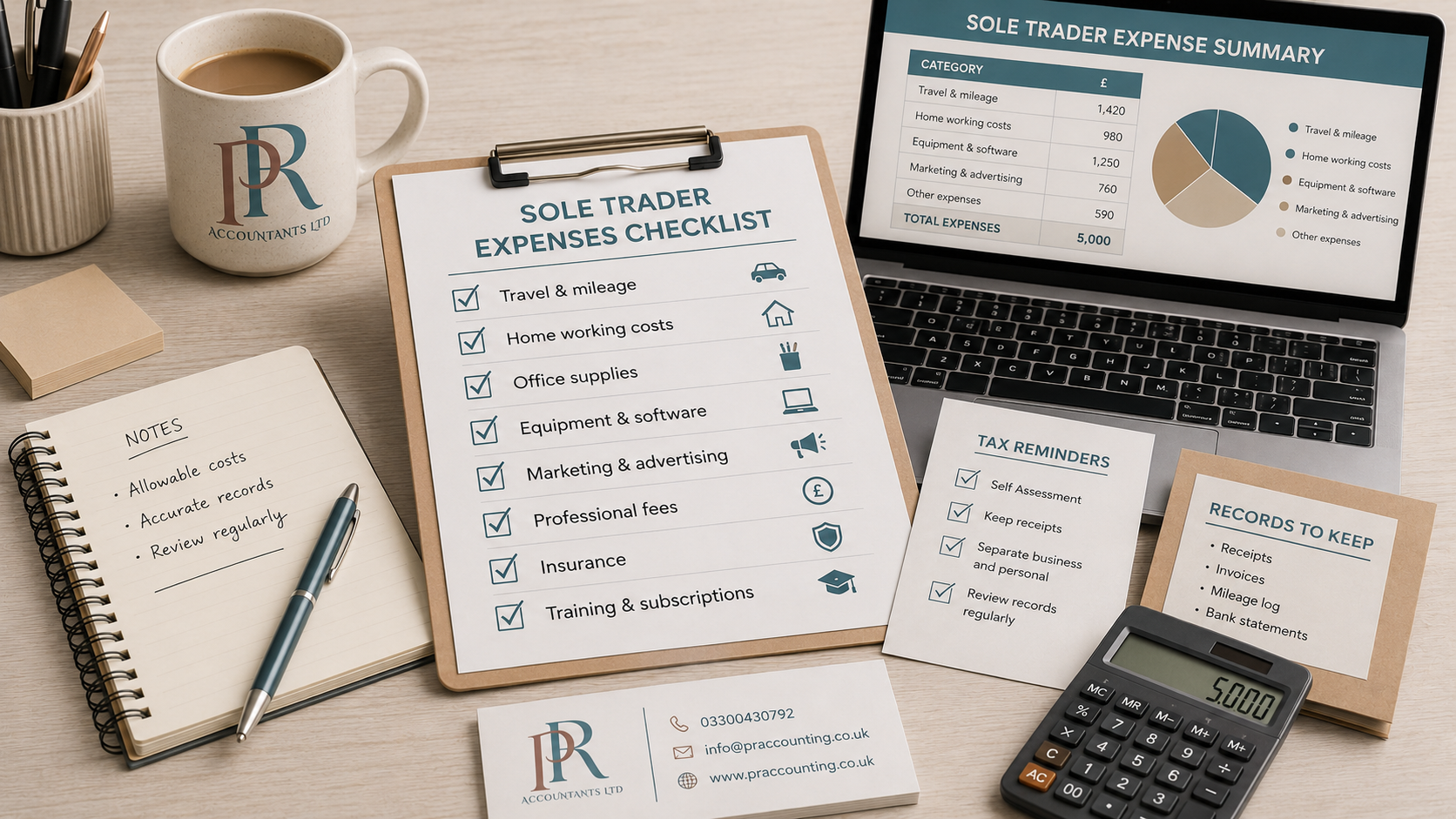
For example, you may be able to claim:
- Business insurance
- Software subscriptions
- Professional fees
- Advertising costs
- Travel to client meetings
- Materials or stock
- Business telephone costs
Where an expense has both business and personal use, you can only claim the business proportion.
For example, if you use your mobile phone partly for work and partly for personal calls, you should calculate a reasonable percentage for business use and claim that amount only.
Office and administration expenses
Many day-to-day business costs can be claimed as allowable expenses.
These may include:
- Stationery and printing
- Postage and courier costs
- Printer ink and office supplies
- Telephone and mobile phone bills
- Internet and broadband costs
- Accounting software subscriptions
- Cloud storage and business software
- Website hosting and domain renewals
- Payment processing fees
- Business bank charges
- Office rent
- Utility bills for business premises
- Business rates
- Security costs for your office or premises
If you rent an office, shop, studio, salon or workshop, expenses relating to that premises are usually easier to identify as business costs.
Working from home expenses
Many sole traders work from home, either full time or for part of the week.
You may be able to claim a reasonable proportion of your household costs where your home is used for business purposes.
This can include a business proportion of:
- Heating and electricity
- Council Tax
- Rent
- Mortgage interest
- Internet and telephone use
You cannot claim mortgage capital repayments.
There are two main methods available.
Claiming actual home-working costs
You can calculate the business proportion of household expenses using a reasonable method.
This might be based on:
- The number of rooms in your home
- The number of rooms used for business
- The amount of time the room is used for work
- The percentage of phone or internet use that relates to the business
For example, where one room in a five-room home is used as an office for part of the week, you may be able to calculate an appropriate proportion of the relevant household costs.
Using simplified expenses
Sole traders can also use HMRC simplified expenses for working from home.
The flat rates are: Hours worked from home each month Allowable amount 25 to 50 hours £10 per month 51 to 100 hours £18 per month 101 hours or more £26 per month
These rates cover household running costs. Telephone and internet expenses can be claimed separately based on the business proportion of actual use.
Simplified expenses can save time, but they are not always the most beneficial option. In some cases, calculating actual costs may produce a higher claim.
Vehicle and travel expenses
Travel costs can be claimed where the journey is undertaken for business purposes.
Examples include:
- Travel to client meetings
- Travel between temporary work locations
- Train, bus and taxi fares for business trips
- Parking costs for business appointments
- Tolls for business journeys
- Hotel accommodation for qualifying overnight business trips
You cannot normally claim ordinary travel between home and a regular place of work.
You also cannot claim parking fines, speeding fines or other penalties.
Claiming mileage
Many sole traders use mileage rates rather than claiming actual vehicle running costs.
For the 2026/27 tax year, the mileage rates are: Vehicle type Rate Cars and vans, first 10,000 business miles 55p per mile Cars and vans, business miles above 10,000 25p per mile Motorcycles 24p per mile
Mileage rates are intended to cover costs such as fuel, servicing, repairs, insurance and vehicle depreciation.
You can still claim additional costs such as business parking, tolls and train fares where appropriate.
Once you use mileage rates for a particular vehicle, you would normally continue using that method for as long as the vehicle is used in the business.
Stock, materials and direct costs
If you sell products, manufacture goods or provide services using materials, you can normally claim direct business costs.
Examples include:
- Stock purchased for resale
- Raw materials
- Ingredients
- Packaging
- Delivery costs
- Materials used for customer work
- Supplies used directly in providing your service
For example, a tradesperson may claim materials used for client jobs, while an online retailer may claim stock bought for resale.
Items purchased for personal use cannot be claimed.
Staff and subcontractor costs
Where your business employs staff or uses subcontractors, you may be able to claim costs such as:
- Employee wages and salaries
- Employer’s National Insurance contributions
- Pension contributions for employees
- Agency fees
- Subcontractor payments
- Staff training related to the business
- Staff benefits where treated correctly
Payments to family members can be claimed where they genuinely work for the business and are paid a commercially reasonable amount.
Marketing and advertising costs
Costs incurred to promote your business are usually allowable.
This may include:
- Website design and maintenance
- Online advertising
- Social media advertising
- Business cards
- Leaflets and brochures
- Search engine optimisation services
- Photography and video content for marketing
- Directory listings
- Promotional samples
- Email marketing software
However, client entertainment is not usually allowable.
This means you generally cannot claim tax relief for:
- Meals with clients
- Hospitality events
- Sports or event tickets
- Entertainment for suppliers or customers
- Most business gifts
It may still be a worthwhile business expense commercially, but it is normally not deductible when calculating your taxable profit.
Professional fees, insurance and financial costs
Sole traders can usually claim professional and financial costs that relate directly to the business.
This may include:
- Accountancy fees
- Legal fees for business matters
- Professional indemnity insurance
- Public liability insurance
- Trade association membership fees
- Professional subscriptions relevant to the business
- Merchant service charges
- Business bank charges
- Interest on business loans and overdrafts
- Leasing costs
Loan repayments themselves are not allowable expenses. However, the interest element of a qualifying business loan may be deductible.
Training and professional development
Training can be claimed where it relates to your existing business and helps you maintain, improve or update relevant skills.
Examples may include:
- Refresher courses
- Industry compliance training
- Software training
- Health and safety training
- Courses that improve skills already used in your business
- Administrative or management training that supports your existing business
Training is less likely to be allowable where it prepares you for a completely new trade or an unrelated area of business.
For example, a self-employed bookkeeper may be able to claim training in bookkeeping software or tax updates. Training to become a personal trainer would not normally be an allowable expense of the bookkeeping business.
Clothing expenses
Clothing is an area where many sole traders make mistakes.
You may be able to claim for:
- Uniforms
- Protective clothing
- Safety footwear
- Specialist workwear
- Costumes for performers and entertainers
You cannot normally claim for everyday clothing, even if you only wear it for work.
For example, suits, smart dresses, office shoes and normal business clothing are usually not allowable simply because they are worn when meeting clients.
Equipment and larger purchases
Some equipment can be claimed as a normal business expense, while larger or longer-term assets may need different tax treatment.
Examples may include:
- Laptops
- Computers
- Printers
- Office furniture
- Tools
- Machinery
- Cameras
- Specialist equipment
- Business vehicles
The treatment can depend on whether you use cash basis accounting or traditional accounting, whether the item is partly used personally, and the type of asset purchased.
This is particularly important for vehicles, expensive equipment and assets bought before your business started.
Expenses you cannot normally claim
Some costs may feel connected to your work but are not allowable for tax purposes.
Common examples include:
- Personal shopping
- Private household costs
- Everyday clothing
- Client entertainment
- Event hospitality
- Parking fines and penalties
- Personal gym memberships
- Political donations
- Private travel
- Ordinary commuting costs
- Personal Income Tax payments
- Loan capital repayments
- Depreciation charged in your accounts
A cost does not become tax deductible simply because it helps you feel more productive, professional or prepared for work.
The £1,000 trading allowance
Some sole traders may be able to use the £1,000 trading allowance instead of claiming actual business expenses.
Where eligible, you can deduct the £1,000 allowance from your business income rather than calculating and claiming individual expenses.
This can be useful for smaller businesses with relatively low costs.
However, you cannot claim the £1,000 trading allowance and your actual business expenses against the same income. You need to choose the method that gives the best result for your circumstances.
Keep accurate records
You do not need to submit every receipt with your Self Assessment tax return, but you must keep accurate records that support the figures you claim.
Good records include:
- Sales invoices
- Supplier invoices and receipts
- Business bank statements
- Mileage logs
- Notes showing how mixed-use costs have been split
- Home-working calculations
- Details of equipment purchases
- Evidence of business travel
Keeping your business transactions separate from personal spending makes this much easier.
Using a dedicated business bank account, keeping your bookkeeping up to date and reviewing your expenses regularly can help you avoid missing legitimate claims or including costs that should not be claimed.
Need help with your sole trader expenses?
Claiming expenses correctly is not about including every payment that leaves your bank account. It is about identifying genuine business costs, separating private spending and keeping records that support your Self Assessment tax return.
At PR Accountants Ltd, we help sole traders with bookkeeping, expense reviews, Self Assessment tax returns and practical tax planning.
Contact us today for clear advice on what you can claim and how to keep your records organised.