
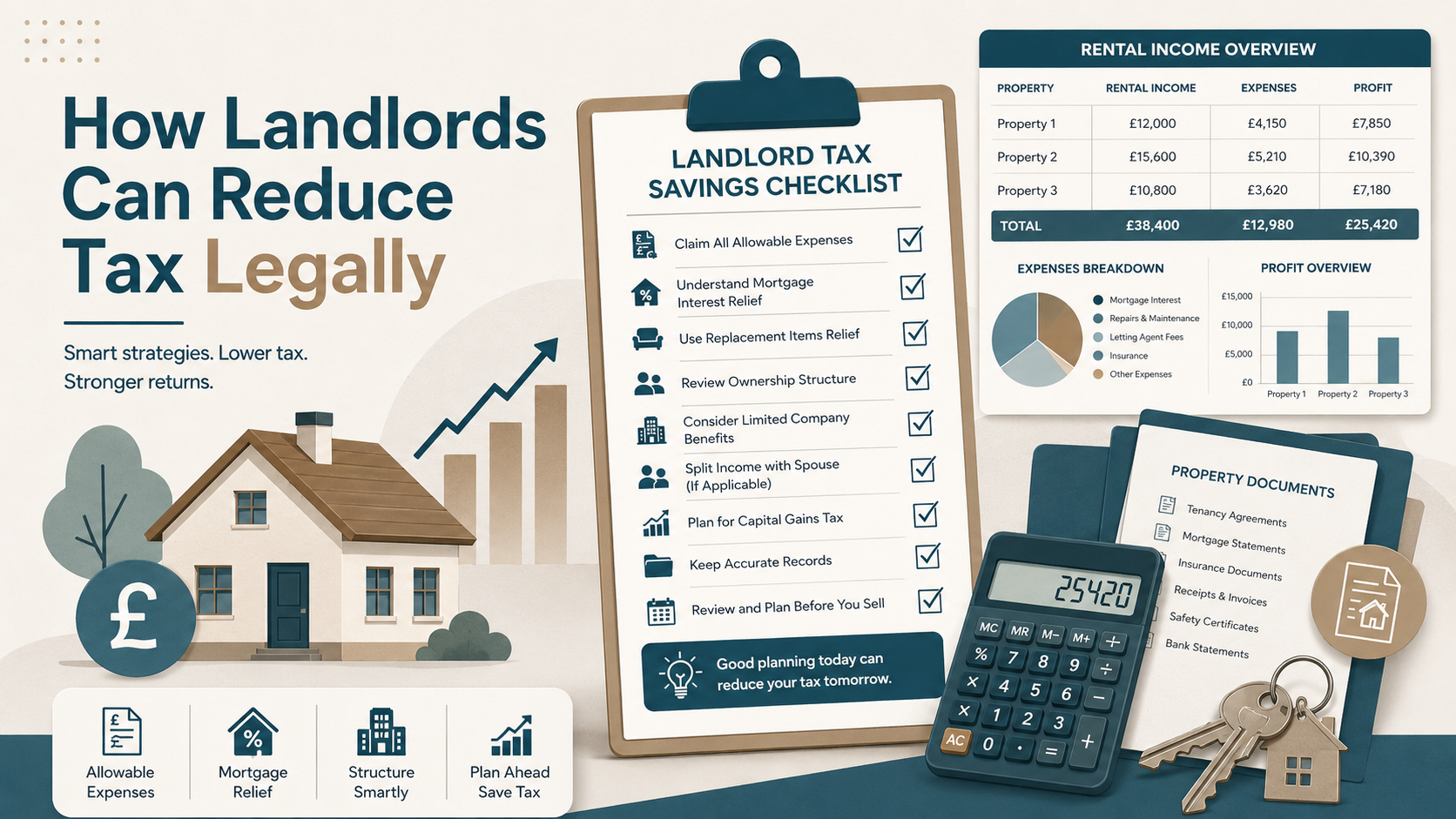
How Landlords Can Reduce Tax Legally
Many landlords want to know how to reduce tax on rental income.
That is understandable. Property tax rules have become more complex, mortgage interest costs have increased for many landlords, and cashflow pressure can be significant.
However, legal tax reduction is not about hiding income, exaggerating expenses or using aggressive schemes.
Good landlord tax planning is about:
- claiming legitimate expenses correctly
- understanding mortgage interest relief
- choosing the right ownership structure
- keeping accurate records
- planning before selling property
- preparing for Making Tax Digital
- reviewing whether personal or company ownership is more suitable
- understanding VAT where serviced accommodation is involved
- making decisions before the tax year ends, not afterwards
The strongest tax planning is usually practical, well-documented and based on the landlord’s real circumstances.
1. Keep Proper Records From the Start
The first and simplest way to reduce tax legally is to keep proper records.
Many landlords overpay tax because they do not keep receipts, invoices or complete statements. Others underclaim expenses because they cannot prove what they spent.
Good records help you claim what you are entitled to claim.
Landlords should keep:
- rent statements
- letting agent statements
- mortgage interest certificates
- service charge statements
- repair invoices
- insurance documents
- legal documents
- tenancy agreements
- safety certificates
- bank statements
- property purchase documents
- refurbishment records
- completion statements
- mileage logs, where relevant
- accountant invoices
- software records
Good record keeping is not just admin. It directly affects tax.
Practical Example
A landlord spends £3,500 during the year on repairs, safety checks, insurance and letting agent fees.
They only keep records for £1,900.
The missing £1,600 may not be claimed properly if there is no evidence.
At a 40% tax rate, that could mean unnecessary tax of £640.
2. Claim Allowable Expenses Correctly
Landlords can usually deduct genuine rental business expenses when calculating taxable rental profit.
Common allowable expenses may include:
- letting agent fees
- repairs and maintenance
- property insurance
- service charges
- ground rent
- safety certificates
- cleaning between tenancies
- gardening and maintenance
- advertising for tenants
- accountancy fees relating to the rental business
- legal fees relating to certain tenant matters
- replacement domestic items, where the rules are met
The key is that the cost must relate to the property rental business.
Common Mistake
Some landlords only claim the obvious expenses, such as letting agent fees, but forget smaller costs.
These may include:
- key cutting
- tenant referencing
- inventory fees
- smoke alarms
- carbon monoxide alarms
- minor repairs
- mileage to inspect the property
- postage and admin costs
- cleaning supplies
Small costs can add up over the year.
3. Understand Repairs vs Improvements
This is one of the biggest areas where landlords make mistakes.
A repair normally restores the property to its previous condition.
An improvement enhances the property beyond its original condition or adds something new.
Examples of Repairs
These may include:
- fixing a broken boiler
- repairing a leaking roof
- replacing damaged floorboards
- repainting between tenancies
- repairing existing kitchen units
- replacing a broken window
Examples of Improvements
These may include:
- building an extension
- converting a loft
- adding a new bathroom where none existed
- upgrading a basic kitchen to a significantly higher specification
- major structural improvements
Repairs may be deductible against rental income.
Improvements are often capital in nature and may instead be relevant for Capital Gains Tax when the property is sold.
Practical Example
A landlord replaces a damaged standard kitchen worktop with a similar modern equivalent.
This may be a repair.
But if the landlord installs a high-end designer kitchen as part of a major upgrade, some or all of the cost may be capital.
The invoice and evidence should be kept either way.
4. Use Replacement Domestic Items Relief Where Available
For residential lettings, landlords may be able to claim relief when replacing certain domestic items.
This can include replacement items such as:
- beds
- sofas
- curtains
- carpets
- white goods
- furniture
- crockery
- kitchenware
The key word is replacement.
The relief generally applies where an old item is replaced, rather than where the landlord is buying the item for the first time.
Practical Example
A landlord replaces an old washing machine in a furnished rental property with a similar washing machine.
This may qualify for replacement domestic items relief.
But buying the first washing machine for a property that did not previously have one may be treated differently.
5. Review Mortgage Interest Tax Relief
Mortgage interest is one of the most important tax issues for landlords.
For many individual residential landlords, mortgage interest is no longer deducted in the same way as ordinary expenses.
Instead, finance cost relief is usually given as a basic rate tax credit.
This can create a much higher tax bill for higher-rate and additional-rate taxpayers.
Practical Example
A landlord receives £30,000 rental income and pays £18,000 mortgage interest.
The landlord may feel the property profit is only £12,000 before other costs.
However, due to the finance cost restriction, the taxable income calculation may not reflect the same cash result.
This can push landlords into higher tax bands even where cashflow is tight.
Planning Point
Landlords should review:
- mortgage interest levels
- rental yield
- tax bands
- other income
- whether the portfolio is still viable
- whether personal or company ownership is more appropriate
- whether refinancing changes tax and cashflow outcomes
Mortgage interest planning should be reviewed annually, especially where interest rates have changed.
6. Consider Whether a Limited Company Structure Is Suitable
A limited company can sometimes reduce tax for landlords, but it is not automatically better.
Companies can generally deduct finance costs when calculating company profits, which can be attractive for highly leveraged portfolios.
However, a company structure brings other tax and commercial issues, including:
- Corporation Tax
- dividend tax when extracting profits personally
- additional compliance costs
- Companies House filings
- mortgage availability and interest rates
- legal costs
- accountancy fees
- Stamp Duty Land Tax or equivalent taxes
- possible Capital Gains Tax if transferring existing properties
- long-term exit planning
When a Company May Be Worth Considering
A company may be more attractive where:
- profits are retained for reinvestment
- the landlord is building a portfolio
- mortgage interest is significant
- the landlord is a higher-rate taxpayer
- there is a long-term growth plan
- profits are not needed personally straight away
When a Company May Not Be Worth It
A company may be less attractive where:
- there is only one property
- borrowing is low
- profits are withdrawn personally each year
- the landlord wants simplicity
- transfer taxes would be too high
- mortgage costs outweigh tax savings
Practical Example
A landlord with one low-mortgage rental property producing modest profit may not benefit enough from using a company.
A landlord with six mortgaged properties who reinvests profits may need a more detailed company structure review.
The answer depends on the numbers.
7. Be Careful Before Incorporating Existing Properties
Moving existing personally owned properties into a limited company is not simple.
It may trigger:
- Capital Gains Tax
- Stamp Duty Land Tax or equivalent property transaction taxes
- mortgage lender issues
- legal fees
- valuation requirements
- refinancing costs
- company compliance obligations
Some landlords hear about incorporation relief and assume it will automatically apply. That is risky.
Incorporation relief can be complex and depends on the facts. It should not be relied on without proper advice.
Planning Point
Before transferring properties to a company, landlords should ask:
- Is there a genuine property business?
- What is the CGT exposure?
- What is the SDLT/LBTT/LTT position?
- Are lenders willing to refinance?
- Will future tax savings justify the cost?
- How will profits be extracted?
- What is the exit plan?
A company structure can be powerful, but only where the wider position supports it.
8. Review Ownership Between Spouses or Civil Partners
Where spouses or civil partners own property together, the income split matters.
In many cases, jointly owned property income between spouses or civil partners living together is taxed 50/50 unless the correct steps are taken to reflect unequal beneficial ownership.
This is where Form 17 may be relevant.
However, Form 17 is not a casual tax-saving form.
The income split must reflect the actual beneficial ownership of the property. Evidence is usually needed, such as a declaration of trust or deed.
Practical Example
A married couple owns a rental property.
One spouse pays tax at 40%, and the other has unused basic rate band.
They want the rental income taxed 90/10 in favour of the lower-income spouse.
This may be possible only if the beneficial ownership is actually 90/10 and the correct declaration is made to HMRC.
Simply entering different figures on a tax return is not enough.
Planning Point
Ownership planning can reduce tax legally, but it must be properly documented.
Landlords should get advice before transferring ownership or changing income splits.
9. Use the Property Allowance Where It Gives a Better Result
The property allowance can be useful for landlords with small amounts of property income.
It allows up to £1,000 of property income to be tax-free.
However, if you claim the property allowance, you cannot also deduct actual expenses against that income.
Practical Example
A landlord has:
- £1,500 rental income
- £200 expenses
Using the property allowance may be better.
But if the landlord has:
- £5,000 rental income
- £3,000 allowable expenses
claiming actual expenses is likely to be better than using the property allowance.
The correct choice depends on the numbers.
10. Do Not Miss Capital Gains Tax Planning
Landlords often focus on rental income tax but forget about Capital Gains Tax.
CGT can arise when a rental property is sold or transferred.
Planning before sale can help reduce problems and avoid missed deadlines.
Key points to consider include:
- original purchase cost
- legal fees on purchase
- Stamp Duty Land Tax or equivalent property transaction tax
- capital improvement costs
- estate agent fees
- legal fees on sale
- ownership percentages
- private residence relief, where relevant
- timing of sale
- use of annual exempt amount
- losses available
- 60-day CGT reporting requirements
Practical Example
A landlord sells a former home that has been rented out for several years.
The gain may need to consider:
- period of occupation as main residence
- period of letting
- improvement costs
- ownership shares
- final taxable gain
This should be reviewed before completion, not months later.
11. Keep Evidence of Capital Improvements
Even if improvement costs are not deductible against rental income, they may reduce the taxable gain when the property is sold.
Examples may include:
- extensions
- structural improvements
- loft conversions
- major renovations
- adding new facilities
- improvement works not previously deducted as repairs
Practical Example
A landlord spends £25,000 on a qualifying capital improvement but loses the paperwork.
Years later, the property is sold.
Without evidence, it may be difficult to support the claim in the CGT calculation.
Good records can reduce tax legally later.
12. Plan Before Selling a Property
Selling a rental property without tax planning can be expensive.
Before selling, landlords should review:
- estimated gain
- available reliefs
- ownership split
- completion date
- potential losses
- 60-day CGT reporting
- cash needed to pay tax
- whether sale timing affects tax year planning
Important Point
For UK residential property disposals, Capital Gains Tax may need to be reported and paid within 60 days of completion.
Waiting until the Self Assessment deadline can lead to penalties and interest.
13. Track Each Property Separately
Landlords with more than one property should track income and expenses property by property.
This helps identify:
- which properties are profitable
- which properties are cashflow weak
- repair-heavy properties
- low-yield assets
- high mortgage-interest properties
- properties that may need rent review
- properties that may be better sold or refinanced
Practical Example
A landlord owns five properties.
Overall rental income looks healthy.
But property-by-property reporting shows one flat has high service charges, repeated repair costs and low rental yield.
Without separate tracking, the landlord may not realise that one property is reducing overall profitability.
14. Use Software and Prepare for Making Tax Digital
Making Tax Digital for Income Tax affects many landlords.
Under MTD, affected landlords need to keep digital records and submit quarterly updates to HMRC using compatible software.
This changes the old approach of preparing rental accounts only once a year.
Planning Point
Even if a landlord is not yet within MTD, moving to software early can help:
- reduce missed expenses
- improve tax forecasting
- track property-by-property performance
- prepare quarterly figures
- avoid year-end panic
- improve cashflow planning
MTD should be treated as a chance to improve financial visibility, not just another compliance burden.
15. Review VAT Before Moving Into Serviced Accommodation
Standard residential letting is usually exempt from VAT.
However, serviced accommodation and short-term accommodation can create different VAT issues.
Landlords moving into Airbnb, Booking.com or serviced accommodation should review VAT before they scale.
VAT planning is important because:
- taxable turnover may count towards the VAT threshold
- pricing may need to include VAT impact
- platform fees can complicate bookkeeping
- input VAT recovery may become relevant
- incorrect VAT treatment can create backdated liabilities
Practical Example
A landlord moves from standard AST letting to serviced accommodation.
The nightly rates look attractive.
However, once platform fees, cleaning, VAT exposure, management costs and void periods are considered, the profit may be very different.
VAT should be reviewed before the business model is expanded.
16. Understand Furnished Holiday Letting Changes
The Furnished Holiday Lettings tax regime has been abolished from April 2025.
This is important for landlords who previously relied on FHL advantages.
Short-term holiday accommodation income is now generally treated under the ordinary property income rules.
This affects planning around:
- finance costs
- capital allowances
- pension-relevant earnings
- CGT reliefs
- losses
- overall tax structure
Landlords should not rely on old FHL assumptions.
17. Use Losses Properly
Property losses can be useful, but they have rules.
Losses from a UK property business are usually carried forward and set against future profits of the same property business.
They are not usually available to offset against employment income or unrelated income.
Practical Example
A landlord has a property loss this year due to major repairs.
The loss may be carried forward and used against future property profits.
Good bookkeeping ensures losses are recorded and not forgotten.
18. Review Rent Levels and Commercial Performance
Tax planning is not only about expenses.
Sometimes the best way to improve after-tax returns is to review the commercial performance of the property.
Landlords should review:
- rent compared with market rate
- service charges
- insurance costs
- letting agent fees
- repair patterns
- void periods
- refinancing options
- tenant quality
- compliance costs
A property with low rent and high costs may produce poor returns even if tax planning is done well.
19. Avoid Aggressive or Artificial Tax Schemes
Landlords should be cautious about schemes promising unrealistic tax savings.
Warning signs include:
- guaranteed tax-free rent
- artificial incorporation claims
- circular loan arrangements
- offshore structures with no commercial substance
- arrangements designed mainly to avoid tax
- advice that ignores SDLT, CGT or mortgage consequences
- social media “hacks” with no detailed calculations
Legal tax planning is based on evidence, commercial reality and proper documentation.
If a strategy sounds too good to be true, it usually needs careful review.
20. Get Advice Before Major Decisions
Tax advice is most valuable before a transaction happens.
Landlords should seek advice before:
- buying property
- selling property
- transferring ownership
- refinancing
- incorporating a portfolio
- moving into serviced accommodation
- making large improvements
- changing income shares
- gifting property
- claiming unusual expenses
- changing from personal to company ownership
Once a transaction has happened, the planning options may be limited.
Common Mistakes Landlords Make When Trying to Reduce Tax
1. Claiming Improvements as Repairs
This can lead to incorrect tax returns and potential HMRC issues.
2. Not Keeping Receipts
Without evidence, legitimate expenses may be missed.
3. Ignoring Mortgage Interest Restrictions
This can create unexpected tax bills.
4. Incorporating Without Proper Calculations
Company ownership can help, but it can also trigger costs and complexity.
5. Splitting Income Incorrectly
Ownership splits must be legally and beneficially correct.
6. Forgetting CGT Reporting
UK residential property gains may need to be reported within 60 days.
7. Relying on Old FHL Rules
The FHL regime has been abolished, so old advice may no longer apply.
8. Not Preparing for MTD
Landlords affected by MTD need software and regular digital records.
Practical Scenario: Tax Planning Done Well
A landlord owns three rental properties.
They:
- keep separate records for each property
- claim allowable expenses properly
- keep receipts and invoices
- review mortgage interest impact annually
- track rental profit and cashflow
- consider whether company ownership is suitable for future purchases
- plan before selling property
- prepare early for Making Tax Digital
- seek advice before changing ownership
This landlord is more likely to pay the correct amount of tax — not too much and not too little.
Practical Scenario: Tax Planning Done Poorly
Another landlord owns several properties but:
- mixes personal and property expenses
- keeps poor records
- does not track properties separately
- claims improvements as repairs
- ignores mortgage interest restrictions
- waits until January to prepare records
- sells a property without checking CGT deadlines
- follows online advice about incorporation without calculations
This creates avoidable tax risk, stress and potentially higher costs.
Frequently Asked Questions
Can landlords reduce tax legally?
Yes. Landlords can reduce tax legally by claiming allowable expenses, keeping proper records, reviewing ownership structure, planning mortgage interest impact, preparing for CGT and using the correct tax treatment.
What expenses can landlords claim?
Common expenses may include letting agent fees, repairs, insurance, service charges, safety certificates, cleaning, advertising, accountancy fees and replacement domestic items where the rules are met.
Can landlords claim mortgage interest?
Individual residential landlords usually receive finance cost relief as a basic rate tax credit rather than deducting mortgage interest fully from rental income.
Is a limited company better for landlords?
Not always. A company can be useful for some landlords, especially where profits are retained and portfolios are growing, but Corporation Tax, dividend tax, mortgage rates, SDLT and CGT must be reviewed.
Can landlords split rental income with a spouse?
Potentially, but the split must reflect actual beneficial ownership where unequal shares are claimed. Form 17 may be needed for married couples or civil partners living together.
Can landlords claim improvements against rental income?
Usually not in the same way as repairs. Improvements are often capital costs and may be relevant for Capital Gains Tax when the property is sold.
Do landlords need software?
Many landlords will need digital records under Making Tax Digital depending on their qualifying income. Even before MTD applies, software can improve accuracy and tax planning.
Is serviced accommodation taxed the same as normal residential rent?
Not always. Serviced accommodation can create different VAT, bookkeeping and tax issues, especially where short stays and platform bookings are involved.
How PR Accountants Can Help
At PR Accountants, we help landlords reduce tax legally and stay compliant.
We support landlords and property investors with:
- rental income accounts
- Self Assessment tax returns
- allowable expense reviews
- mortgage interest relief calculations
- property-by-property reporting
- Form 17 and ownership split reviews
- Capital Gains Tax calculations
- 60-day CGT reporting
- limited company property planning
- serviced accommodation VAT reviews
- Making Tax Digital preparation
- bookkeeping and software setup
- management accounts and cashflow planning
Our aim is to help landlords understand their numbers, avoid common tax mistakes and make better long-term property decisions.
Final Thoughts
Landlords can reduce tax legally, but the best results come from proper planning rather than last-minute fixes.
Good tax planning means:
- claiming the right expenses
- keeping accurate records
- understanding mortgage interest relief
- reviewing ownership structure
- planning before selling property
- preparing for Making Tax Digital
- avoiding aggressive schemes
- getting advice before major decisions
Tax efficiency should be practical, compliant and based on the landlord’s real portfolio.
Strong Call to Action
Want to Reduce Landlord Tax Legally and Stay Compliant?
Property tax can become complicated quickly, especially where mortgage interest, joint ownership, Capital Gains Tax, Making Tax Digital or serviced accommodation are involved.
PR Accountants provides practical, proactive tax and accounting support for landlords and property investors across the UK.
👉 Contact PR Accountants today for clear, reliable landlord tax advice tailored to your situation. Contact Us