Management Accounts Explained: Why Growing Businesses Need More Than Year-End Accounts
Many small businesses only review their accounts once a year.
Usually, this happens when the accountant prepares:
- annual accounts
- Corporation Tax return
- Self Assessment return
- VAT returns
- Companies House filings
That may be enough for basic compliance, but it is not enough for strong business management.
Year-end accounts are mainly historic. They tell you what happened after the year has ended.
Management accounts are different.
They help business owners understand what is happening now.
This is especially important for growing businesses, property businesses, serviced accommodation operators and limited companies where cashflow, tax liabilities and profitability need regular monitoring.
What Are Management Accounts?
Management accounts are regular financial reports prepared to help business owners make better decisions.
They are not usually filed with HMRC or Companies House.
Instead, they are prepared for internal use.
Management accounts help answer questions such as:
- Is the business profitable?
- Are costs rising too quickly?
- Are we charging enough?
- Can we afford to hire?
- Are we setting enough aside for tax?
- Which services, projects or properties are performing best?
- Are we relying too much on one customer or income stream?
- Will cashflow be tight in the next few months?
In simple terms:
Management accounts help you run the business, not just report the past.
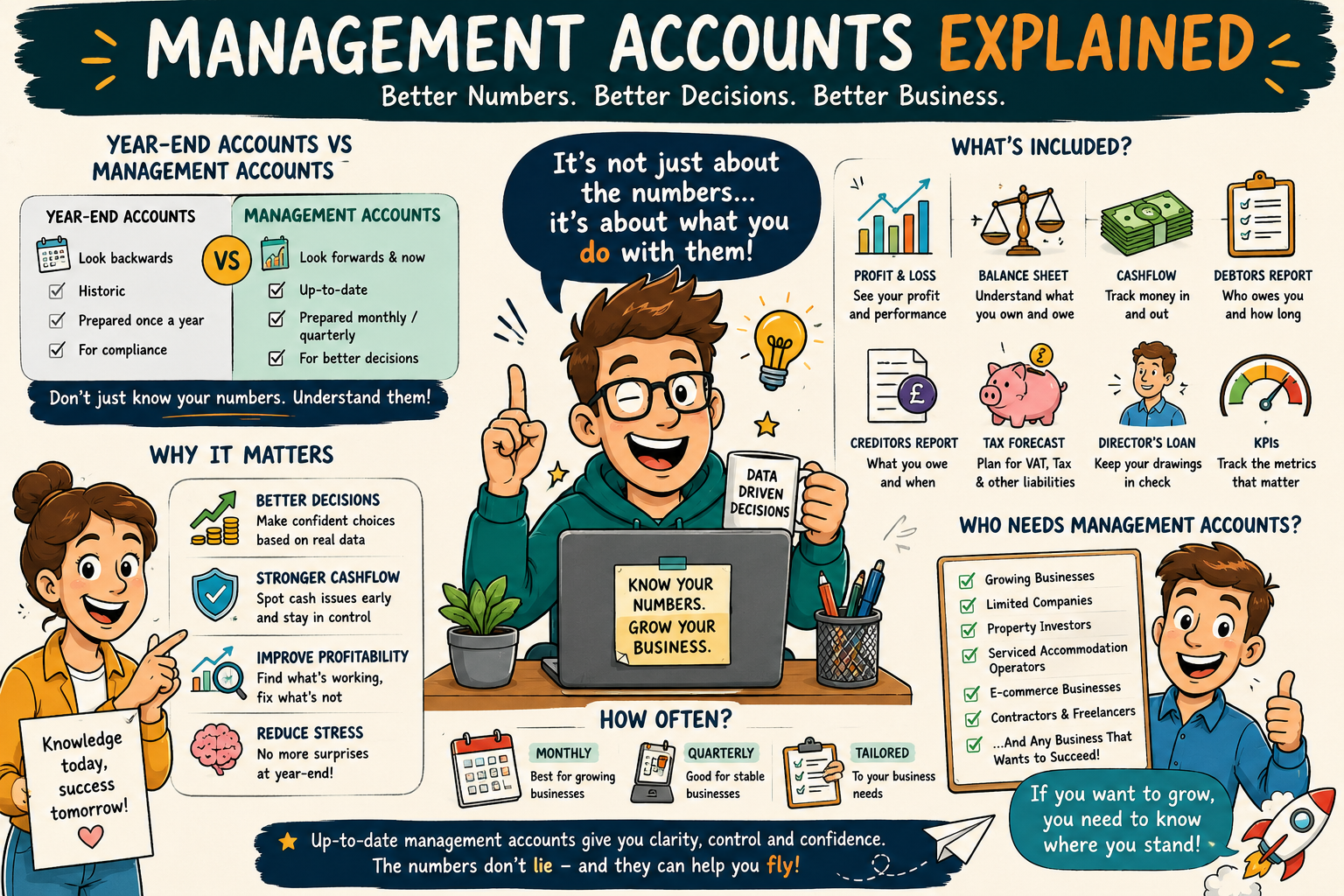
Year-End Accounts vs Management Accounts
Year-end accounts and management accounts serve different purposes.
Year-End Accounts
Year-end accounts are usually prepared after the financial year has ended.
They are mainly used for:
- statutory compliance
- Corporation Tax calculations
- filing requirements
- lender or mortgage evidence
- shareholder reporting
- historical performance review
They are important, but they are often too late to influence decisions during the year.
Management Accounts
Management accounts are usually prepared monthly or quarterly.
They are used for:
- monitoring performance
- managing cashflow
- reviewing profit margins
- forecasting tax liabilities
- making pricing decisions
- planning growth
- identifying problems early
The key difference is timing.
Year-end accounts look backwards.
Management accounts help you act while there is still time to make changes.
What Do Management Accounts Usually Include?
Management accounts can be tailored to the business, but they often include several core reports.
1. Profit and Loss Report
The profit and loss report shows income, costs and profit for a period.
It helps you understand:
- sales income
- direct costs
- gross profit
- overheads
- net profit
- trends over time
Practical Example
A business has increased monthly sales from £30,000 to £45,000.
That sounds positive.
But the management accounts show that direct costs and wages have increased even faster.
Sales are up, but profit margin is down.
Without management accounts, the owner may assume the business is doing better simply because turnover has increased.
2. Balance Sheet
The balance sheet shows what the business owns and owes at a point in time.
It may include:
- bank balances
- debtors
- creditors
- VAT owed or recoverable
- PAYE liabilities
- Corporation Tax provision
- director’s loan account balance
- assets
- loans
- retained profits
The balance sheet is often overlooked by small business owners, but it is extremely important.
It shows whether profits are supported by real financial strength.
Practical Example
A company has made £60,000 profit.
But the balance sheet shows:
- £25,000 owed by customers
- £18,000 VAT and PAYE due
- £12,000 supplier debts
- an overdrawn director’s loan account
The business is profitable, but cashflow may still be weak.
3. Cashflow Summary
Profit and cash are not the same.
A cashflow summary helps show how money moves through the business.
It can highlight:
- customer payment delays
- large upcoming bills
- tax payment pressure
- payroll commitments
- loan repayments
- VAT payments
- seasonal dips
- working capital needs
Practical Example
A business appears profitable in the profit and loss report.
However, customers are taking 60–90 days to pay.
The business is profitable on paper but struggles to pay suppliers on time.
A cashflow review identifies this problem early.
4. Aged Debtors Report
An aged debtors report shows who owes the business money and how long the invoices have been unpaid.
This report is essential for businesses that invoice customers.
It helps identify:
- overdue invoices
- slow-paying customers
- cash collection issues
- bad debt risk
- customer concentration risk
Practical Example
A business has £80,000 unpaid invoices.
Management accounts show that £35,000 is overdue by more than 60 days.
The owner can then take action before cashflow becomes critical.
5. Aged Creditors Report
An aged creditors report shows what the business owes suppliers.
This helps the owner understand:
- upcoming payment pressure
- overdue supplier balances
- cash needed in the next month
- whether the business is falling behind
This is particularly useful where cashflow is tight or supplier terms are important.
6. Tax Liability Forecast
One of the biggest benefits of management accounts is tax visibility.
Management accounts can estimate:
- VAT due
- Corporation Tax
- PAYE and National Insurance
- dividend tax planning
- Self Assessment liabilities
- CIS deductions
- pension contributions
Practical Example
A company has a strong first half of the year.
Management accounts estimate that Corporation Tax could be around £18,000.
The director starts setting aside tax monthly instead of facing a surprise bill after year-end.
This improves cashflow planning and reduces stress.
7. Director’s Loan Account Review
For limited company directors, management accounts can help monitor the director’s loan account.
This is important because director withdrawals may be treated as:
- salary
- dividends
- reimbursed expenses
- loan repayments
- director’s loans
If withdrawals are not reviewed regularly, the director’s loan account can become overdrawn.
This may create tax issues.
Practical Example
A director withdraws money throughout the year.
Management accounts show that profits are lower than expected and dividends may not fully cover the withdrawals.
This allows the accountant and director to address the issue early instead of discovering it after year-end.
8. Key Performance Indicators
Management accounts can include key performance indicators, often called KPIs.
These depend on the business.
Examples include:
For Service Businesses
- revenue per client
- gross profit margin
- staff utilisation
- average project value
- recurring income
- debtor days
For Property Businesses
- profit by property
- occupancy rate
- average nightly rate
- repairs per property
- net cashflow per unit
- mortgage interest impact
For Construction Businesses
- project profitability
- CIS suffered
- subcontractor costs
- material costs
- debtor days
- cashflow by project
KPIs make management accounts more useful because they connect the numbers to real business decisions.
Why Management Accounts Matter
Management accounts help business owners move from guesswork to clarity.
They are particularly useful when the business is:
- growing quickly
- VAT registered
- employing staff
- taking dividends
- managing several properties
- running serviced accommodation
- working with multiple projects
- applying for finance
- struggling with cashflow
- considering expansion
1. They Help You Make Better Decisions
Business owners make decisions every week.
Should you hire?
Should you increase prices?
Should you take on a new unit?
Should you buy equipment?
Should you expand marketing?
Should you pay dividends?
Should you reduce costs?
Without management accounts, these decisions may be based on instinct or bank balance.
Management accounts provide evidence.
2. They Help You Understand Real Profit
Turnover is not profit.
A growing business may have impressive sales but weak margins.
Management accounts show whether growth is actually improving profitability.
Practical Example
A business increases turnover by 40%.
But management accounts show:
- higher staff costs
- increased software costs
- lower gross margin
- higher debtors
- rising VAT liabilities
The business is bigger, but not necessarily stronger.
3. They Help Prevent Cashflow Surprises
Many businesses fail because of cashflow, not because they are unprofitable.
Management accounts can identify cashflow pressure before it becomes urgent.
They can show:
- tax due soon
- customer invoices unpaid
- supplier payments due
- loan repayments
- payroll commitments
- VAT liabilities
- upcoming seasonal dips
This gives the business more time to act.
4. They Help With Tax Planning
Tax planning is much more effective during the year than after the year has ended.
Management accounts help with:
- estimating Corporation Tax
- reviewing VAT exposure
- planning director salary and dividends
- monitoring pension contributions
- reviewing director’s loan accounts
- managing cash reserves
- preparing for Self Assessment liabilities
By the time year-end accounts are prepared, many planning opportunities may already have passed.
5. They Help With Funding and Mortgage Applications
Lenders often want up-to-date financial information.
Management accounts can support:
- business loans
- asset finance
- mortgage applications
- refinancing
- investor conversations
- affordability reviews
A business with clean, regular management accounts usually looks more organised and financially controlled.
6. They Help Identify Problems Earlier
If costs are rising, margins are falling or cashflow is weakening, management accounts reveal this early.
Early warning gives the owner options.
They may be able to:
- increase prices
- reduce costs
- chase overdue invoices
- delay non-essential spending
- adjust dividends
- renegotiate supplier terms
- review staffing
- secure finance before pressure becomes urgent
The earlier the problem is visible, the easier it is to deal with.
7. They Help Property and Serviced Accommodation Operators
Management accounts are especially useful for landlords and serviced accommodation operators.
Property businesses often need to track income and expenses by property.
Serviced accommodation operators also need to understand:
- gross booking income
- platform fees
- cleaning costs
- occupancy levels
- VAT turnover
- repairs
- utilities
- profit by unit
- seasonal performance
Practical Example
A serviced accommodation operator has five units.
Overall income looks strong.
Management accounts show:
- two units are highly profitable
- one unit breaks even
- one unit has high cleaning costs
- one unit is loss-making due to low occupancy and high utility bills
This allows the operator to make better decisions about pricing, operations and future expansion.
How Often Should Management Accounts Be Prepared?
The right frequency depends on the business.
Monthly Management Accounts
Best for:
- growing businesses
- VAT-registered companies
- businesses with staff
- businesses with cashflow pressure
- serviced accommodation operators
- businesses applying for finance
- companies paying regular dividends
Quarterly Management Accounts
May be suitable for:
- stable small businesses
- businesses with fewer transactions
- landlords with simpler portfolios
- businesses needing periodic tax planning
Annual Accounts Only
This may be enough for very small, low-risk businesses.
However, once a business grows or becomes more complex, annual accounts alone are often not enough.
Management Accounts and Bookkeeping
Management accounts are only as reliable as the bookkeeping behind them.
If the bookkeeping is inaccurate, management accounts will also be inaccurate.
Good management accounts need:
- reconciled bank accounts
- accurate sales records
- supplier bills entered correctly
- VAT coded properly
- payroll posted correctly
- loan balances reviewed
- director withdrawals categorised
- receipts and invoices retained
- accruals and prepayments considered where needed
Software alone is not enough.
The bookkeeping must be reviewed properly.
Management Accounts and Forecasting
Management accounts show what has happened recently.
Forecasting shows what may happen next.
Together, they are powerful.
Management accounts can feed into:
- cashflow forecasts
- tax forecasts
- profit forecasts
- budget reviews
- hiring plans
- pricing decisions
- investment decisions
Practical Example
Management accounts show that the business has made £50,000 profit so far this year.
The forecast shows that upcoming VAT, payroll, rent and supplier payments will reduce available cash in the next two months.
The owner can plan before the pressure hits.
What Should a Good Management Accounts Pack Include?
A useful management accounts pack may include:
- profit and loss report
- balance sheet
- cashflow summary
- aged debtors
- aged creditors
- VAT position
- tax provision
- payroll summary
- director’s loan account review
- variance against budget
- forecast update
- commentary and recommendations
The commentary is important.
Numbers alone do not always help business owners. The value comes from explaining what the numbers mean and what action may be needed.
Common Mistakes Businesses Make
1. Only Looking at the Bank Balance
The bank balance does not show future tax, unpaid suppliers or overdue customer invoices.
2. Waiting Until Year-End
By then, many problems have already happened.
3. Confusing Turnover With Profit
High sales do not guarantee strong profit.
4. Ignoring Cashflow
A profitable business can still run out of cash.
5. Not Reviewing Debtors
Late-paying customers can quietly damage cashflow.
6. Paying Dividends Without Checking Profits
This can create director’s loan account issues.
7. Not Tracking Different Income Streams
Businesses with multiple services, projects or properties need detailed reporting.
8. Having Reports Without Commentary
Reports are most useful when someone explains what they mean and what action should be taken.
Practical Scenario: Business Without Management Accounts
A growing limited company has strong sales.
The director checks the bank balance regularly and assumes the business is healthy.
However:
- VAT has not been forecast
- Corporation Tax has not been provided for
- customers are paying late
- payroll costs have increased
- dividends have been taken regularly
- supplier bills are building up
At year-end, the business discovers profits are lower than expected and cashflow is tight.
This is a reactive approach.
Practical Scenario: Business With Management Accounts
Another business prepares monthly management accounts.
Each month, the director reviews:
- profit
- cashflow
- debtor balances
- VAT due
- Corporation Tax estimate
- payroll costs
- director’s loan account
- forecast for the next quarter
When costs rise, the director acts early.
When cashflow tightens, dividends are reviewed.
When profit improves, the director plans tax and investment properly.
This is proactive financial management.
Frequently Asked Questions
What are management accounts?
Management accounts are regular financial reports prepared for business owners to help monitor performance, profit, cashflow, tax liabilities and decision-making.
Are management accounts legally required?
Usually, no. Management accounts are generally not a statutory filing requirement, but they are highly useful for running and growing a business.
How often should management accounts be prepared?
Growing businesses often benefit from monthly management accounts. Stable smaller businesses may use quarterly reports.
What is included in management accounts?
They often include a profit and loss report, balance sheet, cashflow summary, aged debtors, aged creditors, VAT position, tax forecast and commentary.
What is the difference between management accounts and year-end accounts?
Year-end accounts are mainly historic and compliance-focused. Management accounts are regular internal reports used for decision-making during the year.
Do small businesses need management accounts?
Not every small business needs detailed monthly reports, but growing businesses, VAT-registered businesses and companies with staff or cashflow pressure often benefit significantly.
Can management accounts help with tax planning?
Yes. They can help estimate Corporation Tax, VAT, payroll taxes, dividend capacity and director’s loan account issues before year-end.
Can landlords and serviced accommodation operators use management accounts?
Yes. They can be very useful for tracking income, expenses, profit and cashflow by property or unit.
How PR Accountants Can Help
At PR Accountants, we help business owners move beyond basic compliance and understand their numbers properly.
We support clients with:
- management accounts
- bookkeeping reviews
- cashflow summaries
- tax forecasts
- VAT monitoring
- Corporation Tax planning
- director salary and dividend reviews
- director’s loan account monitoring
- property-by-property reporting
- serviced accommodation reporting
- budgeting and forecasting
Our aim is to give business owners clear, practical financial information so they can make better decisions with confidence.
Final Thoughts
Management accounts are not just for large companies.
They are valuable for any business owner who wants to understand what is really happening in the business.
Year-end accounts tell you what happened.
Management accounts help you decide what to do next.
For growing businesses, they can improve cashflow, tax planning, pricing decisions, dividend planning, funding applications and long-term stability.
The strongest businesses usually do not wait until year-end to understand their numbers.
They review them regularly, act early and plan ahead.
Strong Call to Action
Want Clearer Visibility Over Your Business Finances?
If you only look at your accounts once a year, you may be missing important risks and opportunities.
PR Accountants can help you prepare practical management accounts, cashflow summaries and tax forecasts so you can understand your numbers and make better business decisions.
👉 Contact PR Accountants today for proactive accounting and management reporting support tailored to your business. Contact Us