
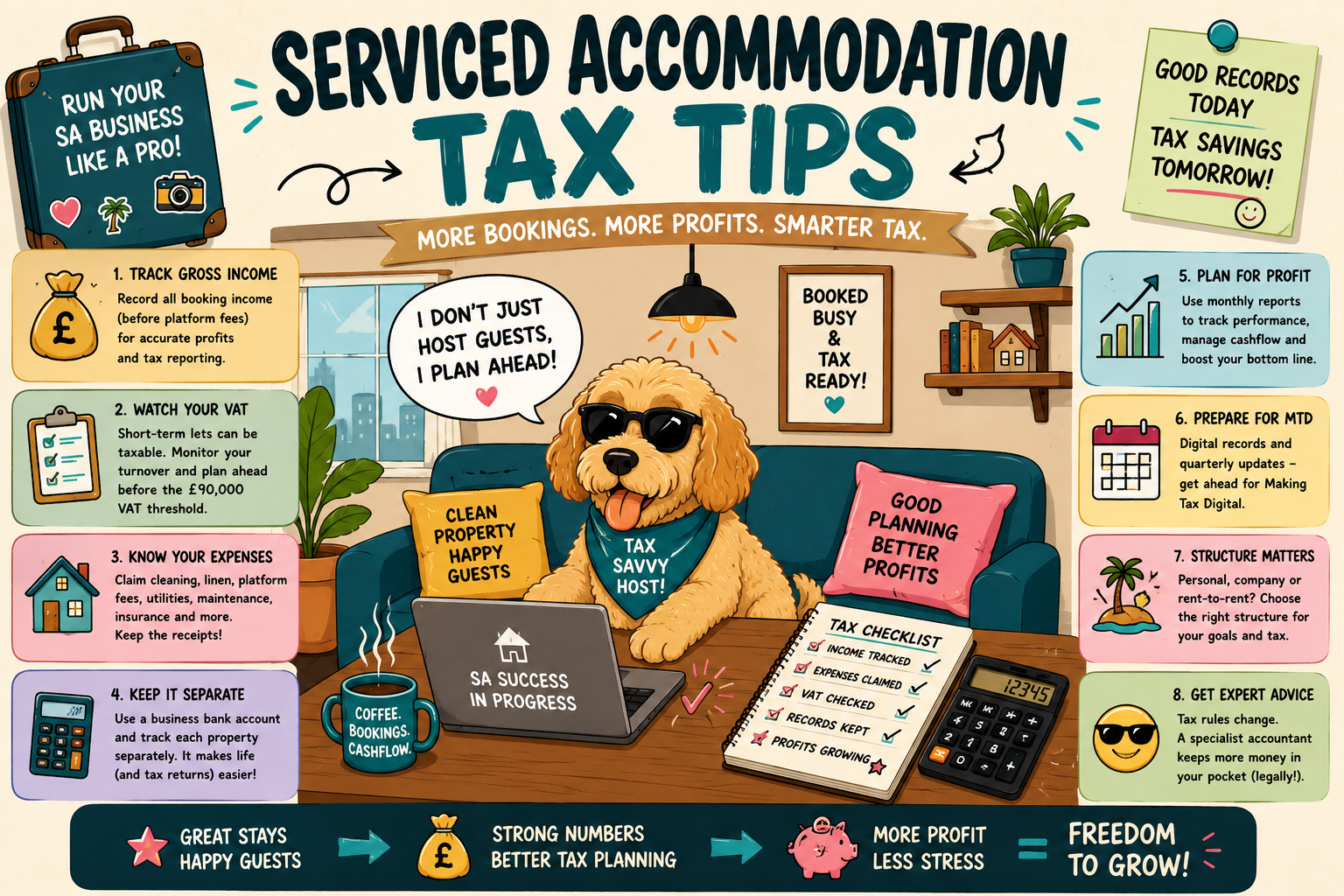
Serviced Accommodation Tax Tips: What UK Operators Need to Know
Serviced accommodation has become a popular property strategy for landlords and investors.
Instead of letting a property on a traditional long-term tenancy, serviced accommodation operators often provide short-term stays through platforms such as Airbnb, Booking.com, Vrbo or direct corporate bookings.
The potential benefits can be attractive:
- higher nightly rates
- flexible pricing
- corporate guests
- short-term stay demand
- stronger gross income potential
- portfolio growth opportunities
However, serviced accommodation also comes with more tax and accounting complexity than many operators expect.
The tax treatment is not always the same as standard buy-to-let. VAT can become relevant. Platform fees need careful bookkeeping. Mortgage interest rules may differ depending on structure. Furnished Holiday Letting rules have changed. Business rates, council tax, Making Tax Digital and ownership structure all need attention.
This guide explains practical tax tips for UK serviced accommodation operators.
1. Track Gross Booking Income, Not Just Payouts
One of the biggest bookkeeping mistakes in serviced accommodation is recording only the amount received into the bank.
Platforms often deduct fees before paying the host.
For example, a booking may show:
- guest payment: £500
- platform fee: £75
- payout to host: £425
If you only record £425 as income, your records may be wrong.
The better approach is usually to record:
- gross booking income
- platform fees separately
- cleaning charges separately, where relevant
- VAT treatment, where applicable
- net payout received
This gives a much clearer picture of real turnover and profitability.
Practical Example
An operator receives £8,000 per month in platform payouts.
After reviewing the platform statements, the actual gross booking income is £9,250 and platform fees are £1,250.
If the operator only records bank receipts, turnover may be understated and VAT threshold monitoring may be inaccurate.
2. Monitor the VAT Registration Threshold Carefully
VAT is one of the biggest tax risks for serviced accommodation operators.
Many landlords assume:
“Property income is exempt from VAT.”
That may be true for standard residential letting, but serviced accommodation and holiday accommodation can be different.
Short-term accommodation is generally treated more like hotel accommodation for VAT purposes, rather than ordinary residential rent.
This means serviced accommodation income may count towards taxable turnover for VAT registration.
The current UK VAT registration threshold is £90,000 taxable turnover.
Operators should monitor turnover on a rolling 12-month basis, not just by tax year or accounting year.
Practical Example
An operator has three serviced accommodation units.
Average gross booking income is £8,500 per month.
Over 12 months, this is £102,000.
The operator may need to register for VAT if the income is taxable turnover and the threshold has been exceeded.
If VAT was not built into pricing, registration can seriously affect profit margins.
3. Understand That VAT Can Affect Pricing and Profit
VAT can reduce profits if pricing is not planned properly.
For example, if a nightly rate is advertised to guests as £120 and VAT registration applies, the operator may need to treat that £120 as VAT-inclusive unless prices are increased.
That could mean the net income is lower than expected.
Practical Scenario
A serviced accommodation business charges £120 per night.
After VAT registration, if the price remains £120 VAT-inclusive, the business may effectively be receiving £100 net income plus £20 VAT.
If the operator has not planned for this, the VAT cost may come directly out of margin.
This is why VAT should be considered before scaling.
4. Review Input VAT Recovery
VAT registration is not always negative.
A VAT-registered serviced accommodation business may be able to recover input VAT on certain business costs, depending on the circumstances.
This could include VAT on:
- furniture
- linen
- cleaning supplies
- repairs
- software
- professional fees
- utilities
- refurbishment costs
- equipment
- management costs
However, VAT recovery depends on proper invoices, correct VAT treatment and whether the cost relates to taxable business activity.
Practical Example
An operator spends £18,000 plus VAT furnishing and setting up a new serviced accommodation unit.
If the business is VAT registered and the costs qualify, input VAT recovery may improve cashflow.
But if the operator is not registered or the invoices are not valid VAT invoices, the position may be different.
5. Do Not Assume the Flat Rate VAT Scheme Is Best
Some serviced accommodation operators consider the Flat Rate VAT Scheme because it appears simpler.
However, it is not automatically better.
The Flat Rate Scheme may reduce admin, but it may also limit input VAT recovery.
For operators with significant setup, refurbishment, furniture, repairs or cleaning costs, the normal VAT scheme may produce a better result.
Planning Point
Before joining the Flat Rate Scheme, compare:
- expected gross turnover
- VAT on costs
- setup costs
- refurbishment costs
- whether the business is a limited cost trader
- pricing model
- future expansion plans
Do not choose a VAT scheme based only on simplicity.
6. Separate Each Property in the Bookkeeping
Serviced accommodation operators should track performance property by property.
This is important because one unit may perform very differently from another.
For each property, track:
- gross booking income
- cleaning costs
- platform fees
- utilities
- repairs
- rent or mortgage costs
- council tax or business rates
- insurance
- linen and laundry
- supplies
- management fees
- occupancy levels
- seasonal performance
Practical Example
An operator has four serviced apartments.
Overall income looks strong.
But property-by-property reporting shows:
- Unit 1 is highly profitable
- Unit 2 has high cleaning costs
- Unit 3 has low occupancy
- Unit 4 has strong revenue but very high utility bills
Without separate tracking, poor-performing units can stay hidden.
7. Understand the Difference Between Rent-to-Rent and Owned Property
Tax treatment depends partly on the business model.
Serviced accommodation can be operated through:
- personally owned property
- limited company owned property
- rent-to-rent arrangements
- management agreements
- lease agreements
- joint venture arrangements
Each model has different tax, VAT, legal and accounting consequences.
Rent-to-Rent Example
An operator rents a property from a landlord and then uses it for serviced accommodation.
The operator may have:
- rent paid to the landlord
- guest income
- cleaning costs
- platform fees
- furniture costs
- VAT considerations
- contract risks
- licensing or planning considerations
The operator does not own the property, so tax treatment differs from an owner-landlord model.
8. Keep Personal and Business Spending Separate
Serviced accommodation businesses often involve many transactions.
These may include:
- cleaning supplies
- maintenance
- linen
- toiletries
- repairs
- guest refunds
- furniture
- subscriptions
- platform fees
- travel
- parking
- contractor payments
If the operator mixes personal spending with business transactions, bookkeeping becomes messy quickly.
This can lead to:
- missed expenses
- disallowed costs
- VAT errors
- director’s loan account issues
- unreliable profit figures
Use a dedicated bank account for each business or entity where possible.
9. Claim Allowable Expenses Properly
Serviced accommodation operators may be able to claim a wide range of business expenses.
Common costs may include:
- cleaning fees
- laundry
- linen
- toiletries
- utilities
- broadband
- insurance
- repairs and maintenance
- software
- photography
- platform fees
- accounting fees
- furniture replacement
- guest supplies
- key safes and access systems
- maintenance contractor costs
- marketing and website costs
- card processing fees
- management fees
The cost must be genuinely connected to the business and properly evidenced.
Common Mistake
Operators sometimes claim all property-related costs without considering whether they are capital, revenue, personal or mixed-use.
For example, replacing broken furniture may be treated differently from furnishing a property for the first time.
10. Repairs vs Improvements Still Matter
A repair usually restores something to its previous condition.
An improvement usually enhances the property or adds something new.
This distinction matters because repairs may be deductible against income, while improvements may be capital in nature.
Practical Example
Replacing a broken like-for-like sofa may be treated differently from a full high-end redesign of the apartment.
Similarly, repainting walls between guests is different from a major renovation or extension.
Keep invoices and descriptions clear so the treatment can be reviewed properly.
11. The Furnished Holiday Letting Regime Has Changed
Historically, some serviced accommodation and holiday letting businesses benefited from the Furnished Holiday Lettings regime.
However, the FHL tax regime has been abolished from April 2025.
This matters because the old FHL rules offered certain tax advantages compared with standard property income treatment.
Operators should no longer rely on outdated assumptions around:
- finance cost treatment
- capital allowances
- pension-relevant earnings
- CGT reliefs
- loss treatment
If your previous tax planning relied on FHL treatment, it should be reviewed.
12. Review Business Rates and Council Tax
Serviced accommodation may fall within council tax or business rates depending on the circumstances and local rules.
This can affect:
- property running costs
- eligibility for reliefs
- pricing
- profitability
- local authority compliance
Operators should not assume the property will automatically remain under council tax.
This is especially important for short-term lets, holiday accommodation and properties advertised commercially.
Practical Point
If a property moves from council tax to business rates, the operator should check whether small business rate relief or equivalent local relief may apply.
The rules can differ depending on location, especially between England, Wales and Scotland.
13. Watch Local Licensing, Planning and Compliance Rules
Although this is not purely a tax issue, it affects tax planning because it affects whether the business model is viable.
Serviced accommodation operators may need to consider:
- lease restrictions
- mortgage lender permission
- insurance terms
- planning rules
- local authority licensing
- fire safety requirements
- health and safety duties
- waste and noise rules
- building management rules
Tax planning should never be separated from commercial and legal compliance.
A tax-efficient structure is not useful if the underlying operation is not permitted.
14. Decide Whether Personal or Limited Company Ownership Is Better
Some serviced accommodation operators use limited companies.
Others operate personally.
The right structure depends on:
- ownership of the property
- profit levels
- whether profits are withdrawn personally
- VAT position
- finance costs
- risk exposure
- long-term growth plans
- mortgage availability
- investor involvement
- exit strategy
Limited Company Potential Advantages
A company may provide:
- separate legal identity
- profit retention for reinvestment
- structured bookkeeping
- easier separation of business finances
- possible planning flexibility
Limited Company Potential Disadvantages
A company may also bring:
- Corporation Tax
- dividend tax on extraction
- Companies House filings
- additional accounting costs
- potential mortgage restrictions
- administrative complexity
The answer depends on the numbers and the long-term plan.
15. Do Not Ignore Director’s Loan Accounts
If the serviced accommodation business operates through a limited company, director withdrawals must be handled carefully.
Money taken from the company is not automatically personal income.
It may be:
- salary
- dividends
- reimbursed expenses
- repayment of a director’s loan
- a new director’s loan
- something else requiring adjustment
If directors withdraw money randomly without proper payroll, dividends or expense treatment, the director’s loan account can become overdrawn.
This may create tax issues.
16. Prepare for Making Tax Digital
Making Tax Digital for Income Tax will affect many landlords and property businesses operating personally.
Affected individuals will need to keep digital records and submit quarterly updates to HMRC using compatible software.
This means serviced accommodation operators should move away from year-end-only bookkeeping.
Even where MTD does not yet apply, monthly bookkeeping is strongly recommended because serviced accommodation has high transaction volume and VAT risk.
Practical Example
An operator earns £55,000 gross income from serviced accommodation personally.
They currently use spreadsheets and update records once a year.
Under MTD, this may not be sufficient unless the records are digitally linked and compliant.
Moving to proper software early reduces stress later.
17. Use Management Accounts, Not Just Year-End Accounts
Serviced accommodation is operationally more like a hospitality business than a passive rental.
This means annual accounts alone are not enough.
Operators should review:
- monthly income
- occupancy
- average nightly rate
- cleaning costs
- platform fees
- utilities
- repairs
- VAT exposure
- profit per unit
- cashflow
- seasonal trends
Practical Example
An operator thinks the business is profitable because summer bookings are strong.
Monthly management accounts show that winter occupancy, high cleaning costs and VAT exposure reduce annual profit significantly.
Without regular reporting, decisions may be based on misleading headline income.
18. Forecast Cashflow Before Expanding
Expansion can be risky if cashflow is not planned.
New units often require upfront spending on:
- furniture
- deposits
- rent in advance
- professional photography
- linen
- smart locks
- utilities
- cleaning setup
- maintenance
- software
- compliance
- marketing
At the same time, bookings may take time to build.
Practical Scenario
An operator adds three new units quickly.
Bookings increase, but so do upfront costs, rent, utilities and VAT exposure.
Without cashflow forecasting, the business becomes profitable on paper but cash-poor in practice.
Growth should be planned, not guessed.
19. Keep Platform Statements and Guest Records
Serviced accommodation operators should retain detailed records from booking platforms.
These may include:
- booking reports
- guest payments
- cleaning fees charged
- platform service fees
- refunds
- cancellations
- host payouts
- VAT invoices from platforms
- occupancy reports
Do not rely only on bank deposits.
The bank receipt may not show the full booking value or deductions.
20. Get Tax Advice Before Scaling
Serviced accommodation can become complex quickly.
Tax advice is especially important before:
- crossing the VAT threshold
- moving from one unit to multiple units
- switching from buy-to-let to short-term lets
- using rent-to-rent agreements
- operating through a company
- registering or deregistering for VAT
- making large refurbishment purchases
- taking on investors
- transferring property ownership
- entering management agreements
- applying for business rates treatment
The best time to plan is before the change happens.
Afterwards, the options may be limited.
Common Serviced Accommodation Tax Mistakes
1. Recording Only Net Platform Payouts
This can understate turnover and distort profit.
2. Ignoring VAT Until It Is Too Late
VAT can affect pricing, margins and cashflow.
3. Mixing Personal and Business Spending
This creates messy bookkeeping and tax risk.
4. Not Tracking Each Property Separately
Overall profit can hide weak-performing units.
5. Assuming Old FHL Rules Still Apply
The FHL regime has been abolished, so old planning may no longer work.
6. Treating All Property Costs the Same
Repairs, replacements, capital improvements and setup costs need different treatment.
7. Not Keeping Platform Reports
Bank receipts alone are not enough for accurate records.
8. Scaling Without Forecasting
More units can mean more profit, but also more VAT, cashflow pressure and admin.
Practical Scenario: Serviced Accommodation Done Well
An operator runs three serviced apartments.
They:
- track gross income from booking platforms
- separate platform fees
- monitor VAT turnover monthly
- keep each property separate in the bookkeeping
- reconcile bank receipts to booking reports
- keep receipts and invoices
- review repairs and capital costs properly
- forecast VAT and tax liabilities
- prepare monthly management accounts
- review whether the structure is still suitable
This operator has better control over tax, cashflow and profitability.
Practical Scenario: Serviced Accommodation Done Poorly
Another operator has four units but:
- records only bank payouts
- ignores platform statements
- does not monitor VAT turnover
- mixes personal and business costs
- has no property-by-property reporting
- relies on old FHL assumptions
- only prepares records once a year
- expands without cashflow forecasting
At year-end, they discover:
- profits are lower than expected
- VAT exposure may have been missed
- expenses are difficult to support
- one unit is loss-making
- tax liabilities were not planned
This is avoidable with proper systems.
Frequently Asked Questions
Is serviced accommodation taxed the same as normal rental income?
Not always. Standard residential letting and serviced accommodation can have different VAT, bookkeeping and operational tax issues.
Does Airbnb income count towards VAT registration?
Serviced accommodation income may count as taxable turnover for VAT purposes, so operators should monitor gross income carefully.
Should I record Airbnb payouts or gross bookings?
You should usually track gross booking income, platform fees and net payouts separately. Recording only bank payouts can understate turnover.
Can I claim cleaning and laundry costs?
Yes, where they are genuine business costs and properly evidenced.
Can I claim furniture costs?
The treatment depends on whether the cost is initial setup, replacement, repair or capital expenditure. This should be reviewed carefully.
Do the old Furnished Holiday Letting rules still apply?
The FHL tax regime has been abolished from April 2025, so operators should not rely on old FHL assumptions.
Should serviced accommodation be run through a limited company?
Sometimes, but not always. The right structure depends on profit levels, VAT, finance costs, ownership, growth plans and how profits are extracted.
Do serviced accommodation operators need Making Tax Digital?
Individuals with qualifying property and/or self-employment income above the relevant thresholds will need to comply with MTD for Income Tax.
How PR Accountants Can Help
At PR Accountants, we help serviced accommodation operators understand their numbers and stay compliant.
We support clients with:
- serviced accommodation bookkeeping
- VAT registration reviews
- VAT returns
- platform income reconciliation
- property-by-property reporting
- limited company accounts
- Corporation Tax
- Self Assessment
- Making Tax Digital preparation
- management accounts
- cashflow forecasting
- business structure reviews
- landlord and property tax planning
Our aim is to help operators avoid tax surprises, improve profitability and make better decisions.
Final Thoughts
Serviced accommodation can be profitable, but it needs better financial control than many operators expect.
The key tax tips are:
- track gross income properly
- monitor VAT turnover monthly
- understand platform fees
- separate each property
- keep accurate records
- review expenses carefully
- do not rely on old FHL rules
- forecast cashflow before scaling
- use management accounts
- get advice before major changes
Good tax planning is not about shortcuts. It is about clarity, compliance and better decision-making.
Strong Call to Action
Need Help With Serviced Accommodation Tax and Bookkeeping?
Serviced accommodation tax can become complicated quickly, especially where VAT, platform fees, property-by-property reporting and growth planning are involved.
PR Accountants provides practical, proactive accounting support for serviced accommodation operators, landlords and property investors across the UK.
👉 Contact PR Accountants today for clear, reliable serviced accommodation tax advice tailored to your business. Contact Us.