
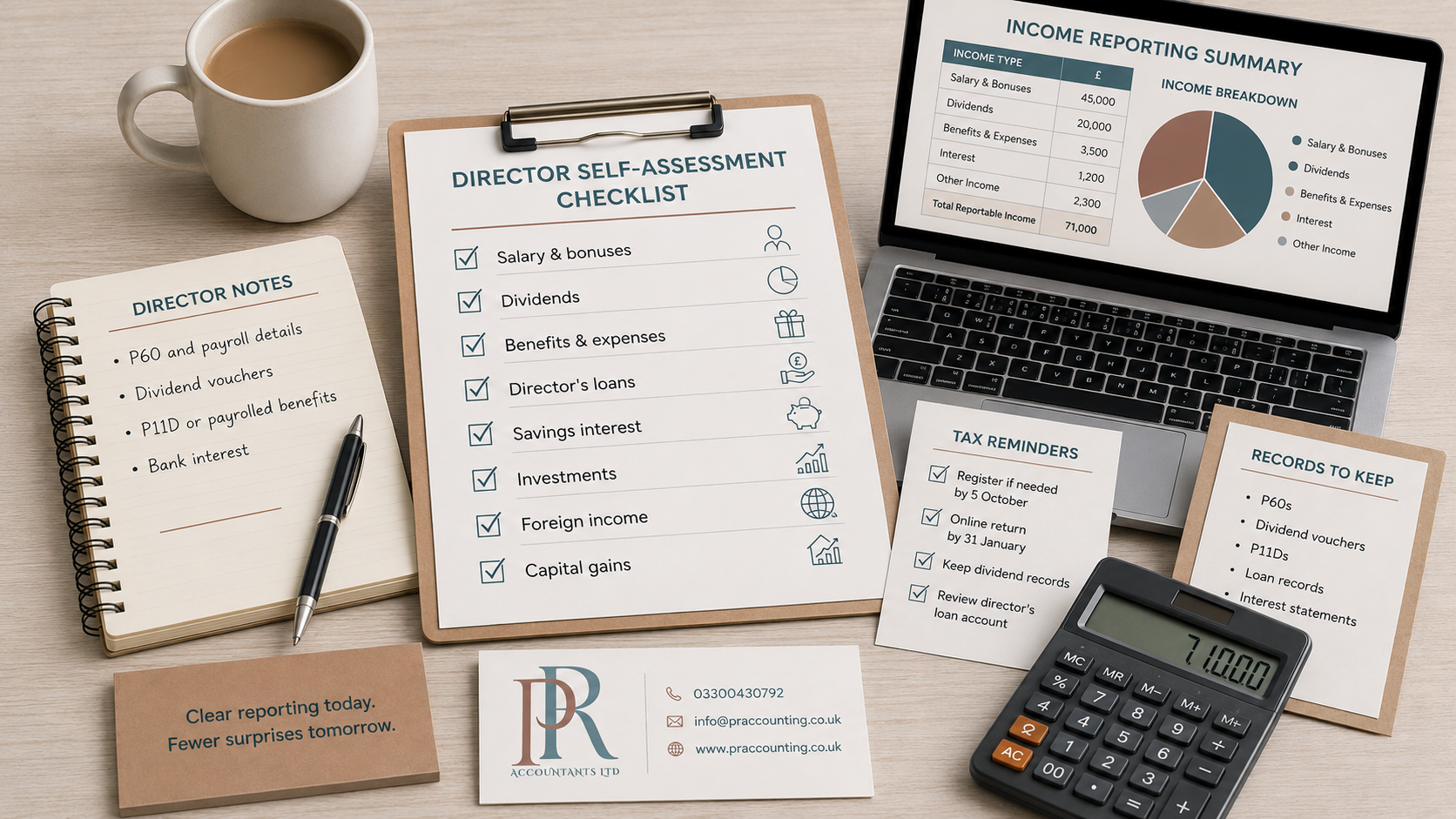
Self Assessment for Company Directors: What Income Needs Reporting?
Company directors often receive money from their company in several different ways. You may take a salary through payroll, receive dividends as a shareholder, use company benefits, make withdrawals through your director’s loan account or have income from other sources outside the company.
This can make Self Assessment more complicated than it first appears.
A common mistake is assuming that only dividends matter. Another is assuming that because tax has been deducted through payroll, nothing needs to be included on a tax return.
The correct position depends on your personal circumstances, the income you receive and whether HMRC has issued you with a notice to complete a Self Assessment tax return.
This guide explains the main types of income company directors may need to report and the records you should keep.
Do all company directors need to complete a Self Assessment tax return?
No. Being a company director does not automatically mean you must complete a Self Assessment tax return every year.
However, you may need to complete one where you:
- Receive dividends
- Have untaxed income in addition to your director’s salary
- Receive rental income
- Have significant savings or investment income
- Receive foreign income
- Make taxable capital gains
- Have a taxable director’s loan benefit
- Need to pay the High Income Child Benefit Charge
- Are required to file by HMRC
If HMRC sends you a notice to file a tax return, you must submit it unless HMRC formally confirms that you no longer need to do so.
A director receiving only a salary through PAYE, with no dividends or other taxable income, may not always need a tax return. However, this should be reviewed each year rather than assumed.
Your director’s salary and bonuses
If you take a salary, director’s fees or bonus through payroll, the income is usually taxed through PAYE.
Your P60 will normally show:
- Gross salary or director’s remuneration
- Income Tax deducted
- National Insurance contributions
- Student loan deductions where applicable
Where you are required to complete a Self Assessment tax return, your salary and PAYE tax details should still be included.
This is important because HMRC uses your full income position to calculate whether additional tax is due.
For example, your salary may already have been taxed correctly through payroll, but dividends, rental income or investment income could push part of your overall income into a higher tax band.
If you have more than one directorship or employment, each source of employment income should be included separately.
Dividends from your own company
Dividends are one of the most common reasons company directors need to complete a Self Assessment tax return.
Dividends are not salary. They are distributions of company profit to shareholders.
If you receive dividends from your company, you should keep clear records of:
- Dividend dates
- Dividend amounts
- Dividend vouchers
- Dividend meeting minutes or written resolutions
- Your shareholding percentage
- Available company profits at the time the dividend was declared
Dividends should not be treated as a business expense in your company accounts.
They must also be paid from available distributable profits. Taking money from the company and simply describing it as a dividend does not make it a valid dividend.
If you already complete a Self Assessment tax return, all dividend income should be included, including dividends from your own company and dividends received from other shareholdings.
The dividend allowance can reduce the tax payable on part of your dividend income, but it does not mean dividend income can always be ignored.
For the 2026/27 tax year, the dividend allowance is £500. Dividends above this may create a personal tax liability depending on your total income.
Where dividend income exceeds £10,000 in a tax year, a Self Assessment tax return is normally required.
Benefits provided by your company
Company directors can receive benefits from their company in addition to salary and dividends.
These benefits may be taxable personally, even where no money has been paid directly into your bank account.
Examples can include:
- Company cars
- Fuel for private journeys
- Private medical insurance
- Interest-free or low-interest loans
- Personal use of company assets
- Certain subscriptions or memberships
- Accommodation
- Non-business expenses paid by the company
Some benefits are taxed through payroll. Others may be reported on a P11D.
Where benefits have been payrolled, the tax may already be included in your salary deductions. Where they have not been payrolled, you may receive a P11D showing the taxable value.
It is important not to duplicate income that has already been treated through payroll. Equally, do not ignore benefits simply because you have not received cash.
A company paying for a personal cost does not automatically make that cost tax deductible for the company or tax-free for the director.
Genuine business expenses and reimbursements
Not every payment made by your company for your benefit is taxable.
Your company can reimburse genuine business expenses, provided the expense is incurred wholly and exclusively for the company’s trade and the relevant records are kept.
Examples may include:
- Business mileage
- Travel to client meetings
- Hotel costs for qualifying business trips
- Business software
- Office equipment
- Professional subscriptions relevant to your role
- Training related to your existing duties
- Business use of a personal mobile phone
The distinction between a legitimate business reimbursement and a personal expense paid by the company is important.
For example, reimbursing a director for business mileage may be appropriate. Paying for private holidays, personal shopping or ordinary everyday clothing is unlikely to be treated in the same way.
Where personal expenses are paid through the company, they may need to be treated as a taxable benefit, salary, dividend or director’s loan.
Director’s loans and withdrawals from the company
A director’s loan account records money moving between you and your company that is not salary, dividends or legitimate business expenses.
This can include:
- Cash withdrawn from the company
- Personal bills paid by the company
- Funds transferred to you without being recorded as salary or dividends
- Amounts you personally paid on behalf of the company
- Expenses you paid personally and later claimed back
A director’s loan is not automatically taxable income. However, it must be reviewed carefully.
You may need to report relevant amounts on your Self Assessment tax return where:
- A loan is written off or released by the company
- You owe the company more than £10,000 at any point in the tax year
- You pay interest below HMRC’s official rate
- A taxable benefit arises from an interest-free or low-interest loan
A loan written off by the company can create an Income Tax liability for the director.
A debit director’s loan account can also create company tax consequences if it remains outstanding after the relevant Corporation Tax deadline.
This is why directors should not treat the company bank account as an extension of their personal bank account.
Property income
Rental income must usually be considered separately from your company income.
This includes income from:
- Residential rental properties
- Commercial properties
- Furnished holiday lettings where relevant
- Overseas property
- Rent received from lodgers in some circumstances
- Income from jointly owned property
If you receive rental income personally, you may need to report the income and allowable expenses through Self Assessment.
You should keep records of:
- Rental income received
- Letting agent statements
- Mortgage interest information
- Repairs and maintenance costs
- Insurance
- Service charges
- Legal and professional fees
- Capital improvements
- Property ownership percentages
Income earned by your limited company should not be confused with personally owned property income.
The company is a separate legal entity. Its rental income is normally reported through the company accounts and Corporation Tax return, while personally owned property income is reported on your personal tax return.
Savings, investments and other dividend income
Company directors may also need to report personal investment income.
This can include:
- Bank and building society interest
- Interest from business loans made personally
- Dividends from shares in other companies
- Investment fund distributions
- Bond income
- Peer-to-peer lending interest
- Trust income
- Income from employment-related shares or share schemes
The tax position can depend on the amount received, your total income and whether tax has already been deducted.
Even where no additional tax is due, the income may still need to be included if you are already submitting a Self Assessment tax return.
Foreign income and overseas assets
If you are UK resident and receive foreign income, you may need to report it through Self Assessment.
This may include:
- Overseas employment income
- Foreign rental income
- Foreign dividends
- Overseas bank interest
- Income from foreign investments
- Capital gains on overseas assets
Foreign tax paid may sometimes be available for relief against UK tax, but the income usually still needs to be declared.
This is an area where specialist advice is important, particularly where you have lived or worked abroad, own overseas property or receive income in another currency.
Capital gains
A Self Assessment tax return may also be needed if you make taxable gains.
This can include gains on:
- Shares
- Investment portfolios
- Cryptocurrency disposals
- Second properties
- Land
- Business assets
- Overseas assets
Not every sale creates tax, but disposals should be reviewed.
You may need to calculate the gain, deduct eligible costs and consider whether Capital Gains Tax is payable.
Property disposals can have separate reporting deadlines, so it is important not to wait until the normal Self Assessment deadline before taking advice.
What company directors do not report as personal income
It is equally important to understand what does not belong on your personal Self Assessment tax return.
You do not normally report:
- Your company’s total sales income
- Your company’s business expenses
- Corporation Tax paid by the company
- Company profit before dividends
- Money you lend to the company
- Genuine business expenses properly reimbursed by the company
- Payroll costs relating to other employees
Your personal tax return is for your personal income, gains, reliefs and tax position.
Your company accounts and Corporation Tax return deal with the company’s financial position.
Keeping these separate is essential.
Common mistakes company directors make
Company directors often make errors because money can move between the business and personal accounts in several different ways.
Common mistakes include:
- Forgetting to report director’s salary because PAYE has already been deducted
- Reporting only dividends from their own company and missing other investment income
- Treating all cash withdrawals as dividends
- Taking dividends without sufficient available profits
- Ignoring an overdrawn director’s loan account
- Omitting company benefits such as private medical insurance or a company car
- Including company turnover on the personal tax return
- Using the company year-end figures rather than the correct personal tax year information
- Failing to keep dividend paperwork
- Leaving Self Assessment until January without budgeting for tax due
Good bookkeeping throughout the year makes the tax return significantly easier and reduces the risk of errors.
Records to keep for your Self Assessment tax return
Before preparing your return, gather the information needed for the full tax year from 6 April to 5 April.
This may include:
- P60s and payroll reports
- Dividend vouchers and dividend meeting minutes
- Your company accounts
- Director’s loan account records
- P11D information or payroll benefit reports
- Bank interest certificates
- Investment statements
- Rental income and expense records
- Overseas income details
- Capital gains calculations
- Pension contribution confirmations
- Gift Aid donation records
- Details of student loan repayments
- Details of Child Benefit received where relevant
Keeping clear records makes it easier to identify the right tax treatment and reduces the chance of missing income.
Self Assessment deadlines for company directors
For the tax year ending 5 April 2026, the key deadlines are: Action Deadline, Tell HMRC you need to complete a return, where required 5 October 2026,Submit a paper tax return 31 October 2026, Submit an online tax return 31 January 2027, Pay the balancing tax due, 31 January 2027, Second payment on account, where applicable31 July 2027.
Your tax bill may include payments on account for the following tax year.
This can create a larger than expected payment in the first year that you have significant dividends, rental income or other untaxed income.
Planning early helps avoid cashflow pressure in January.
Contact us
Self Assessment for company directors is not just about entering a salary and dividend figure.
You need to consider the full picture, including company benefits, director’s loans, property income, investments, foreign income and any capital gains.
At PR Accountants Ltd, we help company directors prepare accurate Self Assessment tax returns, review director’s loan accounts, plan dividend withdrawals and understand their personal tax position.
Contact us today for clear advice on what needs to be reported and how to prepare for your tax bill.