
What Happens If You Miss a Tax Deadline in the UK?
Tax deadlines are easy to miss when business owners are busy dealing with customers, staff, suppliers, cashflow and day-to-day operations.
However, missed deadlines can quickly create problems.
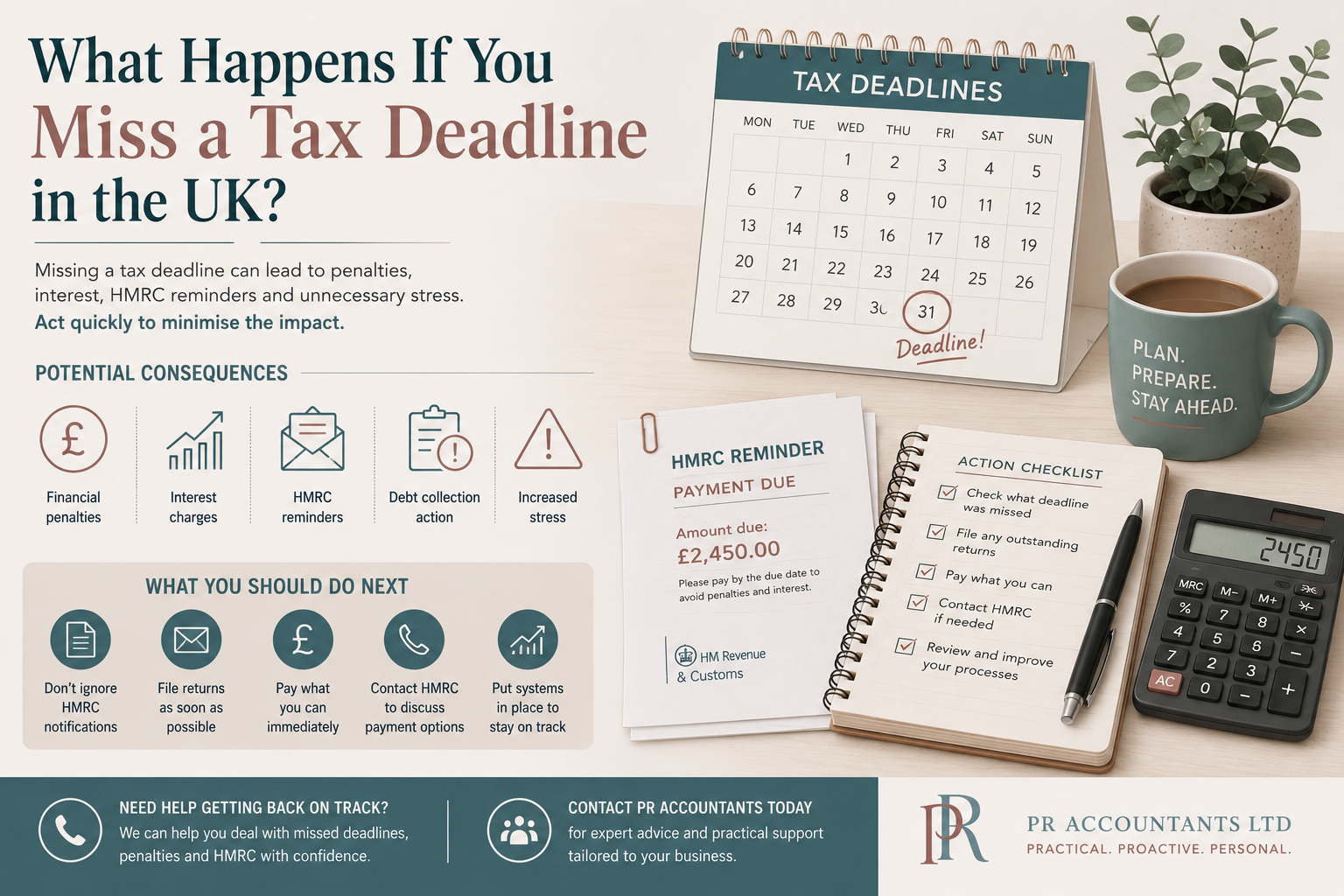
Depending on the tax involved, missing a deadline may lead to:
- late filing penalties
- late payment penalties
- interest
- HMRC reminders
- payment pressure
- debt collection action
- increased scrutiny
- cashflow stress
- difficulty agreeing payment plans
- unnecessary accountancy work
The impact depends on the type of tax, how late the return or payment is, whether HMRC has been contacted, and whether the taxpayer has a reasonable excuse.
The key message is simple:
If you miss a tax deadline, act quickly. Do not ignore it.
Filing Late vs Paying Late
There are two different problems that are often confused.
Filing Late
This means the tax return, report or submission was not sent to HMRC by the required deadline.
Examples include:
- Self Assessment tax return submitted late
- Corporation Tax return filed late
- VAT return submitted late
- payroll FPS submitted late
- CIS monthly return submitted late
Paying Late
This means the tax itself was not paid by the due date.
Examples include:
- Self Assessment tax unpaid by 31 January
- Corporation Tax unpaid after the due date
- VAT not paid on time
- PAYE and National Insurance paid late
- CIS deductions paid late
You can have one problem without the other.
For example, a business may file its VAT return on time but pay the VAT late.
Or a company may pay an estimated Corporation Tax amount but file the CT600 late.
Both filing and payment deadlines matter.
Why Missing a Deadline Matters
Missing one deadline may not feel serious at first.
However, repeated late filing or late payment can create a pattern of non-compliance.
This can affect:
- penalty amounts
- HMRC’s view of the business
- ability to agree Time to Pay arrangements
- stress and admin time
- cashflow
- lender confidence
- business planning
In many cases, the earlier the issue is dealt with, the lower the overall cost and disruption.
What Happens If You Miss a Self Assessment Deadline?
Self Assessment applies to many individuals, including:
- sole traders
- landlords
- company directors with reportable income
- partners in partnerships
- people with untaxed income
- individuals with capital gains
- higher earners with certain tax charges
The main online Self Assessment filing and payment deadline is usually 31 January following the end of the tax year.
There is also normally a 31 July deadline for the second payment on account, where payments on account apply.
If You File Your Self Assessment Tax Return Late
HMRC can charge an automatic late filing penalty.
The penalties can increase the longer the return remains outstanding.
This can include:
- an initial fixed penalty
- daily penalties after a certain period
- further penalties after 6 months
- further penalties after 12 months
This can become expensive even where no tax is due.
If You Pay Self Assessment Tax Late
If the tax is not paid on time, HMRC may charge late payment penalties and interest.
This can apply separately from late filing penalties.
Practical Example
A sole trader misses the 31 January deadline because their bookkeeping is incomplete.
They submit the return two months late and pay the tax late.
They may face:
- a late filing penalty
- late payment interest
- possible late payment penalties
- extra stress due to rushed records
- difficulty planning future payments on account
This is why bookkeeping should not be left until January.
What Happens If You Miss a VAT Deadline?
VAT deadlines are important because VAT is often money collected from customers on behalf of HMRC.
A VAT-registered business must usually:
- keep digital VAT records
- submit VAT returns by the deadline
- pay VAT due by the deadline
- use the correct VAT codes
- retain supporting evidence
Late VAT Submission
VAT late submission penalties work on a points-based system.
A business receives penalty points for late VAT returns.
Once the penalty point threshold is reached, HMRC can charge a financial penalty. Further late returns can lead to further penalties while the business remains at the threshold.
This means one late VAT return may not always create an immediate financial penalty, but repeated late submissions can become costly.
Late VAT Payment
Late VAT payment can also lead to penalties and interest.
The longer VAT remains unpaid, the more expensive the position can become.
Practical Example
A business submits VAT returns late several quarters in a row.
At first, the owner may think nothing serious has happened.
However, penalty points can build up, and once the threshold is reached, financial penalties may apply.
The business may also suffer late payment interest if VAT is not paid on time.
What Happens If Your Company Misses the Corporation Tax Deadline?
Limited companies need to deal with Corporation Tax carefully.
There are two separate deadlines to understand:
- the deadline to pay Corporation Tax
- the deadline to file the Company Tax Return
For many smaller companies, Corporation Tax is payable before the CT600 Corporation Tax return is due.
This can catch directors out.
Late Corporation Tax Payment
If Corporation Tax is paid late, HMRC may charge interest.
The company should pay as soon as possible or contact HMRC if it cannot pay in full.
Late Company Tax Return
If the CT600 is filed late, HMRC can charge late filing penalties.
The penalties increase the longer the return is outstanding.
If the return is significantly late, HMRC may estimate the Corporation Tax bill. The company still needs to file the return so HMRC can recalculate the correct tax, interest and penalties.
Practical Example
A company’s accounts are delayed because the bookkeeping was not completed on time.
The Corporation Tax payment deadline passes.
The CT600 is then filed late.
The company may suffer:
- late payment interest
- late filing penalties
- additional admin
- avoidable pressure on cashflow
- possible HMRC correspondence
Good company bookkeeping throughout the year reduces this risk.
What Happens If You Miss a PAYE Deadline?
Employers have regular payroll responsibilities.
PAYE deadlines can involve both:
- reporting payroll information to HMRC
- paying PAYE and National Insurance
Late Payroll Reporting
Employers usually need to send payroll information to HMRC on or before paying employees.
This is done through Real Time Information submissions, including the Full Payment Submission.
If payroll reports are late or missing, HMRC can charge penalties depending on the size of the payroll.
Late PAYE and National Insurance Payment
Employers also need to pay PAYE and National Insurance to HMRC by the correct deadline.
Late payment can lead to penalties and interest.
Payroll taxes should be treated as a priority because they often include deductions made from employees’ pay.
Practical Example
A company pays employees but does not submit payroll reports on time.
It also delays paying PAYE to HMRC because cashflow is tight.
This can lead to:
- payroll filing penalties
- late payment charges
- interest
- HMRC reminders
- cashflow pressure
- problems if the company repeatedly falls behind
Payroll should be managed regularly, not left until year-end.
What Happens If You Miss a CIS Deadline?
Construction businesses operating under the Construction Industry Scheme have monthly responsibilities.
Contractors usually need to:
- verify subcontractors
- deduct CIS where required
- submit monthly CIS returns
- pay deductions to HMRC
- issue deduction statements
- keep proper records
Missing CIS deadlines can lead to penalties and cashflow issues.
This is especially important because CIS deductions are not normal business income. They are amounts deducted from subcontractors and payable to HMRC.
Practical Example
A construction company deducts CIS from subcontractors but does not submit monthly returns on time.
The company may face penalties, HMRC reminders and problems reconciling subcontractor records later.
Subcontractors may also need deduction statements for their own tax claims.
What Happens If You Miss a Deadline Because You Cannot Pay?
Some business owners delay filing because they cannot afford the tax.
This is usually a mistake.
In most cases, it is better to file the return on time and then deal with the payment issue separately.
Late filing can create extra penalties on top of late payment interest and penalties.
Practical Example
A company cannot afford its VAT bill.
The director delays submitting the VAT return because they do not want HMRC to know the amount owed.
This can make the situation worse.
The better approach is usually to submit the return, understand the liability and contact HMRC to discuss payment options if needed.
Can You Arrange a Payment Plan With HMRC?
If you cannot pay a tax bill in full, you may be able to ask HMRC for a payment plan.
This is often called a Time to Pay arrangement.
A payment plan may allow the tax to be paid in instalments.
HMRC will usually want to understand:
- how much is owed
- why it cannot be paid immediately
- what the business can pay now
- what can be paid monthly
- income and spending
- other tax debts
- whether future tax payments can be kept up to date
A payment plan should be realistic.
Do not agree to instalments that the business cannot afford.
What Happens If You Ignore HMRC?
Ignoring HMRC can make the position worse.
If HMRC does not receive a return or payment, it may:
- send reminders
- issue penalties
- charge interest
- estimate liabilities
- contact the taxpayer directly
- use debt collection agencies
- take enforcement action
- pursue unpaid tax through other recovery methods
The exact action depends on the tax involved and the circumstances.
The important point is that doing nothing usually reduces your options.
Can You Appeal a Tax Penalty?
In some cases, a penalty can be appealed.
This usually requires a reasonable excuse.
A reasonable excuse depends on the facts.
Examples may include serious illness, bereavement, unexpected system issues or other events outside the taxpayer’s control.
However, HMRC will not usually accept excuses such as:
- forgetting the deadline
- not having enough money
- relying on someone else without checking
- being too busy
- misunderstanding basic obligations
Evidence is important.
If you appeal a penalty, explain clearly what happened, when it happened, why the deadline was missed, and what steps were taken to correct the issue.
What Should You Do Immediately After Missing a Tax Deadline?
If a deadline has been missed, take action quickly.
1. Identify What Was Missed
Check whether the issue relates to:
- filing
- payment
- both filing and payment
- Self Assessment
- VAT
- PAYE
- Corporation Tax
- CIS
- another HMRC obligation
2. Submit Any Outstanding Returns
Do not delay further.
The longer a return remains outstanding, the more penalties may build.
3. Pay What You Can
If the full amount cannot be paid, consider paying what is affordable.
This may reduce interest and penalties.
4. Contact HMRC Where Needed
If payment cannot be made in full, speak to HMRC or arrange a payment plan where possible.
5. Review the Cause
Ask why the deadline was missed.
Was it because of:
- poor bookkeeping
- cashflow pressure
- missing information
- software issues
- misunderstanding the deadline
- no reminder system
- waiting too long to contact the accountant
The same problem should not keep happening.
Why Bookkeeping Is Often the Real Issue
Many tax deadline problems begin months earlier.
For example:
- receipts are missing
- bank accounts are not reconciled
- invoices are not entered
- payroll has not been posted
- VAT codes are wrong
- director withdrawals are unclear
- property income is mixed together
- subcontractor CIS records are incomplete
- platform income has only been recorded as net payouts
By the time the deadline arrives, the records are not ready.
This leads to panic, rushed figures and missed deadlines.
Good bookkeeping throughout the year is one of the best ways to avoid tax deadline stress.
Why Cashflow Planning Matters
Even where returns are filed on time, payments can still be missed if cashflow is not planned.
Common cashflow issues include:
- VAT money being spent
- Corporation Tax not being set aside
- customers paying late
- directors taking too much out of the company
- payroll costs rising
- supplier bills building up
- unexpected repairs
- seasonal dips
- large one-off costs
Tax payments should be forecast during the year.
Business owners should not discover their tax bill only when the deadline arrives.
How to Avoid Missing Future Tax Deadlines
Businesses can reduce the risk of missed deadlines by:
- keeping bookkeeping up to date
- using accounting software properly
- setting calendar reminders
- saving tax funds monthly
- reviewing VAT each quarter
- monitoring payroll deadlines
- preparing accounts early
- keeping receipts and invoices organised
- reviewing cashflow monthly
- using management accounts
- speaking to an accountant before the deadline
- keeping HMRC login details accessible
- checking Companies House and HMRC deadlines separately
A good system is better than relying on memory.
Common Tax Deadlines Business Owners Should Track
The exact deadlines depend on the business, but common dates include:
- Self Assessment registration deadline
- Self Assessment filing deadline
- Self Assessment payment deadlines
- VAT return filing and payment deadlines
- Corporation Tax payment deadline
- Company Tax Return filing deadline
- payroll reporting deadlines
- PAYE and National Insurance payment deadlines
- CIS monthly return deadline
- P11D and benefits reporting deadlines
- dividend tax planning dates
- Capital Gains Tax reporting deadlines
Every business should have a tax calendar.
Practical Scenario: Deadline Managed Properly
A business owner realises the VAT return deadline has been missed.
They:
- submit the return immediately
- check the VAT payable
- pay what they can
- contact HMRC if they cannot pay in full
- review why the deadline was missed
- update bookkeeping processes
- set reminders for future quarters
The issue is dealt with quickly and does not continue.
Practical Scenario: Deadline Ignored
Another business owner misses a VAT deadline and ignores HMRC letters.
The bookkeeping is behind.
The next VAT period is also missed.
PAYE is then paid late because cashflow is tight.
The business now faces:
- penalties
- interest
- multiple overdue obligations
- HMRC pressure
- poor financial visibility
- stress close to year-end
The original issue may have been manageable, but it became worse because it was ignored.
Common Mistakes to Avoid
1. Waiting Until HMRC Chases You
It is usually better to act before HMRC escalates the issue.
2. Filing Late Because You Cannot Pay
File on time where possible, even if payment is difficult.
3. Ignoring Penalty Notices
Penalty notices often have appeal deadlines.
4. Assuming Software Has Submitted Everything
Always check submission confirmations.
5. Treating VAT as Business Cash
VAT collected from customers should be protected.
6. Leaving Bookkeeping Until the Deadline
This creates unnecessary stress and increases the risk of errors.
7. Not Reviewing Director Withdrawals
Company cash may be needed for tax, payroll and suppliers.
8. Forgetting Payments on Account
Self Assessment payments on account can surprise sole traders, landlords and directors.
Frequently Asked Questions
What happens if I miss a tax deadline in the UK?
You may face penalties, interest, HMRC reminders and possible enforcement action depending on the tax involved and how late the return or payment is.
Is filing late the same as paying late?
No. Filing late means the return or submission was sent late. Paying late means the tax was not paid by the deadline. Both can lead to separate consequences.
Should I still submit my tax return if I cannot pay?
Yes. It is usually better to submit the return on time and deal with the payment separately. Filing late can create extra penalties.
Can HMRC give me more time to pay?
HMRC may agree a Time to Pay arrangement if the payment plan is realistic and affordable.
Can I appeal a tax penalty?
You may be able to appeal if you have a reasonable excuse. Evidence and timing are important.
Will HMRC charge interest?
HMRC can charge interest on late-paid tax. Interest may continue until the tax is paid.
What if my accountant missed the deadline?
You are usually still responsible for your tax affairs. However, you should review the circumstances and seek advice if you believe there are grounds for an appeal.
How can I avoid missing deadlines again?
Keep records up to date, use a tax calendar, review cashflow regularly, prepare accounts early and work with an accountant before deadlines become urgent.
How PR Accountants Can Help
At PR Accountants, we help business owners stay on top of tax deadlines and avoid unnecessary HMRC stress.
We can support with:
- Self Assessment tax returns
- Corporation Tax returns
- VAT returns
- payroll submissions
- CIS returns
- bookkeeping reviews
- tax deadline reminders
- cashflow planning
- management accounts
- HMRC correspondence support
- penalty review and appeal support where appropriate
- Time to Pay preparation
- tax liability forecasting
Our aim is to help you stay compliant, understand your obligations and deal with tax issues before they escalate.
Final Thoughts
Missing a tax deadline can happen, but ignoring it is where problems often become more serious.
The best approach is to:
- act quickly
- file outstanding returns
- pay what you can
- contact HMRC where needed
- keep records up to date
- review why the deadline was missed
- put better systems in place
Tax deadlines should not be managed by memory or last-minute panic.
Good bookkeeping, cashflow planning and proactive accounting support can make a major difference.
Strong Call to Action
Missed a Tax Deadline or Worried About an Upcoming One?
Late tax filings and unpaid HMRC bills can quickly become stressful, especially where VAT, PAYE, Corporation Tax or Self Assessment are involved.
PR Accountants can help you review your position, bring your records up to date and plan the next steps clearly.
👉 Contact PR Accountants today for practical support with tax deadlines, HMRC correspondence and compliance. Contact Us