Why Growing Businesses Need Forecasting and Budgeting
Many business owners only look closely at their numbers when accounts are due, VAT is payable, tax is approaching, or cashflow becomes tight.
That may be manageable when a business is small.
But as the business grows, this approach becomes risky.
Growth usually brings more complexity:
- higher sales
- more expenses
- more staff
- more suppliers
- bigger VAT bills
- larger tax liabilities
- increased stock or equipment costs
- delayed customer payments
- pressure to invest before cash is available
A growing business can look successful on paper but still run into serious cashflow problems.
That is where forecasting and budgeting become essential.
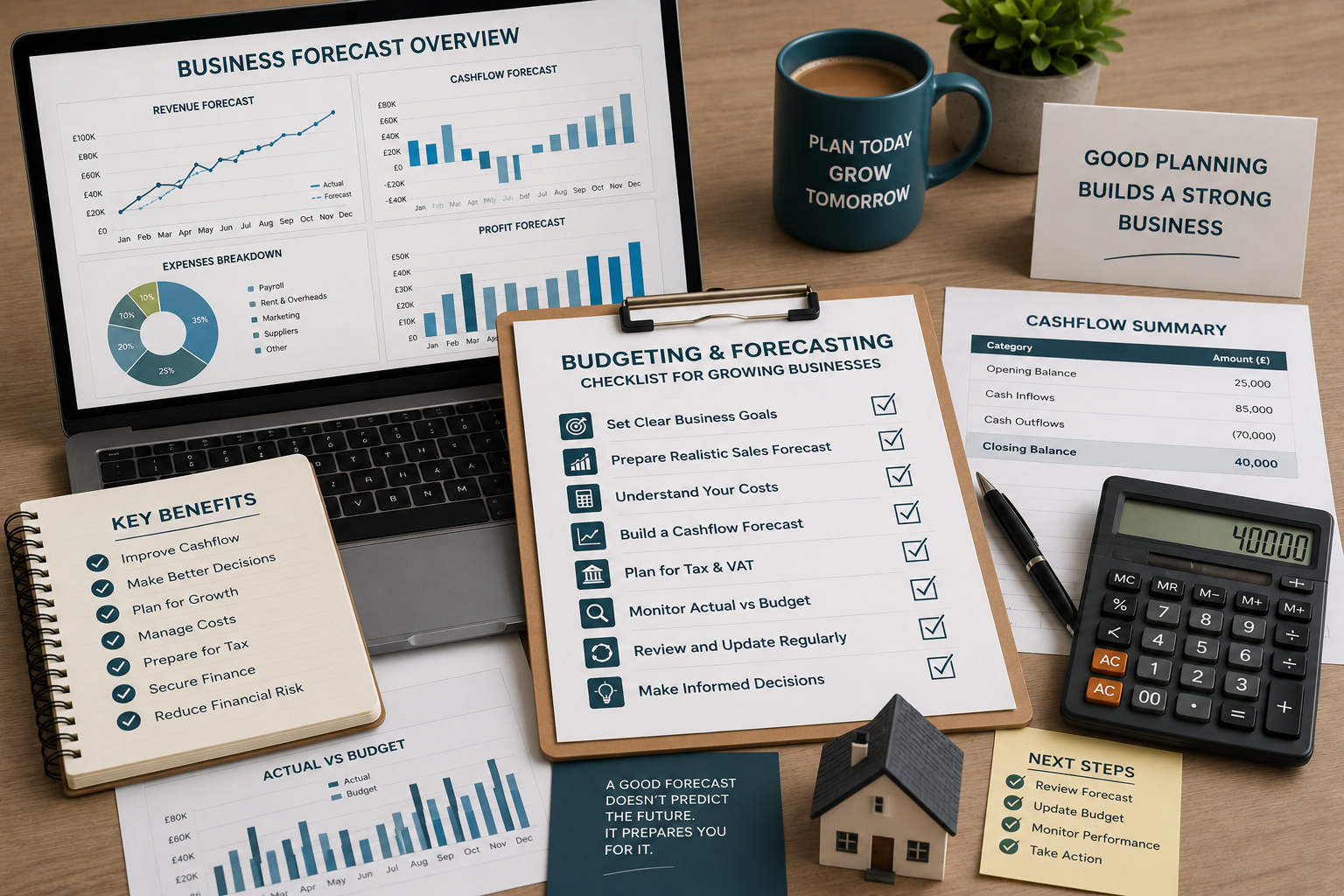
They help business owners move from reactive decision-making to proactive financial control.
What Is a Budget?
A budget is a financial plan.
It sets out what the business expects, targets or intends to achieve over a period of time.
A budget may include:
- expected sales
- expected direct costs
- wages and payroll costs
- rent and overheads
- marketing spend
- software subscriptions
- loan repayments
- VAT and tax payments
- expected profit
- planned investment
- cash reserves
A budget gives the business a benchmark.
It allows the owner to compare actual performance against what was planned.
Practical Example
A business sets a monthly budget for:
- £40,000 sales
- £22,000 direct costs
- £8,000 overheads
- £4,000 payroll
- £3,000 expected tax savings provision
At the end of each month, actual results can be compared against the budget.
If sales are lower or costs are higher, the business can take action early.
What Is a Forecast?
A forecast is an updated view of what is likely to happen based on current information.
While a budget is usually a plan or target, a forecast is more flexible.
A forecast may change each month as the business receives new information.
It may reflect:
- actual sales trends
- confirmed contracts
- customer payment delays
- seasonal changes
- unexpected costs
- staff changes
- tax liabilities
- loan repayments
- price increases
- market changes
A good forecast helps the business answer:
“Based on what we know now, what is likely to happen next?”
Budgeting vs Forecasting: What Is the Difference?
Budgeting and forecasting are closely linked, but they are not the same.
Budgeting
A budget sets the plan.
It answers:
- What do we want to achieve?
- What income are we targeting?
- What costs do we expect?
- What profit are we aiming for?
- How much can we afford to spend?
Forecasting
A forecast updates expectations.
It answers:
- Are we still on track?
- What has changed?
- Will we have enough cash?
- Will tax bills be affordable?
- Do we need to adjust spending?
- Can we afford to hire, invest or expand?
In simple terms:
The budget is the plan.
The forecast is the reality check.
Growing businesses need both.
Why Forecasting and Budgeting Matter More as a Business Grows
When a business is small, the owner may feel close to every transaction.
They may know roughly what is coming in, what is going out and what bills are due.
As the business grows, that becomes harder.
More growth usually means more moving parts.
For example:
- more invoices issued
- more customers to chase
- more suppliers to pay
- more employees
- more tax obligations
- more software subscriptions
- more stock or project costs
- more risk if cashflow is not managed
Without proper forecasts and budgets, the owner may make decisions based on bank balance instead of financial reality.
That is dangerous.
The bank balance does not show future VAT, Corporation Tax, payroll, supplier bills, loan repayments or upcoming investment costs.
1. Forecasting Helps Protect Cashflow
Cashflow is one of the biggest reasons businesses struggle.
A business can be profitable and still run out of cash.
This often happens because money is tied up in:
- unpaid invoices
- stock
- equipment
- staff costs
- VAT liabilities
- deposits
- project costs
- loan repayments
- expansion costs
Practical Example
A business wins a large contract worth £80,000.
On paper, this looks like excellent growth.
But to deliver the work, the business needs to pay:
- subcontractors
- materials
- staff overtime
- software costs
- travel
- VAT
- insurance
- project setup costs
If the customer pays in 60 days but the business must pay suppliers within 14 days, cashflow pressure can build quickly.
A cashflow forecast helps identify this before it becomes a crisis.
2. Budgeting Stops Spending From Growing Too Fast
Growth often makes business owners feel more confident.
That can lead to increased spending on:
- staff
- marketing
- vehicles
- equipment
- premises
- software
- stock
- office upgrades
- subscriptions
Some investment may be necessary.
But without a budget, costs can rise faster than profit.
Practical Example
A business grows turnover from £120,000 to £220,000.
The owner assumes profit will automatically increase.
But overheads also increase:
- new staff
- higher software costs
- more marketing
- finance repayments
- professional fees
- more admin time
At year-end, profit has barely improved.
Budgeting helps the owner understand whether growth is actually producing better returns.
3. Forecasting Helps Plan Tax Liabilities
Tax liabilities can create major cashflow pressure if they are not forecast.
Growing businesses may need to plan for:
- Corporation Tax
- VAT
- PAYE and National Insurance
- Self Assessment
- dividend tax
- CIS deductions
- student loan deductions
- pension contributions
The danger is that tax bills often become larger as the business grows, but the cash may already have been spent.
Practical Example
A limited company has a strong year and makes £90,000 profit.
The director sees healthy bank balances during the year and withdraws money regularly.
Later, the company must pay Corporation Tax, VAT and payroll liabilities.
The business is profitable, but cash is tight because tax was not forecast and set aside.
A tax forecast helps business owners plan withdrawals, dividends and spending properly.
4. Forecasting Helps Directors Pay Themselves Properly
For limited company directors, forecasting is particularly important.
Many directors take a combination of:
- salary
- dividends
- reimbursed expenses
- pension contributions
- director’s loan repayments
But dividends should only be paid where the company has sufficient distributable profits.
If bookkeeping is out of date and there is no forecast, directors may take dividends based on guesswork.
This can create:
- illegal dividends
- overdrawn director’s loan accounts
- unexpected personal tax
- company cashflow pressure
Practical Example
A director withdraws £4,000 per month as dividends.
The company appears to have enough cash.
However, the forecast shows that after VAT, Corporation Tax, payroll and supplier payments, profits are lower than expected.
The director may need to adjust the extraction strategy before problems arise.
5. Forecasting Supports Better Hiring Decisions
Hiring staff is one of the biggest decisions a growing business can make.
It can improve capacity, but it also creates fixed costs.
A new employee may involve:
- salary
- employer National Insurance
- pension contributions
- payroll costs
- equipment
- training
- software licences
- holiday pay
- management time
Without forecasting, the business may hire too early or at the wrong cost level.
Practical Example
A business wants to hire an administrator at £28,000 per year.
The real cost may be higher once employer costs, pension, equipment and software are included.
A forecast can show whether the business can afford the role now, or whether it should wait until income becomes more stable.
6. Budgeting Helps Control Profit Margins
Many businesses focus heavily on sales.
But sales alone do not guarantee profit.
Profit margins can be reduced by:
- supplier price increases
- underpricing
- discounts
- poor project costing
- high staff costs
- inefficient processes
- platform fees
- finance costs
- VAT pricing errors
A budget helps the owner understand the expected margin.
A forecast helps show whether the margin is actually being achieved.
Practical Example
A service business charges £2,000 for a project.
The owner expects a strong profit.
After reviewing costs, the real position includes:
- staff time
- subcontractor costs
- software
- travel
- revisions
- admin
- VAT impact
The true profit is much lower than expected.
Budgeting and forecasting help business owners price properly.
7. Forecasting Helps With VAT Planning
VAT can create cashflow pressure for growing businesses.
A business approaching the VAT threshold needs to plan early.
VAT affects:
- pricing
- bookkeeping
- software
- customer communication
- cashflow
- profit margins
- VAT return deadlines
- whether input VAT can be reclaimed
If a business registers late or does not price correctly, VAT can become a direct hit to margin.
Practical Example
A business sells mainly to consumers and crosses the VAT threshold.
If prices cannot easily be increased, VAT may reduce profit unless planning is done early.
A forecast helps identify when the threshold may be reached and what action is needed.
8. Forecasting Helps With Finance and Funding Applications
Lenders and investors often want to see credible financial forecasts.
They may ask for:
- cashflow forecast
- profit forecast
- balance sheet forecast
- business plan
- management accounts
- debtor reports
- tax position
- current liabilities
- repayment affordability
A business with clean forecasts is usually in a stronger position when applying for finance.
Practical Example
A business wants funding to buy equipment.
The lender asks whether the business can afford repayments.
A forecast can show:
- expected income
- expected costs
- available cash
- loan repayments
- tax liabilities
- whether the investment improves profit
This makes the finance application more credible.
9. Forecasting Helps Avoid “Growth Without Profit”
Growth is not always good.
A business can increase turnover but reduce profit if growth is poorly managed.
This can happen where:
- prices are too low
- staff costs rise too quickly
- customers pay late
- projects are under-costed
- overheads increase
- stock ties up cash
- VAT is not planned
- systems are weak
Practical Example
A business doubles turnover from £200,000 to £400,000.
However:
- staff costs increase
- errors increase
- cash collection slows
- admin becomes overloaded
- profit margins fall
The business is bigger, but not stronger.
Forecasting helps identify whether growth is profitable and sustainable.
10. Budgeting Helps Business Owners Make Decisions With Confidence
Without a budget, every decision can feel uncertain.
Can we hire?
Can we buy equipment?
Can we increase marketing?
Can we afford a new office?
Can we pay dividends?
Can we reduce prices?
Can we take on a large contract?
A budget does not remove risk, but it improves decision-making.
It gives the owner a financial framework.
11. Forecasting Helps Identify Problems Early
One of the biggest benefits of forecasting is early warning.
A forecast can show:
- cash shortfalls
- falling margins
- rising costs
- tax pressure
- staffing affordability issues
- VAT exposure
- weak debtor collection
- seasonal dips
- loan repayment pressure
The earlier a problem is identified, the more options the business has.
Practical Example
A forecast shows that cash will become tight in three months.
The business may still have time to:
- chase debtors
- reduce discretionary spending
- negotiate supplier terms
- delay non-essential purchases
- review pricing
- arrange finance
- adjust dividend payments
If the problem is only spotted when the bank balance is already low, options are much more limited.
12. Forecasting Is Especially Useful for Seasonal Businesses
Some businesses have strong seasonal patterns.
This can include:
- hospitality
- serviced accommodation
- retail
- construction
- events
- tourism
- property maintenance
- education-related businesses
Seasonal businesses may have strong income in some months and weaker income in others.
Forecasting helps ensure profitable months support quieter periods.
Practical Example
A serviced accommodation operator earns strong income in summer but has lower occupancy in winter.
Without forecasting, they may overspend during the strong months and struggle later with VAT, rent, utilities and maintenance costs.
A forecast helps spread planning across the full year.
13. Forecasting Supports Better Stock and Supplier Planning
For product-based businesses, poor stock planning can damage cashflow.
Too much stock ties up cash.
Too little stock can reduce sales.
Forecasting helps business owners plan:
- purchasing
- supplier payments
- stock levels
- seasonal demand
- storage costs
- minimum order quantities
- cash requirements
Practical Example
A business orders extra stock for a busy period.
Sales are expected to increase, but supplier payments are due before customer payments are received.
A forecast helps show whether enough cash is available to manage the gap.
14. Budgeting Helps Control Overheads
Overheads can creep up quietly.
Common examples include:
- software subscriptions
- insurance
- professional fees
- marketing tools
- phone contracts
- rent
- utilities
- finance costs
- outsourced support
- memberships
- unused apps
A budget helps identify whether overheads are still proportionate to the size and profitability of the business.
Practical Example
A business signs up for multiple software tools during a growth phase.
Each cost seems small individually.
Together, they add £1,200 per month to overheads.
A budget review helps remove unused costs and protect profit.
15. Forecasting Works Best With Management Accounts
Forecasting is strongest when it is based on reliable bookkeeping and management accounts.
Year-end accounts are useful for compliance, but they usually arrive too late to support real-time decisions.
Management accounts give business owners regular visibility over:
- profit and loss
- balance sheet
- cashflow
- debtors
- creditors
- VAT
- payroll
- project performance
- tax liabilities
- key performance indicators
When management accounts are combined with forecasts, the business owner can make decisions using current information.
16. How Often Should a Business Forecast?
The answer depends on the size and complexity of the business.
As a guide:
- small stable businesses may review quarterly
- growing businesses should often review monthly
- businesses with tight cashflow may need weekly cashflow monitoring
- businesses seeking funding may need formal forecasts
- seasonal businesses should forecast across the full year
The forecast should not be prepared once and forgotten.
It should be updated as the business changes.
17. What Should a Good Forecast Include?
A useful forecast may include:
- expected sales
- expected direct costs
- gross profit
- overheads
- payroll costs
- VAT payments
- Corporation Tax or Income Tax
- PAYE and National Insurance
- loan repayments
- capital expenditure
- dividends or drawings
- opening bank balance
- expected closing cash position
For some businesses, the forecast should also include:
- debtor days
- stock purchases
- project costs
- occupancy rates
- seasonal assumptions
- funding requirements
- scenario planning
18. What Is Scenario Planning?
Scenario planning means looking at different possible outcomes.
For example:
Base Case
What is expected to happen.
Best Case
What happens if sales are stronger than expected.
Worst Case
What happens if sales fall, costs rise or customers pay late.
Scenario planning helps business owners prepare for uncertainty.
Practical Example
A business is considering hiring a new team member.
The forecast is prepared under three scenarios:
- expected sales
- 15% lower sales
- 25% higher sales
This helps the owner understand whether the hire is affordable even if growth is slower than expected.
Common Forecasting and Budgeting Mistakes
1. Using Overly Optimistic Sales Figures
Forecasts should be realistic, not wishful thinking.
2. Ignoring Tax
VAT, Corporation Tax, PAYE and personal tax can create major cashflow pressure.
3. Forgetting Loan Repayments
Profit forecasts may look healthy, but loan repayments affect cash.
4. Not Reviewing Actual Results
A budget is only useful if actual results are compared against it.
5. Failing to Update Forecasts
A forecast should change as the business changes.
6. Confusing Profit With Cash
Profit and cash are different. A business can be profitable and still cash-poor.
7. Not Including Owner Withdrawals
Director dividends, drawings or salary must be included in cash planning.
8. Ignoring Seasonality
A full-year profit can hide difficult months.
Practical Scenario: Forecasting Done Well
A growing limited company prepares monthly management accounts.
The business also maintains a rolling 12-month cashflow forecast.
Each month, the owner reviews:
- actual income
- actual costs
- gross profit margin
- VAT due
- payroll costs
- Corporation Tax estimate
- debtor balances
- projected cash position
- planned investments
The owner can decide whether to hire, buy equipment, increase marketing or adjust pricing based on reliable numbers.
This is proactive financial management.
Practical Scenario: Forecasting Done Poorly
Another business relies mainly on the bank balance.
Sales are increasing, but bookkeeping is behind.
The owner hires staff, increases marketing and takes dividends.
Several months later, the business faces:
- VAT arrears
- Corporation Tax pressure
- supplier debts
- payroll stress
- unpaid customer invoices
- limited cash reserves
The business was growing, but not financially controlled.
Forecasting could have identified the pressure earlier.
Frequently Asked Questions
What is the difference between budgeting and forecasting?
A budget sets the financial plan or target. A forecast updates expectations based on current information and helps show what is likely to happen next.
Why do growing businesses need forecasting?
Growing businesses need forecasting because growth often increases costs, tax liabilities, staffing needs and cashflow pressure. Forecasting helps identify risks before they become urgent.
How often should a business update its forecast?
A growing business should usually review forecasts monthly. Businesses with tight cashflow or seasonal income may need more frequent reviews.
Can a profitable business still run out of cash?
Yes. Profit and cashflow are different. A profitable business may still struggle if customers pay late, stock ties up cash, tax is not planned or costs increase quickly.
Does a forecast help with tax planning?
Yes. Forecasting helps estimate Corporation Tax, VAT, payroll taxes, dividend tax and other liabilities so the business can set money aside in advance.
Do small businesses need a formal budget?
Not every small business needs a complex budget, but most benefit from a clear financial plan. As the business grows, budgeting becomes more important.
Can forecasting help with funding applications?
Yes. Lenders and investors often want to understand whether the business can afford repayments and manage future cashflow.
Is forecasting only for large companies?
No. Forecasting is often most valuable for small and growing businesses because cashflow pressure can appear quickly.
How PR Accountants Can Help
At PR Accountants, we help growing businesses move beyond year-end accounts and build better financial visibility.
We support clients with:
- management accounts
- cashflow forecasting
- budgeting
- VAT planning
- Corporation Tax forecasting
- payroll cost planning
- director salary and dividend planning
- bookkeeping reviews
- profit margin analysis
- business performance reporting
- property and serviced accommodation reporting
Our aim is to help business owners understand their numbers, plan ahead and make better decisions.
Final Thoughts
Growth is exciting, but unmanaged growth can create financial pressure.
Forecasting and budgeting help business owners answer important questions:
- Can we afford to grow?
- Will we have enough cash?
- Are we making enough profit?
- Are costs rising too quickly?
- Can we afford to hire?
- Are tax liabilities covered?
- Is the business stronger or just busier?
The best businesses do not wait until problems appear.
They plan ahead, review regularly and make decisions based on reliable numbers.
Strong Call to Action
Want Better Visibility Over Your Business Finances?
If your business is growing, relying only on year-end accounts or bank balance is not enough.
PR Accountants can help you build practical budgets, cashflow forecasts and management reports so you can plan with confidence.
👉 Contact PR Accountants today for proactive accounting and forecasting support tailored to your business. Contact Us