VAT Returns Explained for Small Businesses
VAT can be one of the most confusing areas of tax for small business owners.
Once a business is VAT registered, it usually needs to charge VAT on relevant sales, keep proper VAT records, submit VAT returns and pay VAT to HMRC by the correct deadline.
The difficulty is that VAT is not just about adding 20% to invoices.
Business owners need to understand:
- when VAT applies
- what VAT rate to charge
- what input VAT can be reclaimed
- how VAT returns are calculated
- which VAT scheme is being used
- how to keep digital records
- when VAT must be paid
- how VAT affects cashflow
- what mistakes can lead to penalties or HMRC questions
This guide explains VAT returns in a practical way for small businesses.
What Is VAT?
VAT stands for Value Added Tax.
It is a tax charged on many goods and services supplied by VAT-registered businesses.
A VAT-registered business usually charges VAT on taxable sales and may be able to reclaim VAT on eligible business purchases.
The difference between VAT charged on sales and VAT paid on purchases is usually reported to HMRC through the VAT return.
In simple terms:
- VAT charged to customers is output VAT
- VAT paid on business purchases is input VAT
- the VAT return calculates what is payable to HMRC or repayable by HMRC
VAT can affect pricing, cashflow, bookkeeping and business decisions.
When Does a Business Need to Register for VAT?
A business must register for VAT if its taxable turnover goes over the VAT registration threshold.
Taxable turnover means the value of sales that are not exempt from VAT.
This includes standard-rated, reduced-rated and zero-rated supplies, but not exempt supplies.
The current VAT registration threshold is £90,000.
Businesses must monitor taxable turnover on a rolling 12-month basis, not just by tax year or accounting year.
Practical Example
A business checks its turnover at the end of March and sees total sales of £82,000 for the tax year.
The owner assumes VAT registration is not needed.
However, when reviewing the rolling 12-month period to May, taxable turnover has reached £92,000.
The business may have crossed the VAT registration threshold even though the tax year figure looked lower.
This is why VAT monitoring should be done regularly.
Do You Only Register at Year-End?
No.
This is a common misunderstanding.
VAT registration is not based only on your financial year-end or tax year-end.
You need to monitor taxable turnover every month on a rolling 12-month basis.
You may also need to register if you expect your taxable turnover to exceed the threshold in the next 30 days alone.
Missing the correct VAT registration date can lead to backdated VAT, interest and penalties.
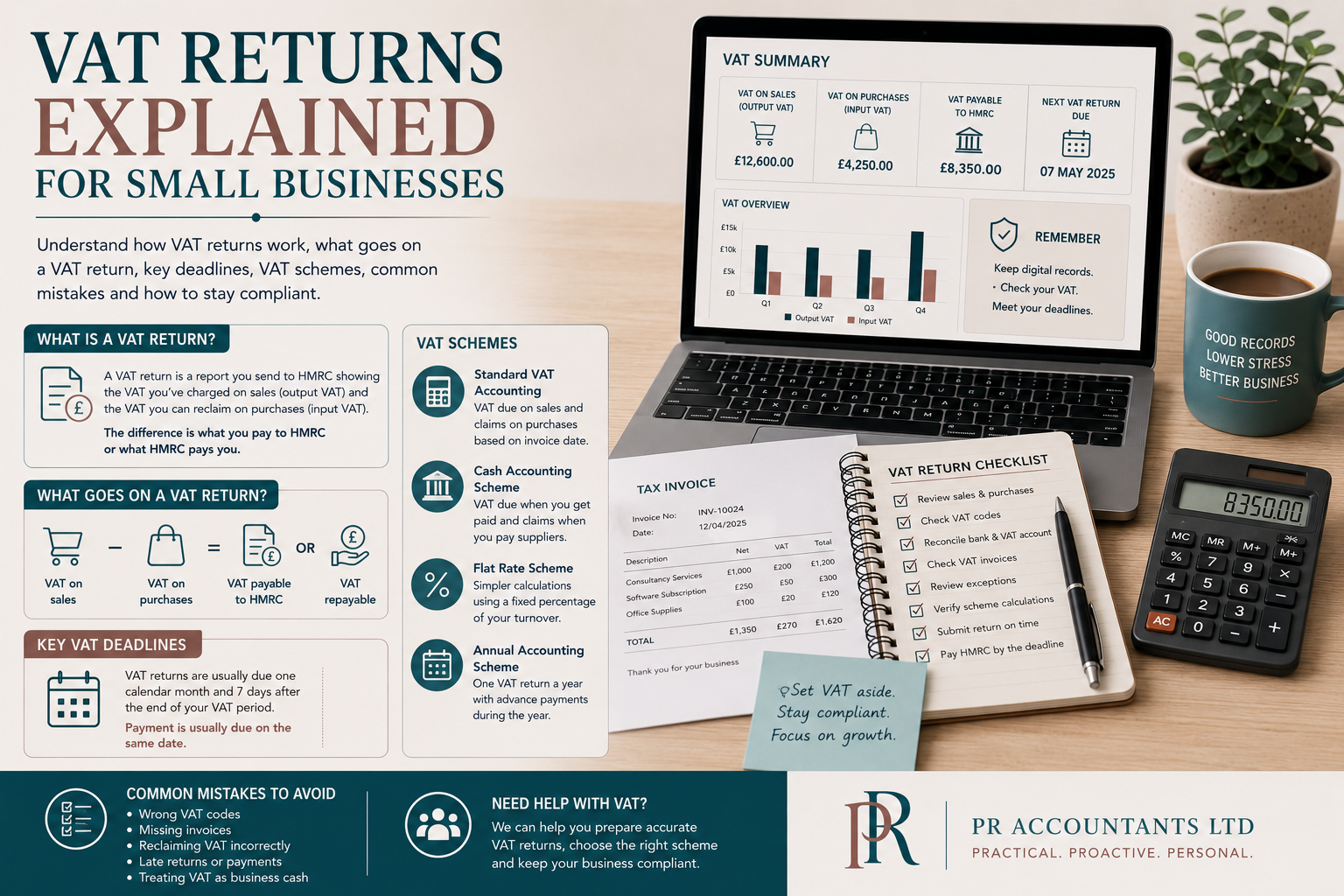
What Is a VAT Return?
A VAT return is a report submitted to HMRC.
It shows the VAT position for a specific VAT period.
Most VAT returns include:
- total sales
- total purchases
- VAT charged on sales
- VAT reclaimed on purchases
- VAT due to HMRC
- VAT repayable by HMRC
For many small businesses, VAT returns are submitted quarterly, but some businesses may have monthly or annual VAT arrangements depending on their circumstances.
What Does a VAT Return Include?
A VAT return has several boxes.
The exact figures depend on the business and VAT scheme used, but broadly the return includes:
VAT Due on Sales
This is the VAT charged to customers on taxable sales.
For example, if a business sells services for £1,000 plus VAT at 20%, the VAT charged is £200.
That £200 is not business profit. It is VAT collected from the customer and usually payable to HMRC after deducting allowable input VAT.
VAT Due on Purchases From Other Countries
Some transactions involving imports, acquisitions or services from overseas may create VAT entries.
These can be more complex and should be reviewed carefully.
Total VAT Due
This is the total output VAT due before deducting input VAT.
VAT Reclaimed on Purchases
This is VAT the business may be able to reclaim on eligible business costs.
Examples may include VAT on:
- stock
- materials
- business software
- accountancy fees
- equipment
- repairs
- professional fees
- business fuel, subject to rules
- marketing costs
- office costs
The business usually needs valid VAT invoices and must ensure the cost is genuinely for the business.
Net VAT Payable or Repayable
This is the difference between VAT due and VAT reclaimed.
If output VAT is higher than input VAT, the business pays VAT to HMRC.
If input VAT is higher than output VAT, HMRC may owe a VAT repayment.
Practical Example of a VAT Return
A VAT-registered business has the following figures for the quarter:
- sales excluding VAT: £30,000
- VAT charged on sales: £6,000
- purchases excluding VAT: £10,000
- VAT on purchases: £2,000
The VAT return may show:
- output VAT: £6,000
- input VAT: £2,000
- VAT payable to HMRC: £4,000
The business may have received £36,000 from customers, but £6,000 of that was VAT collected on HMRC’s behalf.
This is why VAT cashflow planning is important.
VAT Is Not Your Money
One of the biggest mistakes small businesses make is treating VAT-inclusive sales as fully available business income.
For example, if you charge a customer £1,200 including VAT, part of that amount may belong to HMRC.
If the business spends all the cash received, the VAT return can become a cashflow problem later.
Practical Scenario
A business receives several large customer payments during the quarter.
The bank balance looks healthy.
The owner spends money on stock, wages and personal withdrawals.
When the VAT return is prepared, £8,500 is due to HMRC.
Because VAT was not set aside, the business struggles to pay.
A good system should separate trading cash from tax cash.
VAT Rates: Not Everything Is 20%
The standard VAT rate is 20%, but not every supply is charged at 20%.
Some goods and services may be:
- standard-rated
- reduced-rated
- zero-rated
- exempt
- outside the scope of UK VAT
This matters because using the wrong VAT rate can lead to underpaid VAT, overcharged customers or incorrect VAT returns.
Common Mistake
A business assumes everything it sells is standard-rated at 20%.
However, some supplies may be zero-rated or exempt.
Another business assumes something is exempt when it is actually taxable.
Both mistakes can create VAT problems.
VAT treatment should be reviewed based on what the business actually supplies.
Standard-Rated, Zero-Rated and Exempt: What Is the Difference?
These terms can be confusing.
Standard-Rated
VAT is charged at the standard rate, usually 20%.
Reduced-Rated
VAT is charged at a lower rate where the rules allow.
Zero-Rated
VAT is charged at 0%, but the sale is still a taxable supply.
This means it can count towards VAT taxable turnover.
Exempt
No VAT is charged, but exempt income is different from zero-rated income.
Exempt supplies do not usually allow VAT recovery in the same way.
Outside the Scope
The transaction is outside the UK VAT system.
This can apply in certain situations, including some overseas transactions, depending on the facts.
The distinction matters because it affects registration, VAT returns and input VAT recovery.
What Can You Reclaim VAT On?
A VAT-registered business may be able to reclaim input VAT on business purchases where the cost relates to taxable business activities.
Examples may include:
- goods bought for resale
- materials
- business equipment
- accountancy fees
- software subscriptions
- stationery
- marketing
- repairs
- business phone costs
- professional services
However, VAT cannot be reclaimed just because a receipt shows VAT.
The business must consider:
- whether the cost is for the business
- whether there is a valid VAT invoice
- whether the VAT is correctly charged
- whether there is any private use
- whether the cost relates to taxable or exempt supplies
- whether special rules apply
Costs Where VAT Recovery Needs Care
Some costs need careful review.
These may include:
- business entertainment
- cars
- fuel
- mixed-use expenses
- staff expenses
- subsistence
- home office costs
- property costs
- overseas purchases
- exempt business activities
- costs linked to directors personally
Practical Example
A company director uses the business card to pay for a client meal.
The receipt shows VAT.
The director assumes VAT can be reclaimed.
However, business entertainment VAT is restricted in many cases.
The bookkeeping should not automatically reclaim VAT just because VAT appears on a receipt.
VAT Invoices Matter
To reclaim VAT properly, the business normally needs valid VAT evidence.
For many purchases, this means a VAT invoice.
A VAT invoice should show key details such as:
- supplier name
- supplier VAT number
- invoice date
- invoice number
- description of goods or services
- VAT rate
- net amount
- VAT amount
- gross amount
If the invoice is missing or the supplier is not VAT registered, input VAT recovery may not be allowed.
This is why receipt management is important.
Digital VAT Records and Making Tax Digital
VAT-registered businesses should keep digital VAT records and submit VAT returns using compatible software, unless exempt.
This means businesses should not rely only on manual records, paper notes or last-minute spreadsheets.
Digital records help reduce errors and make VAT returns easier to review.
Common software includes systems such as Xero, QuickBooks, FreeAgent and other HMRC-compatible products.
However, software alone does not guarantee accuracy.
The VAT return is only as good as the bookkeeping behind it.
What Records Should VAT-Registered Businesses Keep?
A VAT-registered business should keep records that support the VAT return.
These may include:
- sales invoices
- purchase invoices
- credit notes
- bank statements
- VAT account
- digital bookkeeping records
- import VAT statements
- reverse charge records
- VAT scheme calculations
- evidence for zero-rated supplies
- evidence for exempt income
- mileage and fuel records, where relevant
- receipts and supplier statements
VAT records should generally be kept for at least 6 years.
Good records are essential if HMRC asks questions.
VAT Return Deadlines
VAT returns are usually due one calendar month and 7 days after the end of the VAT period.
The payment deadline is usually the same date.
For example, if a VAT quarter ends on 31 March, the VAT return and payment are usually due by 7 May.
However, businesses should always check their VAT online account because exact deadlines and payment methods can vary depending on scheme and circumstances.
Do not leave VAT payment until the last minute.
Different payment methods can take different amounts of time to reach HMRC.
What Happens If a VAT Return Is Late?
Late VAT returns can lead to penalty points.
Once the business reaches the penalty point threshold, HMRC can charge a financial penalty.
Further late submissions while at the threshold can create more penalties.
This means repeated lateness can become expensive.
Late VAT payment can also lead to interest and penalties.
Practical Example
A business submits VAT returns late for several quarters.
At first, the owner may not feel the impact.
But penalty points build up.
Once the threshold is reached, financial penalties may apply, and HMRC may view the business as higher risk.
Regular VAT processes help avoid this.
What If You Cannot Pay the VAT Bill?
If a business cannot pay VAT in full, it should not ignore the deadline.
The business should:
- submit the VAT return on time
- pay what it can
- review cashflow
- contact HMRC where needed
- consider whether a payment plan is possible
- avoid building new VAT debt
- improve VAT cashflow planning for future quarters
Delaying the VAT return because the business cannot pay can make the situation worse.
Filing and payment are separate issues.
Common VAT Schemes for Small Businesses
Different VAT schemes can affect how VAT is calculated and reported.
Not every scheme is suitable for every business.
Standard VAT Accounting
Under standard VAT accounting, VAT is usually reported based on invoice dates.
This means VAT may be due to HMRC before the customer has paid.
Example
You invoice a customer in March.
The customer pays in May.
The VAT may still need to be reported in the March VAT period.
This can create cashflow pressure where customers pay slowly.
Cash Accounting Scheme
Under the Cash Accounting Scheme, VAT is generally accounted for when payment is received and when suppliers are paid.
This can help cashflow for businesses that offer credit terms.
However, the scheme has eligibility rules and may not be suitable for every business.
Example
You invoice a customer in March, but they pay in May.
Under cash accounting, output VAT is usually accounted for when the customer pays.
This can be helpful for businesses with slow-paying customers.
Flat Rate Scheme
The Flat Rate Scheme is designed to simplify VAT for some smaller businesses.
Instead of reclaiming VAT on most purchases, the business pays a fixed percentage of VAT-inclusive turnover based on its business type.
This can reduce admin, but it is not always cheaper.
It can be less beneficial for businesses with significant VATable costs.
The Flat Rate Scheme also has limited cost trader rules, which can increase the effective percentage for some businesses.
Practical Example
A consultant with very low VATable costs may find the Flat Rate Scheme simple.
A business with significant software, equipment, materials or subcontractor costs may find standard VAT accounting more suitable.
A calculation should be done before choosing a scheme.
Annual Accounting Scheme
Under the Annual Accounting Scheme, a business submits one VAT return per year and usually makes advance payments during the year.
This can reduce the number of VAT returns, but it does not remove the need for good records.
It may help some businesses with admin, but it can also create issues if payments do not reflect actual trading.
Choosing the Right VAT Scheme
The best VAT scheme depends on the business.
Factors to consider include:
- turnover
- customer payment terms
- level of VATable purchases
- cashflow
- admin capacity
- business sector
- whether customers are VAT registered
- whether the business has large setup costs
- whether the business has imports or overseas transactions
- whether the business is growing quickly
The wrong VAT scheme can affect cashflow and profitability.
VAT and Cashflow Planning
VAT should be included in cashflow planning.
A business should know:
- when VAT returns are due
- estimated VAT payable
- whether customers have paid
- whether input VAT claims are supported
- whether VAT funds are being set aside
- whether the business can afford the payment
- whether upcoming purchases affect the VAT position
Many businesses benefit from setting aside VAT funds regularly rather than waiting until the return is due.
VAT and Pricing
VAT can affect pricing, especially where customers are not VAT registered.
If your customers are consumers or non-VAT registered businesses, adding VAT may make prices feel more expensive.
If you absorb VAT into existing prices, your net income may reduce.
Practical Example
A business charges £120 to consumers before VAT registration.
After VAT registration, if the price remains £120 VAT-inclusive, the net income may effectively fall because part of the £120 is VAT.
This can reduce profit margins.
Businesses approaching the VAT threshold should review pricing before registration becomes urgent.
VAT and Online Platforms
Businesses using online platforms need to be careful.
This may include:
- Airbnb
- Booking.com
- Etsy
- Amazon
- eBay
- Stripe
- PayPal
- other payment processors
A common mistake is recording only the bank payout.
However, the VAT position may need to consider gross sales, platform fees, refunds and commissions.
Practical Example
A platform shows gross sales of £10,000 and fees of £1,200.
The bank payout is £8,800.
If the business records only £8,800 as income, turnover may be understated.
This can affect VAT returns, VAT threshold monitoring and profit reporting.
VAT and Construction Businesses
Construction businesses may need to consider special VAT rules, including domestic reverse charge VAT.
This is separate from CIS.
A construction business may need to manage:
- VAT returns
- CIS returns
- reverse charge VAT
- subcontractor invoices
- materials
- labour
- project costing
- cashflow
Getting VAT wrong in construction can create large errors because invoice values are often significant.
VAT and Property Businesses
Property and VAT can be complex.
Some property income may be exempt, while other activities may be taxable.
Serviced accommodation, holiday accommodation, commercial property, option to tax and property development can all create different VAT issues.
Landlords and property investors should not assume all property income is treated the same way.
VAT advice should be taken before changing the property use or scaling short-term accommodation.
Common VAT Return Mistakes
1. Using the Wrong VAT Code
Incorrect VAT codes are one of the most common VAT errors in software.
2. Claiming VAT Without Valid Invoices
A bank payment or receipt may not be enough.
3. Recording Only Net Platform Payouts
This can understate income and distort VAT figures.
4. Treating VAT as Business Cash
VAT collected from customers should be protected.
5. Missing the VAT Registration Date
VAT registration is based on taxable turnover, often on a rolling 12-month basis.
6. Reclaiming VAT on Restricted Costs
Some costs have special rules or restrictions.
7. Not Reconciling VAT to Bookkeeping
The VAT return should agree with the underlying records.
8. Forgetting Reverse Charge VAT
This is particularly important in construction and some overseas service transactions.
9. Choosing the Wrong VAT Scheme
A scheme that looks simple may not be tax-efficient.
10. Leaving VAT Until the Deadline
Rushed VAT returns are more likely to contain errors.
How to Prepare a VAT Return Properly
A good VAT return process may include:
- Reconcile the business bank accounts
- Check all sales invoices are included
- Review purchase invoices and receipts
- Check VAT codes
- Review unusual transactions
- Confirm platform income has been recorded correctly
- Check imports, reverse charge and overseas transactions
- Review VAT control accounts
- Compare VAT return figures with profit and loss reports
- Check VAT due against available cash
- Submit the VAT return through compatible software
- Keep submission confirmation
- Pay HMRC by the deadline
This process helps reduce errors and provides a clear audit trail.
Should You Prepare VAT Returns Yourself?
Some businesses can prepare VAT returns themselves, especially where transactions are simple and the bookkeeping is well controlled.
However, VAT support is often useful where the business has:
- high transaction volume
- mixed income types
- platform income
- imports or exports
- property income
- construction work
- domestic reverse charge VAT
- partial exemption issues
- cashflow pressure
- poor historical bookkeeping
- late VAT registration concerns
- uncertainty about VAT schemes
VAT errors can be expensive, so getting advice early is often better than correcting problems later.
Practical Scenario: VAT Done Well
A VAT-registered business keeps digital records throughout the quarter.
Each month, it:
- reconciles bank transactions
- checks VAT codes
- reviews sales invoices
- keeps VAT invoices for purchases
- monitors cashflow
- sets aside VAT collected
- reviews unusual transactions with its accountant
When the VAT return is due, the figures are ready.
There is no last-minute panic, and the business knows what it needs to pay.
Practical Scenario: VAT Done Poorly
Another business leaves VAT until the deadline.
The bookkeeping is incomplete.
Some receipts are missing.
Platform payouts have been recorded as net income.
VAT codes have been applied automatically without review.
The owner does not know whether the VAT return is correct or whether the business can afford the payment.
This increases the risk of errors, penalties and HMRC questions.
Frequently Asked Questions
What is a VAT return?
A VAT return is a report sent to HMRC showing VAT charged on sales, VAT reclaimed on purchases and the net VAT payable or repayable for the VAT period.
How often do small businesses submit VAT returns?
Many small businesses submit VAT returns quarterly, but the exact frequency depends on the business and any VAT scheme used.
When is a VAT return due?
VAT returns are usually due one calendar month and 7 days after the end of the VAT period. The payment deadline is usually the same date.
What is the VAT registration threshold?
The current VAT registration threshold is £90,000 taxable turnover. Businesses must monitor taxable turnover on a rolling 12-month basis.
Can I reclaim VAT on all business expenses?
No. VAT recovery depends on the type of cost, whether it relates to taxable business activity, whether the VAT was correctly charged and whether the business has valid VAT evidence.
Do I need software to submit VAT returns?
VAT-registered businesses generally need to keep digital VAT records and submit VAT returns using compatible software, unless exempt.
What happens if I submit a VAT return late?
Late VAT submissions can lead to penalty points and financial penalties once the relevant threshold is reached. Late payment can also lead to interest and penalties.
Is the Flat Rate Scheme always better?
No. The Flat Rate Scheme may simplify VAT, but it is not always cheaper. It depends on the business type, VATable costs and trading pattern.
How PR Accountants Can Help
At PR Accountants, we help small businesses understand and manage VAT properly.
We can support with:
- VAT registration reviews
- VAT return preparation
- VAT bookkeeping reviews
- VAT scheme comparisons
- Flat Rate Scheme reviews
- Cash Accounting Scheme reviews
- Making Tax Digital setup
- VAT coding checks
- platform income reconciliation
- construction VAT and reverse charge support
- serviced accommodation VAT reviews
- VAT deregistration advice
- HMRC VAT correspondence support
- cashflow planning for VAT payments
Our aim is to help business owners stay compliant, avoid VAT surprises and understand what the VAT figures actually mean.
Final Thoughts
VAT returns are not just a quarterly admin task.
They affect pricing, cashflow, bookkeeping, compliance and business decisions.
Small businesses should understand:
- when VAT registration is required
- what VAT rate applies
- what VAT can be reclaimed
- how VAT returns are calculated
- when VAT is due
- what records must be kept
- which VAT scheme is suitable
- how VAT affects cashflow
Getting VAT right from the start is much easier than correcting errors later.
Strong Call to Action
Need Help With VAT Returns?
VAT can become complicated quickly, especially where software codes, platform income, property income, construction work or cashflow issues are involved.
PR Accountants can help you prepare accurate VAT returns, review your records and choose the right VAT approach for your business.
👉 Contact PR Accountants today for clear, practical VAT support tailored to your business. Contact Us