What Records Should Limited Companies Keep?
Running a limited company comes with legal and tax responsibilities.
It is not enough to keep a few bank statements and wait until the year-end. A company must keep proper records throughout the year so that its accounts, tax returns and Companies House filings can be prepared accurately.
Good record keeping helps directors understand:
• What the company has earned.
• What the company has spent.
• What the company owns.
• What the company owes.
• What customers owe the company.
• What tax may be due.
• Whether dividends can be paid lawfully.
• Whether director withdrawals have been recorded correctly.
A limited company is separate from its directors and shareholders. This means the company’s money and records should be kept separate from personal finances.
The two main types of company records
A limited company normally needs to keep two broad categories of records.
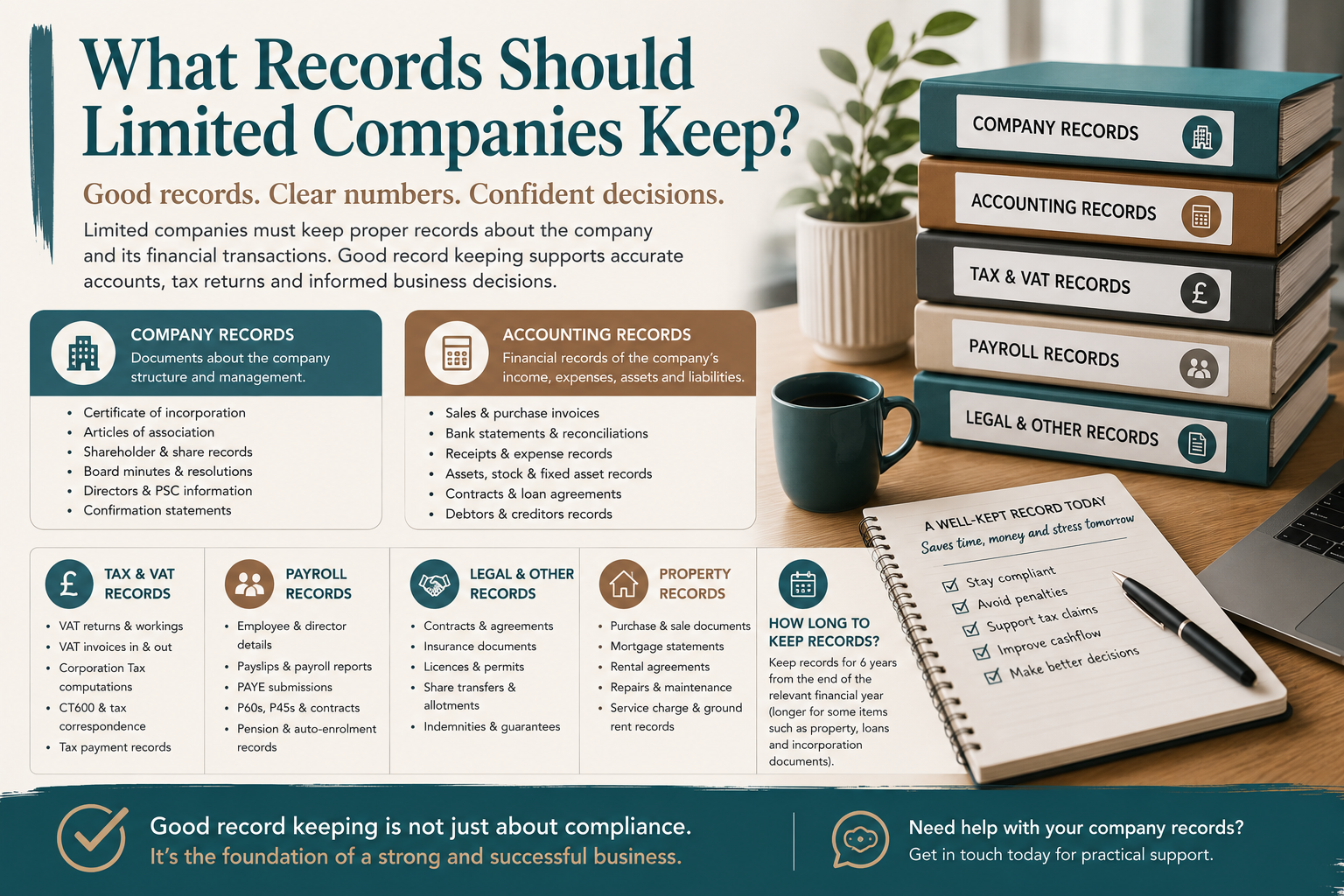
Company records
These are records about the company itself.
They help show who owns and controls the company, what decisions have been made and what information has been reported to Companies House.
Accounting records
These are the financial records showing the company’s income, expenses, assets, liabilities and transactions.
They support the preparation of annual accounts, the Company Tax Return and other tax filings.
Both types of records matter.
A company may have accurate bookkeeping but poor statutory records. It may also have Companies House filings up to date but incomplete financial records. Both can create problems.
Company records to keep
Company records should show key information about the company and its structure.
These may include:
• The company’s certificate of incorporation.
• The articles of association.
• Shareholder details.
• Details of shares issued.
• Share transfers.
• Share allotments.
• Results of shareholder votes and resolutions.
• Board minutes.
• Written resolutions.
• Records of directors’ decisions.
• Records of company secretaries, where applicable.
• People with significant control information.
• Details of loans or mortgages secured against company assets.
• Details of indemnities given by the company.
• Debenture records, where applicable.
• Confirmation statement filings.
• Companies House authentication records.
Companies House rules have changed in recent years, so directors should make sure they understand what must be kept internally and what must be filed or updated at Companies House.
Shareholder and share records
Share records are particularly important because they affect ownership, voting rights, dividends and future company changes.
You should keep records showing:
• Who owns the company shares.
• The number and class of shares held.
• The amount paid or unpaid on shares.
• Share issue dates.
• Share transfer dates.
• Any share certificates issued.
• Any changes to share capital.
• Dividend rights attached to different share classes.
• Voting rights attached to different share classes.
• Any shareholder agreements, where applicable.
Share records should not be treated casually.
If dividend payments, voting rights or ownership percentages are later challenged, clear records are essential.
Director records and Companies House updates
Directors are responsible for ensuring company information is correct and updated.
Records should support changes such as:
• Appointment of a director.
• Resignation of a director.
• Changes to a director’s name.
• Changes to a director’s service address.
• Changes to the registered office address.
• Changes to people with significant control.
• Changes to the company’s registered email address.
• Changes to Standard Industrial Classification codes.
• Changes to share capital or shareholder details.
A confirmation statement must be filed at least once every 12 months, even where nothing has changed. Companies House guidance also confirms that directors and people with significant control must comply with identity verification and personal code requirements when applicable.
Accounting records to keep
Accounting records show the financial activity of the company.
They should include records of:
• All money received by the company.
• All money spent by the company.
• Sales invoices.
• Purchase invoices.
• Receipts.
• Bank statements.
• Bank reconciliations.
• Credit card statements.
• Loan statements.
• Finance agreements.
• Petty cash records, where used.
• Contracts.
• Customer statements.
• Supplier statements.
• Details of assets owned by the company.
• Debts owed by the company.
• Debts owed to the company.
• Stock records, where relevant.
• Stocktaking records.
• Goods bought and sold, where relevant.
• Supporting calculations used for the accounts and tax return.
The records should be detailed enough to prepare accounts that show a true and fair view where required, calculate Corporation Tax correctly and answer HMRC questions if the company is reviewed.
Sales and income records
Companies should keep clear records of all sales and income.
This may include:
• Sales invoices issued.
• Till records.
• Online sales records.
• Booking platform statements.
• Payment processor reports.
• Customer contracts.
• Credit notes.
• Refund records.
• Grant income.
• Insurance proceeds.
• Interest received.
• Other business income.
Income should be recorded gross where appropriate, not simply as the net amount received after platform fees, card charges or deductions.
This is particularly important for VAT, management accounts and turnover-based thresholds.
Purchase and expense records
Companies should keep records for business costs.
These may include:
• Supplier invoices.
• Receipts.
• Purchase orders.
• Delivery notes.
• Subscription invoices.
• Insurance documents.
• Rent and utility bills.
• Software bills.
• Professional fee invoices.
• Travel records.
• Mileage logs.
• Staff expense claims.
• Repairs and maintenance invoices.
• Equipment purchase invoices.
Each expense should be reviewed and coded correctly.
The fact that a cost was paid from the company bank account does not automatically make it allowable for Corporation Tax, VAT or accounting purposes.
Bank and payment records
Bank records are central to company bookkeeping.
The company should keep:
• Business bank statements.
• Credit card statements.
• Merchant account statements.
• PayPal or Stripe reports.
• Direct debit details.
• Loan statements.
• Bank reconciliations.
• Evidence of transfers between company accounts.
• Records explaining unusual payments or receipts.
Bank feeds are useful, but they are not a substitute for bank reconciliation.
The accounting software balance should agree to the actual bank statement.
Payroll and employee records
If the company has directors or employees on payroll, payroll records must be kept accurately.
These may include:
• Employee details.
• Employment contracts.
• Payroll reports.
• Payslips.
• PAYE submissions.
• P60s.
• P45s.
• Starter checklists.
• Student loan information.
• Pension contribution records.
• Workplace pension correspondence.
• Auto-enrolment records.
• Statutory sick pay records.
• Statutory maternity, paternity or parental pay records.
• Staff expense claims.
• Timesheets, where relevant.
Payroll records affect PAYE, National Insurance, pension compliance and the company’s accounts.
They should not be left until the year-end.
VAT records
If the company is VAT registered, VAT records must be kept carefully.
These may include:
• VAT invoices issued to customers.
• VAT invoices received from suppliers.
• VAT return workings.
• Digital VAT records.
• VAT account reports.
• Import VAT statements.
• Postponed VAT Accounting statements.
• Reverse charge calculations.
• Partial exemption calculations, where relevant.
• Flat Rate Scheme workings, where relevant.
• Evidence for zero-rated or exempt supplies.
• Credit notes.
• Records of errors corrected on VAT returns.
VAT coding should be reviewed regularly.
Incorrect VAT treatment can lead to underpayments, overclaims, penalties and time-consuming corrections.
Director’s loan account records
Director’s loan account records are especially important for owner-managed companies.
A director’s loan account records money moving between the company and a director that is not salary, dividends or a properly reimbursed business expense.
The company should keep records of:
• Money lent by the director to the company.
• Money repaid by the company to the director.
• Personal expenses paid by the company.
• Company expenses paid personally by the director.
• Cash withdrawals.
• Transfers to directors.
• Interest charged or not charged on loans.
• Loan repayments.
• Year-end director’s loan balances.
• Any overdrawn director’s loan position.
Poor director’s loan records can create tax issues for both the company and the director.
A director should not treat the company bank account as a personal bank account.
Dividend records
Dividends need proper documentation.
A company should keep:
• Dividend vouchers.
• Board minutes or written resolutions approving dividends.
• Details of the shareholders receiving dividends.
• Dividend dates.
• Dividend amounts.
• Share classes and dividend rights.
• Evidence that sufficient distributable profits were available.
• Records of dividends credited to director’s loan accounts.
Dividends are not wages and are not a business expense for Corporation Tax purposes.
A dividend should not be created simply by labelling a withdrawal as a dividend after the event.
The company must have sufficient distributable profits when the dividend is declared.
Fixed asset records
Companies should keep records of assets bought, sold and owned.
This may include:
• Computers.
• Equipment.
• Tools.
• Machinery.
• Vehicles.
• Furniture.
• Fixtures and fittings.
• Property.
• Leasehold improvements.
• High-value software or systems.
Asset records should show:
• Purchase date.
• Supplier.
• Cost.
• Description.
• Serial number, where relevant.
• Business use.
• Disposal date.
• Sale proceeds.
• Whether the asset was financed.
• Capital allowance treatment.
Fixed asset records help support the accounts, Corporation Tax computations and insurance records.
Loan, finance and hire purchase records
Companies should keep all documents relating to borrowing and finance.
These may include:
• Loan agreements.
• Hire purchase agreements.
• Lease agreements.
• Mortgage statements.
• Interest schedules.
• Repayment schedules.
• Security documents.
• Personal guarantee documents.
• Correspondence with lenders.
• Settlement statements.
• Early repayment charge details.
Loan repayments need careful bookkeeping because capital repayments and interest are not treated in the same way.
Corporation Tax records
Corporation Tax records support the Company Tax Return.
The company should keep:
• Final accounts.
• Corporation Tax computations.
• CT600 returns.
• Capital allowance workings.
• Loss claims.
• Research and development records, where relevant.
• Loan relationship calculations.
• Director’s loan tax calculations, where relevant.
• Pension contribution records.
• Tax payment confirmations.
• HMRC correspondence.
• Records supporting any tax reliefs claimed.
The accounts and tax return should be supported by underlying records, not estimated figures.
Companies House filing records
Directors should keep copies of Companies House filings and related documents.
These may include:
• Annual accounts.
• Confirmation statements.
• Incorporation documents.
• Registered office changes.
• Director appointment and resignation forms.
• PSC updates.
• Share allotment forms.
• Share capital changes.
• Registered email address updates.
• Authentication code records.
• Filing confirmations.
• Companies House correspondence.
For most private companies, annual accounts are normally due at Companies House 9 months after the accounting reference date. First accounts can have different deadlines depending on the period covered.
Contracts and legal documents
Companies should retain important legal and commercial documents.
These may include:
• Customer contracts.
• Supplier contracts.
• Lease agreements.
• Insurance policies.
• Finance agreements.
• Employment contracts.
• Shareholder agreements.
• Terms and conditions.
• Data protection records.
• Professional engagement letters.
• Licences and permits.
• Warranty documents.
• Settlement agreements.
• Legal correspondence.
These records may be needed for accounting, tax, insurance, disputes, financing or sale of the business.
Records for property companies
Property companies should keep additional records.
These may include:
• Purchase completion statements.
• Sale completion statements.
• Mortgage statements.
• Rental agreements.
• Letting agent statements.
• Service charge statements.
• Ground rent records.
• Repairs and maintenance invoices.
• Capital improvement records.
• Insurance documents.
• Deposit records.
• Property management fees.
• Utility bills.
• Council tax or business rates records.
• Furniture and equipment records.
• Legal fee invoices.
• Stamp Duty Land Tax records, or equivalent property tax records.
Property records often affect both revenue expenses and capital gains calculations.
It is important to distinguish between repairs and improvements.
Records for VAT registered companies using digital software
VAT registered companies must keep VAT records digitally and submit VAT returns using compatible software.
Digital records should include:
• Sales and purchase records.
• VAT rates applied.
• VAT amounts charged and reclaimed.
• VAT adjustments.
• Business bank transactions.
• VAT return reports.
• Digital links between records where required.
• Evidence supporting VAT treatment.
Accounting software can help, but the company still needs accurate bookkeeping.
Software does not remove the need to review transactions, VAT codes and supporting documents.
How long should limited company records be kept?
For tax purposes, companies should generally keep records for 6 years from the end of the last company financial year they relate to.
Records may need to be kept longer where:
• They show a transaction covering more than one accounting period.
• The company bought something expected to last more than 6 years.
• The Company Tax Return was submitted late.
• HMRC has started a compliance check.
• The records relate to long-term assets, property, loans or legal matters.
Although Companies House guidance refers to Companies Act accounting record retention periods, HMRC record keeping requirements mean many companies should work on a 6-year retention period for practical tax compliance.
Some records should be kept for longer than 6 years.
Examples include:
• Incorporation documents.
• Articles of association.
• Share records.
• Property purchase records.
• Property improvement records.
• Loan agreements.
• Long-term contracts.
• Asset purchase records.
• Pension scheme records.
• Legal agreements.
If a record may affect ownership, tax relief, asset value or a future sale, it is usually safer to keep it longer.
Paper records or digital records?
Records can often be kept digitally, provided they are complete, readable and accessible.
Good digital record keeping should include:
• Clear file names.
• Proper folder structure.
• Regular backups.
• Secure access controls.
• Receipt capture.
• Cloud storage where appropriate.
• Separation by financial year.
• Separation by company.
• Separation by property or project where relevant.
• Protection against accidental deletion.
A photo of a receipt is only useful if it is readable and stored in a way that can be found later.
Common record keeping mistakes
Mixing personal and company transactions
This creates confusion and can lead to incorrect director’s loan balances.
The company should have its own business bank account.
Keeping only bank statements
Bank statements show money movement, but they do not prove what the transactions were for.
Invoices, receipts and contracts are still needed.
Not keeping dividend paperwork
Dividends need proper records and should only be paid from available distributable profits.
Ignoring director’s loan accounts
Director withdrawals need to be recorded correctly.
Unclear director’s loan records can create tax issues.
Not reconciling accounting software
Software reports are unreliable if bank balances do not reconcile to the actual bank statements.
Losing purchase invoices
Without supplier invoices or receipts, expenses and VAT claims may be difficult to support.
Forgetting Companies House changes
Director changes, registered office changes, PSC updates and share changes should be recorded and filed correctly.
Leaving records until the year-end
Year-end bookkeeping is harder, slower and more likely to contain errors.
Regular bookkeeping keeps records reliable.
A practical monthly record keeping routine
A limited company should have a regular record keeping process.
A monthly routine could include:
• Uploading purchase invoices and receipts.
• Reconciling bank accounts.
• Reviewing sales invoices.
• Checking unpaid customer invoices.
• Reviewing supplier balances.
• Checking director withdrawals.
• Updating payroll records.
• Reviewing VAT codes.
• Checking loan repayments and interest.
• Reviewing cashflow.
• Filing important documents digitally.
• Checking whether any Companies House changes are needed.
This does not need to be complicated, but it does need to be consistent.
Why good records matter
Good records help with more than compliance.
They help directors:
• Understand profit.
• Manage cashflow.
• Prepare for tax bills.
• Avoid late filing penalties.
• Support VAT returns.
• Review dividends.
• Monitor director’s loan balances.
• Make better business decisions.
• Respond to HMRC queries.
• Support finance or mortgage applications.
• Prepare for a future sale or restructuring.
Poor records usually cost more to correct than good records cost to maintain.
How PR Accountants Ltd can help
Limited company record keeping is not just an admin task. It supports the company’s accounts, tax returns, Companies House filings, VAT returns, payroll and director tax planning.
PR Accountants Ltd helps limited companies with bookkeeping, cloud accounting software, statutory accounts, Corporation Tax returns, VAT, payroll, director’s loan account reviews and company compliance.
We can help you keep accurate records throughout the year so your accounts are prepared from reliable information rather than rushed year-end estimates.
Contact us if you want practical support with keeping your company records organised, compliant and up to date. Contact Us
Related articles
• Accounting Software Is Not Enough Without Proper Bookkeeping
• How Much Tax Does a Limited Company Pay in the UK?