How Much Tax Does a Limited Company Pay in the UK?
One of the most common questions from business owners is: how much tax will my limited company pay?
The short answer is that it depends on the company’s taxable profit, the income it receives, the expenses it can claim and how profits are eventually taken out of the company.
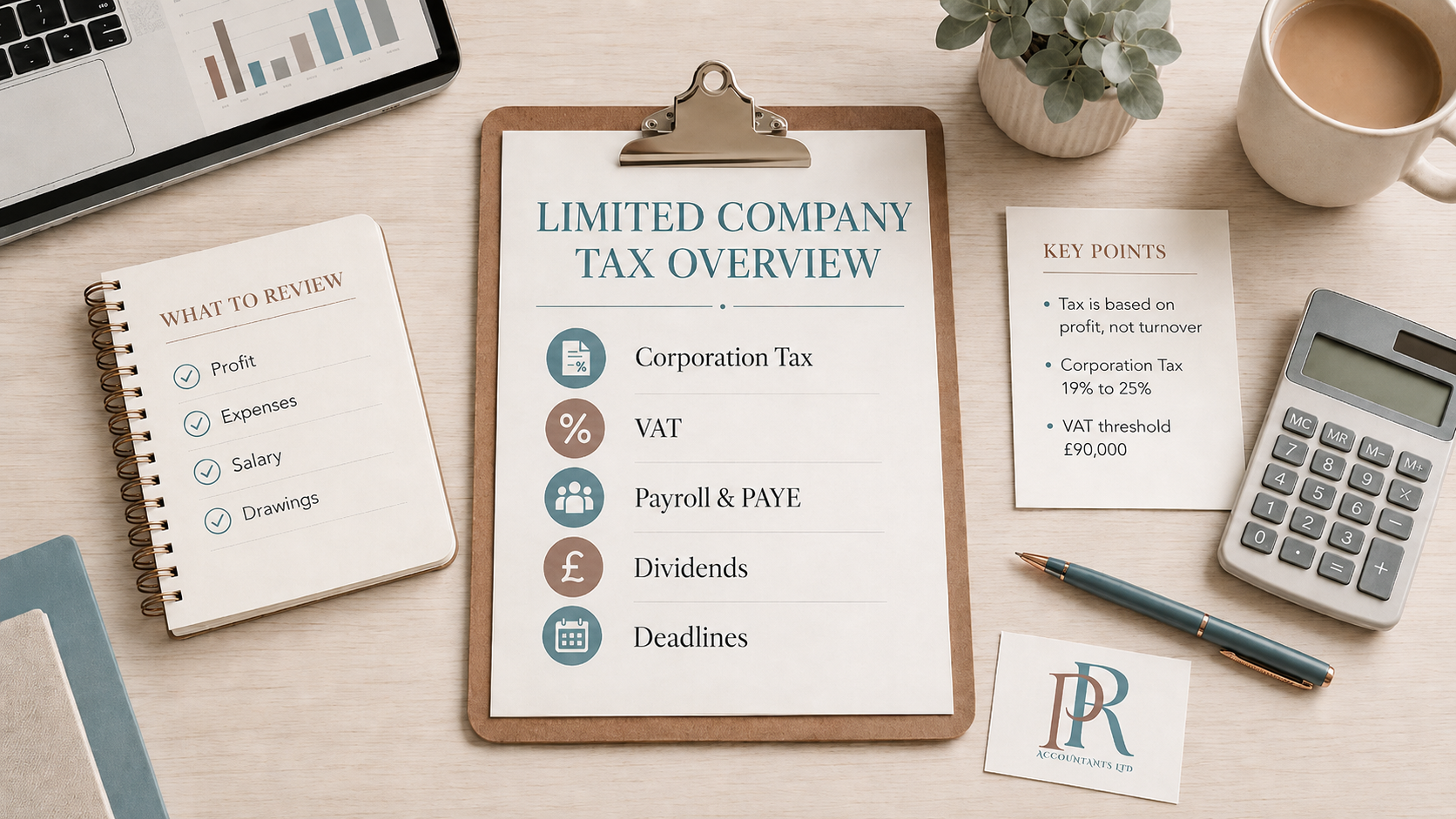
Corporation Tax is usually the main tax paid by a limited company. However, VAT, payroll taxes, Employer’s National Insurance and personal tax on salary or dividends can also affect the overall position.
The important starting point is that a limited company is a separate legal entity from its directors and shareholders.
The company pays tax on its own taxable profits. Directors and shareholders may then pay tax personally when they receive salary, dividends, benefits or other income from the company.
Does a limited company pay tax on turnover or profit?
A limited company does not usually pay Corporation Tax on its total sales income. It pays Corporation Tax on its taxable profit.
Taxable profit is broadly calculated by:
• Starting with sales income and other company income.
• Deducting allowable business expenses incurred wholly and exclusively for the company’s trade.
• Making any necessary tax adjustments for items such as capital allowances, non-allowable expenses, pension contributions, losses brought forward and other tax reliefs.
For example, a company with sales of £200,000 does not automatically pay Corporation Tax on £200,000.
If its allowable expenses total £150,000, its starting profit may be £50,000. The final taxable profit may then be adjusted for items such as capital allowances, non-allowable expenses, pension contributions, losses brought forward or other tax reliefs.
This is why turnover alone does not tell you how much Corporation Tax a company will pay.
Corporation Tax rates for limited companies
For most UK limited companies, the Corporation Tax rate depends on the level of taxable profit.
• Taxable profits of £50,000 or less are generally subject to the small profits rate of 19%.
• Taxable profits between £50,000 and £250,000 are generally subject to the 25% main rate, reduced by Marginal Relief where available.
• Taxable profits above £250,000 are generally subject to the main Corporation Tax rate of 25%.
Marginal Relief prevents a sudden jump from 19% to 25%.
Instead, the effective Corporation Tax rate increases gradually as taxable profits rise between £50,000 and £250,000.
Important: the £50,000 and £250,000 thresholds are not always available in full
The standard Corporation Tax thresholds assume that:
• Your company has a 12-month accounting period.
• Your company has no associated companies.
The thresholds can be reduced where:
• Your company has associated companies. The £50,000 and £250,000 limits may need to be divided between associated companies.
• Your accounting period is shorter than 12 months. The thresholds are reduced proportionately.
This is an important point for business owners with multiple companies under common control. Creating several companies does not automatically create access to several full £50,000 Corporation Tax thresholds.
Examples of Corporation Tax payable
The following examples are simplified and assume:
• A 12-month accounting period.
• No associated companies.
• No losses brought forward.
• No special reliefs.
• No chargeable gains.
• No research and development claims.
• No overseas tax issues.
Examples of the approximate Corporation Tax payable are:
• Taxable profit of £30,000: approximately £5,700 Corporation Tax.
• Taxable profit of £50,000: approximately £9,500 Corporation Tax.
• Taxable profit of £150,000: approximately £36,000 Corporation Tax.
• Taxable profit of £300,000: approximately £75,000 Corporation Tax.
A company with £30,000 taxable profit would generally pay Corporation Tax at 19%.
A company with £300,000 taxable profit would generally pay Corporation Tax at 25%.
A company with taxable profits between £50,000 and £250,000 needs a Marginal Relief calculation. This is why the tax payable is not simply a single percentage applied to the full profit figure.
What expenses reduce Corporation Tax?
Corporation Tax is calculated after deducting expenses that are incurred wholly and exclusively for the company’s trade.
Common allowable costs may include:
• Staff salaries and wages.
• Employer’s National Insurance contributions.
• Employer pension contributions.
• Accountancy and legal fees.
• Business insurance.
• Rent and utility costs.
• Software subscriptions.
• Advertising and marketing.
• Travel for genuine business purposes.
• Stock and materials.
• Repairs and maintenance.
• Professional subscriptions relevant to the business.
• Interest on qualifying business borrowing.
Some costs need a different tax treatment.
For example, equipment, vehicles, computers and machinery may qualify for capital allowances rather than being deducted as an ordinary business expense.
The following costs are not normally allowable for Corporation Tax purposes:
• Dividends paid to shareholders.
• Most client entertainment.
• Fines and penalties.
• Personal expenses.
• Depreciation charged in the accounts.
Depreciation is usually added back for tax purposes. Relief may instead be claimed through capital allowances where available.
Good bookkeeping is essential because it helps identify the genuine business costs that reduce taxable profit while preventing personal expenditure from being incorrectly claimed through the company.
Is VAT included in Corporation Tax?
VAT and Corporation Tax are separate taxes.
Corporation Tax is based on the company’s taxable profit.
VAT is a tax charged on certain goods and services. A business may have to register for VAT when its taxable turnover exceeds the VAT registration threshold.
The current compulsory VAT registration threshold is £90,000 of taxable turnover over a rolling 12-month period.
VAT is not normally a profit tax.
A VAT-registered business collects VAT from customers and may reclaim VAT on qualifying business costs. The difference is then paid to HMRC or reclaimed, depending on the circumstances.
However, VAT can affect cashflow and pricing. It should be monitored carefully, particularly where turnover is close to the registration threshold.
Does a limited company pay tax on salaries?
Where a company pays salaries to directors or employees, it normally needs to operate payroll.
The company may need to deduct:
• Income Tax through PAYE.
• Employee National Insurance contributions.
• Student loan repayments where applicable.
• Pension contributions where relevant.
The company may also need to pay Employer’s National Insurance contributions.
For the 2026/27 tax year, Employer’s National Insurance is normally charged at 15% above the relevant secondary threshold.
Salary, Employer’s National Insurance and employer pension contributions may usually reduce the company’s taxable profit, provided they are genuine business costs.
However, the company’s tax saving must be considered alongside the personal tax position of the director or employee receiving the salary.
What happens when profits are taken as dividends?
Dividends are not an allowable business expense for Corporation Tax purposes.
A company pays Corporation Tax on its taxable profits first. It may then pay dividends to shareholders from available distributable profits.
The shareholder may have personal tax to pay on dividends received.
For the 2026/27 tax year:
• Individuals generally have a £500 dividend allowance.
• Dividend income within the basic rate band is generally taxed at 10.75%.
• Dividend income within the higher rate band is generally taxed at 35.75%.
• Dividend income within the additional rate band is generally taxed at 39.35%.
The tax position depends on the shareholder’s full income, including salary, rental income, savings income, pensions and other dividends.
This means there is no single answer to the question: “Is salary or dividends more tax efficient?”
The right approach depends on the company’s profit, the director’s personal income, National Insurance, available allowances, pension planning, future business investment and wider financial objectives.
Is Corporation Tax the only tax a company may pay?
No. Corporation Tax is usually the main direct tax on company profit, but other taxes can apply depending on how the business operates.
A limited company may also have obligations relating to:
• VAT.
• PAYE.
• Employer’s National Insurance.
• Class 1A National Insurance on taxable benefits.
• Business rates.
• Customs duties and import VAT.
• Construction Industry Scheme deductions.
• Stamp taxes on certain transactions.
• Sector-specific taxes or levies.
Not every company will pay all of these taxes.
For example, a small consultancy business with no employees and turnover below the VAT threshold may mainly deal with Corporation Tax and the director’s personal tax position.
A growing employer with staff, VAT registration and premises may have a much wider range of tax and reporting obligations.
What about money withdrawn from the company bank account?
Money leaving the company bank account is not automatically tax-free or automatically a dividend.
Amounts paid to a director must be recorded correctly. They may be:
• Salary, paid through payroll and subject to PAYE and National Insurance where relevant.
• Dividends, paid from available distributable profits after Corporation Tax.
• Reimbursement of genuine business expenses.
• Repayment of money previously lent to the company.
• Employer pension contributions.
• A director’s loan.
A director’s loan account should be reviewed regularly.
If money is withdrawn without being treated as salary, dividends or a legitimate reimbursement, it may create an overdrawn director’s loan account. This can result in additional company tax charges or personal tax consequences if not managed correctly.
The company bank account should not be treated as an extension of the director’s personal account.
When does a limited company pay Corporation Tax?
For most smaller companies, the key deadlines are:
• Corporation Tax payment deadline: nine months and one day after the end of the accounting period.
• Company Tax Return filing deadline: 12 months after the end of the accounting period.
For example, where a company has a 31 March year-end:
• Corporation Tax is normally due by 1 January of the following year.
• The Company Tax Return is normally due by 31 March of the following year.
Larger companies with taxable profits above £1.5 million may need to pay Corporation Tax in instalments.
Common misconceptions about limited company tax
“My company pays Corporation Tax on all money received.”
Not usually. Corporation Tax is based on taxable profit, not gross sales income.
“All limited companies pay 19% Corporation Tax.”
No. The 19% small profits rate generally applies only where taxable profits are £50,000 or less, subject to associated company and accounting period rules.
“Dividends reduce Corporation Tax.”
No. Dividends are paid from profit after Corporation Tax. They are not deductible when calculating taxable profit.
“VAT is a tax on profit.”
No. VAT is based on taxable sales and purchases. It affects cashflow and pricing, but it is separate from Corporation Tax.
“I can wait until the Company Tax Return deadline to pay Corporation Tax.”
No. Corporation Tax is normally due before the Company Tax Return filing deadline.
“The money in the company bank account is available to withdraw as dividends.”
Not necessarily. A company needs sufficient distributable profits before declaring dividends. Cash in the bank does not always equal distributable profit.
How can a company reduce its tax bill legitimately?
Tax planning should focus on making sure the company claims appropriate reliefs and structures transactions correctly.
This may include:
• Keeping complete bookkeeping records.
• Claiming all genuine business expenses.
• Reviewing capital allowance claims.
• Considering employer pension contributions.
• Managing losses correctly.
• Reviewing the timing of capital expenditure.
• Planning salary and dividends together.
• Monitoring VAT registration.
• Reviewing director’s loan account balances.
• Checking whether there are associated companies.
• Forecasting Corporation Tax before the year-end.
The aim is not to create artificial arrangements. It is to understand the rules, claim available reliefs and make business decisions with clear tax information.
Contact us
There is no single tax rate that applies to every limited company.
The amount of tax payable depends on the company’s taxable profit, expenses, associated companies, VAT position, payroll costs and how profits are taken by directors and shareholders.
At PR Accountants Ltd, we help limited companies with bookkeeping, statutory accounts, Corporation Tax returns, VAT, payroll and director tax planning.
Contact us for clear advice on how much tax your company is likely to pay and how to plan ahead.
Related articles
• Self Assessment for Company Directors: What Income Needs Reporting?