
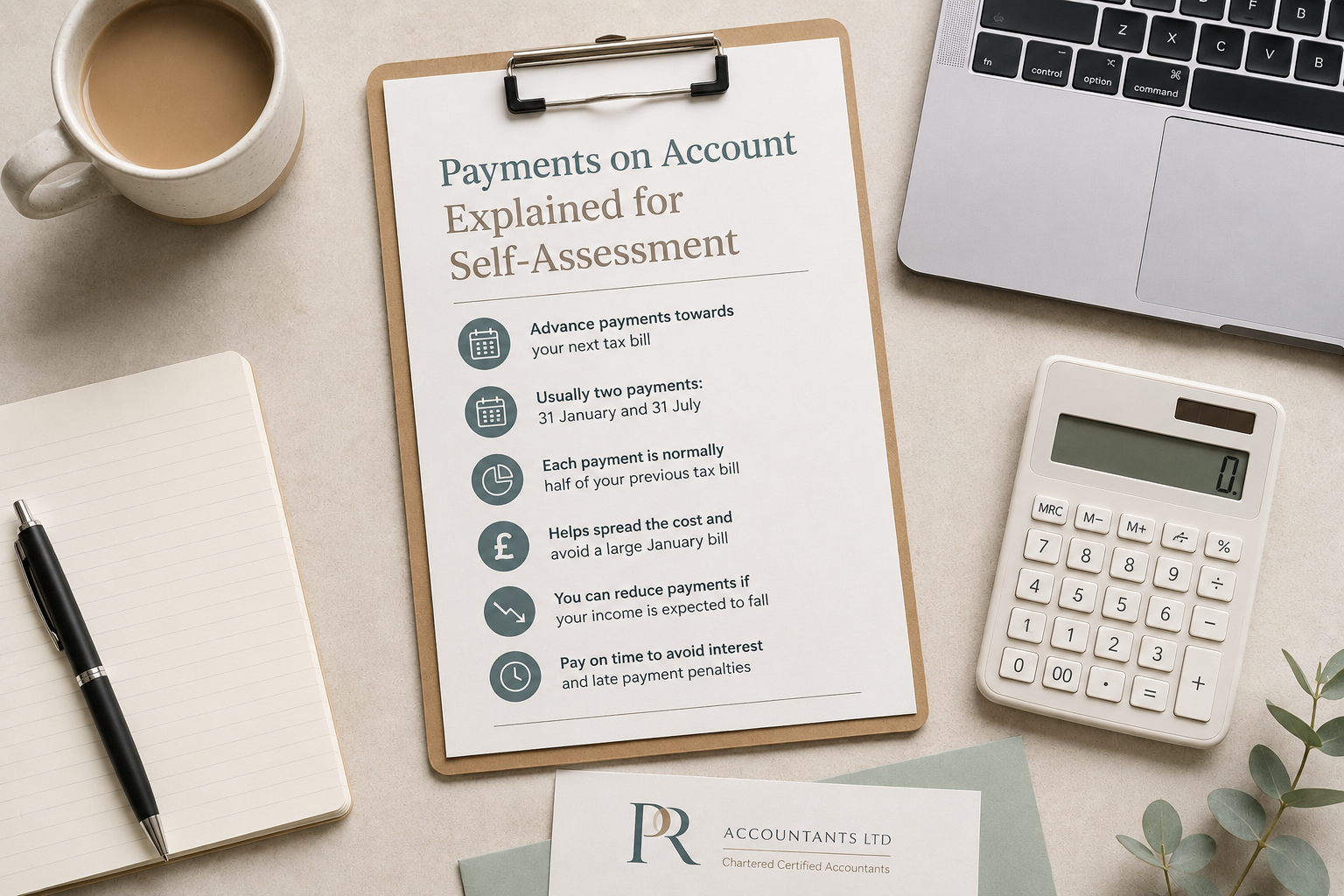
Payments on Account Explained for Self Assessment
Many taxpayers are surprised when they receive their first Self Assessment tax bill and find that the amount due is much higher than expected.
This is often because the bill includes more than tax for the previous year. It may also include a payment on account towards the following tax year.
Payments on account are not an extra tax charge. They are advance payments towards your next Self Assessment tax bill.
However, they can create a significant cashflow issue if you have not budgeted for them.
This guide explains what payments on account are, who needs to make them, how they are calculated, when they are due and when you may be able to reduce them.
What are payments on account?
Payments on account are advance payments towards your next Income Tax bill.
They are usually relevant where you receive income that is not fully taxed at source, such as:
- Sole trader profits
- Partnership income
- Rental income
- Dividends
- Savings and investment income
- Other untaxed income
- Some forms of foreign income
For self-employed individuals, payments on account can also include Class 4 National Insurance contributions.
HMRC usually asks for two payments on account each year. Each payment is normally equal to half of the previous year’s relevant tax bill.
The first payment is due on 31 January and the second payment is due on 31 July.
Why do payments on account cause confusion?
The first year is usually the biggest shock.
When you submit your first Self Assessment tax return, you may need to pay:
- The full tax due for the previous tax year
- The first payment on account towards the following tax year
You then make the second payment on account six months later.
This can mean that the first January bill is substantially higher than the tax you expected to pay for the year that has just ended.
For example, if your Self Assessment tax bill for the 2025/26 tax year is £4,000 and you have not made payments on account before, your payment due by 31 January 2027 could be: Payment Amount Tax due for 2025/26 £4,000, First payment on account for 2026/27 £2,000, Total due by 31 January 2027 £6,000.
A second payment on account of £2,000 would then usually be due by 31 July 2027.
This does not mean you are being taxed twice. The two payments on account are advance payments towards your 2026/27 tax bill.
Who has to make payments on account?
You will usually need to make payments on account where both of the following apply:
- Your Self Assessment tax bill for the previous year was more than £1,000.
- Less than 80% of your tax was collected at source, such as through PAYE.
For example, a company director who receives a small salary through PAYE but also receives substantial dividends may need to make payments on account.
A landlord receiving rental income that has not been taxed at source may also need to make payments on account.
A sole trader with taxable business profits will often need to make them as well.
You may not need to make payments on account if:
- Your relevant Self Assessment tax bill was less than £1,000.
- More than 80% of your tax was already collected through PAYE or another source deduction method.
HMRC will normally calculate this automatically once your tax return has been submitted.
What tax is included in payments on account?
Payments on account usually cover Income Tax and, where relevant, Class 4 National Insurance contributions.
They do not usually cover every amount that may appear on your Self Assessment calculation.
For example, Capital Gains Tax and student loan repayments are generally dealt with through the balancing payment instead.
This means your final January tax bill can still be higher than expected, even where you have already made two payments on account.
When are payments on account due?
The two standard due dates are: Payment Usual due date First payment on account 31 January, Second payment on account 31 July.
For the 2026/27 tax year, this would normally mean: Payment Due date for First payment on account for 2026/27 is 31 January 2027, Second payment on account for 2026/27 is 31 July 2027 and Any balancing payment for 2026/27will be on 31 January 2028.
The January payment can include more than one amount.
For taxpayers already making payments on account, the January bill may include:
- Any balancing payment for the previous tax year
- The first payment on account for the following tax year
This is why January often becomes the most important Self Assessment payment date of the year.
How are payments on account calculated?
Each payment on account is normally 50% of the previous year’s relevant tax bill.
For example, if your relevant Self Assessment tax bill for the year was £6,000, HMRC would normally ask for: Payment Amount for First payment on account = £3,000. Second payment on account = £3,000. Total paid towards the following year = £6,000
HMRC assumes that your income and tax position will be broadly similar in the following year.
However, your actual tax bill may be higher or lower when the year ends.
If your tax bill is higher than the amount you paid through payments on account, you will need to make a balancing payment.
If your tax bill is lower, you may receive a repayment or have the overpayment offset against future tax due.
What is a balancing payment?
A balancing payment is the difference between:
- Your actual tax liability for the year
- The payments on account you have already made
For example, imagine you made two payments on account of £2,000 each during the year.
You have therefore paid £4,000 in advance.
When your Self Assessment tax return is completed, your actual tax liability for the year is £5,200.
You would have a balancing payment of £1,200.
That balancing payment would normally be due by 31 January following the end of the tax year.
If your actual tax liability was only £3,500, you would have overpaid by £500. HMRC may repay this amount or use it against future amounts due.
Why company directors often face payments on account
Company directors commonly receive income through a mix of salary, dividends and other sources.
A director may take a salary through payroll, which is taxed under PAYE, but then receive dividends that create an additional personal tax liability.
Where the dividend tax due is substantial, HMRC may require payments on account.
This can be particularly common where:
- A director starts taking dividends for the first time
- Dividend income increases significantly
- A director also receives rental income
- A director receives investment or savings income
- A director has foreign income
- A director sells assets and has a wider Self Assessment liability
The important point is that payments on account apply to your personal tax position. They are separate from your company’s Corporation Tax, VAT, PAYE and other company liabilities.
Can you reduce payments on account?
Yes. You can ask HMRC to reduce your payments on account if you reasonably expect your tax bill for the current year to be lower than the previous year.
This may be appropriate where:
- Your business profits have fallen
- Rental income has reduced
- You have stopped trading
- You expect lower dividends
- You have moved into employment and more tax will be collected through PAYE
- You expect more tax reliefs or allowances
- Your taxable income has reduced for another genuine reason
For example, you may have paid tax on substantial dividends in one year but expect to take much lower dividends in the following year.
In that case, leaving payments on account unchanged may create an unnecessary cashflow burden.
However, payments should not be reduced simply because paying them feels difficult.
You need a realistic estimate of your likely tax position for the year.
What happens if you reduce payments too much?
Reducing payments on account can be appropriate, but it should be done carefully.
If you reduce them too far and your final tax bill is higher than expected, HMRC can charge interest on the shortfall from the original payment due dates.
This means interest may apply from 31 January or 31 July, even if you only discover the shortfall when completing your tax return later.
Where a reduction claim has been made carelessly or without a reasonable basis, further consequences may also arise.
Before reducing payments on account, it is sensible to review:
- Current business profits
- Expected dividends
- Rental income
- PAYE income and tax deducted
- Investment income
- Pension contributions
- Gift Aid payments
- Other tax reliefs
- Any expected capital gains or losses
What if your income has increased?
Payments on account are based on the previous year, so they may not be enough where your income has increased significantly.
For example, if your business profits rise sharply or you take higher dividends than the previous year, the two payments on account may not cover your eventual tax bill.
In this situation, you may still face a balancing payment in January.
It is often sensible to make additional voluntary payments during the year if you know your income has increased.
This can reduce the amount due at the final deadline and help prevent a large January bill.
How to budget for payments on account
The simplest way to manage payments on account is to plan for tax throughout the year rather than waiting until your tax return is prepared.
Useful steps include:
- Keep your bookkeeping up to date
- Review profit regularly
- Track dividends taken from your company
- Set aside money for tax each month
- Keep personal tax funds separate from business spending
- Review your tax position before 31 January and 31 July
- Submit your Self Assessment return early where possible
- Consider regular payments towards your tax bill through HMRC’s Budget Payment Plan
Submitting your tax return early does not make the tax due earlier. It gives you time to understand the amount due and plan for it properly.
What happens if you cannot pay on time?
Ignoring a Self Assessment payment is not advisable.
HMRC can charge interest on late payments and may charge late payment penalties where amounts remain unpaid.
If you expect to have difficulty paying, take action before the deadline rather than waiting for HMRC to contact you.
Depending on your circumstances, you may be able to arrange a Time to Pay agreement with HMRC.
Any arrangement should be agreed promptly and must be kept to.
The earlier you review your tax position, the more options you are likely to have.
Common mistakes to avoid
Payments on account are straightforward once you understand the principle, but there are several common mistakes.
These include:
- Assuming the January bill relates only to the previous tax year
- Treating payments on account as an extra tax charge
- Forgetting about the July payment
- Reducing payments without a proper estimate
- Assuming Corporation Tax and personal Income Tax are the same thing
- Failing to plan for tax on dividends
- Waiting until January to prepare your Self Assessment information
- Spending money that should have been set aside for tax
- Ignoring a payment because income has reduced without formally claiming a reduction
Good records, regular tax planning and early preparation can prevent most of these issues.
Contact us
Payments on account can be confusing, particularly in the first year that you have significant self-employed profits, rental income, dividends or other untaxed income.
At PR Accountants Ltd, we help sole traders, landlords and company directors understand their Self Assessment obligations, calculate likely tax liabilities, review payments on account and plan ahead for January and July deadlines.
Contact us for clear advice on your tax position and support with managing your Self Assessment obligations.