
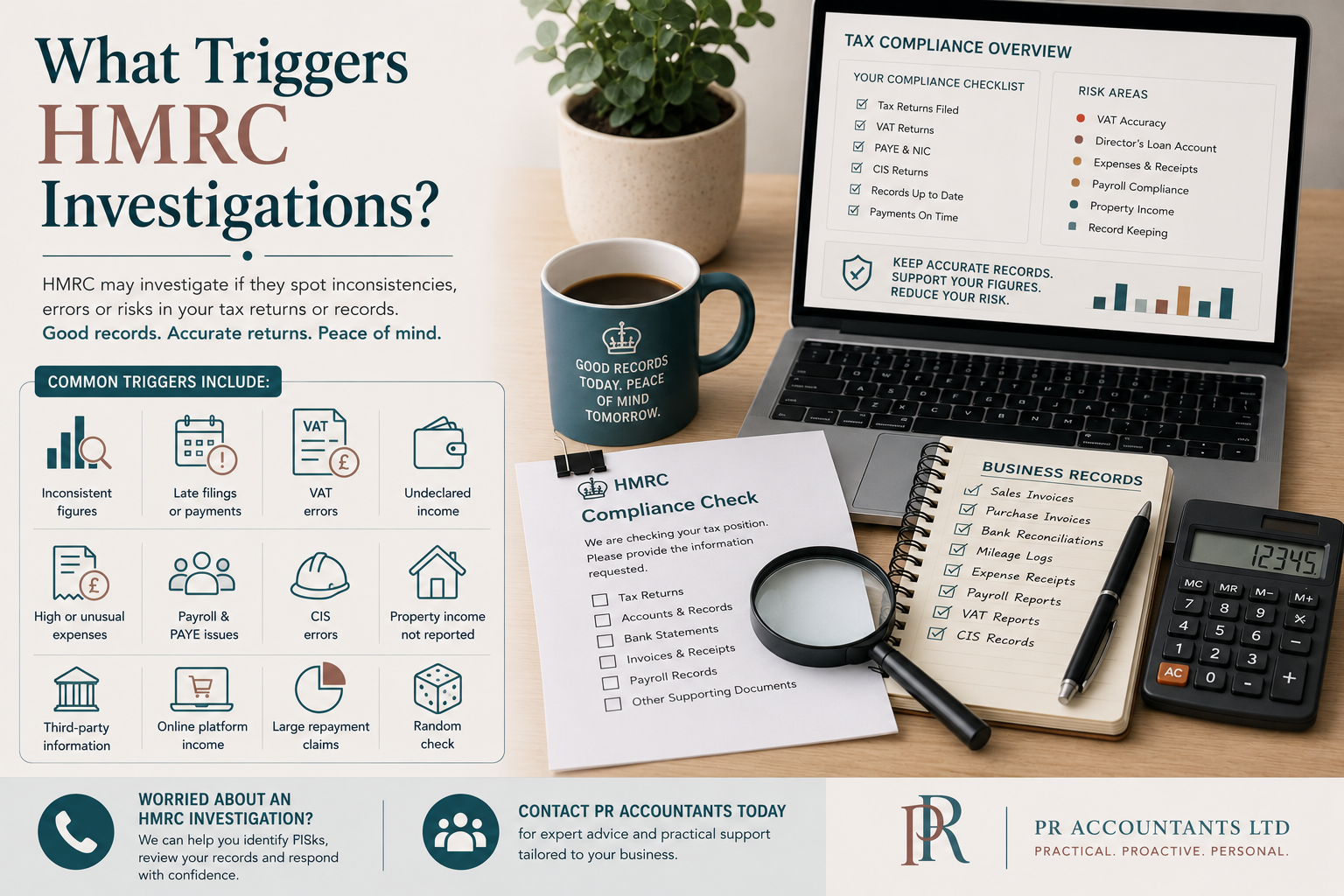
What Triggers HMRC Investigations?
No business owner wants to receive a letter from HMRC saying their tax affairs are being checked.
An HMRC investigation, often referred to as a compliance check, can be stressful, time-consuming and expensive if the records are not in good order.
However, an HMRC check does not always mean the business has done something wrong.
Sometimes HMRC checks a return because something looks unusual. Sometimes it is because information does not match. Sometimes it is part of a wider compliance campaign. Some checks may also be selected randomly.
The important point is this:
Good records, accurate tax returns and early action are your best protection.
This guide explains common triggers for HMRC investigations and what business owners can do to reduce risk.
What Is an HMRC Investigation?
An HMRC investigation is a review of a person’s or business’s tax position.
HMRC may check whether:
- the right amount of tax has been paid
- tax returns are accurate
- VAT has been reported correctly
- PAYE and payroll records are correct
- CIS deductions have been dealt with properly
- expenses are allowable
- income has been fully declared
- tax reliefs and allowances have been claimed correctly
- records support the figures submitted
HMRC may call it a compliance check, enquiry, review or investigation depending on the tax involved and the circumstances.
The check may focus on one area, such as VAT, or it may look more widely at the business.
Does an HMRC Investigation Mean You Have Done Something Wrong?
Not always.
HMRC can open checks for different reasons.
A check may happen because:
- HMRC has identified a risk
- figures look unusual compared with previous years
- third-party information does not match the tax return
- a business sector is being reviewed
- a repayment claim looks high
- a return contains errors
- the business has a pattern of late filing or late payment
- the taxpayer has been selected randomly
That said, even if the check starts routinely, it can become more serious if HMRC finds errors, poor records or undeclared income.
This is why it is important to take HMRC letters seriously from the start.
1. Inconsistent Tax Return Figures
One common trigger is inconsistency.
HMRC may question figures that do not appear to fit together.
Examples may include:
- sales falling sharply while expenses increase
- profit margins changing significantly without explanation
- high expenses compared with turnover
- dividends paid when company profits appear low
- VAT returns not matching accounts
- payroll costs that do not match business activity
- director withdrawals that are not explained
- rental income that does not match property ownership information
Practical Example
A company reports turnover of £180,000 one year and £70,000 the next year, but expenses remain almost the same.
There may be a perfectly reasonable explanation, such as losing a major client or changing the business model.
However, if the figures are not clearly supported by records, HMRC may ask questions.
2. Late Tax Returns and Late Payments
A one-off late tax return may not automatically cause an investigation, but repeated late filing or late payment can increase risk.
HMRC may become concerned if a business regularly misses deadlines for:
- VAT returns
- Corporation Tax returns
- Self Assessment returns
- PAYE submissions
- CIS returns
- tax payments
Repeated delays can suggest weak systems, poor bookkeeping or cashflow problems.
Practical Example
A VAT-registered business submits several VAT returns late and regularly pays VAT after the deadline.
HMRC may want to understand whether the business is keeping proper VAT records, whether VAT is being calculated correctly and whether the business is financially stable.
3. VAT Errors
VAT is a common area for HMRC checks because errors can build quickly.
VAT risks may include:
- late VAT registration
- incorrect VAT codes
- claiming VAT without valid VAT invoices
- claiming VAT on non-business expenses
- failing to apply domestic reverse charge VAT correctly
- treating exempt and taxable income incorrectly
- using the wrong VAT scheme
- incorrect flat rate scheme treatment
- failing to monitor the VAT threshold
- recording only net platform payouts instead of gross income
- not reconciling VAT returns to bookkeeping records
Practical Example
A business approaches the VAT threshold but continues trading without registering.
HMRC may later identify that taxable turnover exceeded the threshold months earlier.
This can lead to backdated VAT, interest and penalties.
VAT should be monitored on a rolling basis, not just at year-end.
4. Undeclared Income
Undeclared income is one of the most serious risk areas.
HMRC may receive information from many sources, including banks, platforms, customers, property records, Companies House, payment processors and other third parties.
Risk areas may include:
- cash sales not recorded
- rental income not declared
- Airbnb or serviced accommodation income missed
- overseas income omitted
- side income not included
- dividends or interest not declared
- CIS income not reported correctly
- platform income recorded only after fees
- personal bank receipts not reviewed
Practical Example
A landlord receives rental income into a personal bank account but does not include it on their Self Assessment tax return.
HMRC may identify rental activity from property ownership data, letting agent records or other information sources.
This can lead to a Let Property Campaign disclosure or a direct HMRC enquiry.
5. High Expense Claims
High expenses are not automatically wrong.
Some businesses genuinely have high costs.
However, HMRC may question expenses that appear unusual, excessive or unsupported.
Examples include:
- large travel costs
- high motor expenses
- significant entertaining costs
- personal costs claimed as business expenses
- large repairs and maintenance costs
- home office claims without evidence
- training costs that appear personal
- clothing costs that are not allowable
- large subcontractor costs
- unexplained consultancy fees
Practical Example
A company claims a large amount for travel, meals and entertainment but has no clear business records or receipts.
HMRC may ask whether the expenses were genuinely incurred wholly and exclusively for business purposes.
Good records are essential.
6. Mixing Business and Personal Spending
Business owners sometimes use the company bank card for personal costs.
This can create problems, especially for limited companies.
The issue is not always that the transaction happened. The issue is whether it has been treated correctly.
Personal spending through a company may need to be treated as:
- director’s loan account transactions
- salary
- dividends
- expenses reimbursed incorrectly
- benefits in kind
- disallowed expenses
Practical Example
A director uses the company card for holidays, personal shopping and household bills.
If the bookkeeping records these as business expenses, the company accounts and tax return may be wrong.
This could trigger questions from HMRC and create director’s loan account issues.
7. Director’s Loan Account Problems
Director’s loan accounts are a common area of confusion.
HMRC may look closely at director withdrawals, especially where:
- dividends appear unsupported by profits
- the director takes regular cash withdrawals
- personal costs are paid by the company
- the director’s loan account is overdrawn
- loans are repaid and redrawn repeatedly
- company tax is unpaid while directors continue withdrawing money
- bookkeeping does not clearly explain payments
Practical Example
A company has low profit but the director has taken large regular withdrawals.
If these withdrawals are not salary, dividends or genuine expense reimbursements, they may create an overdrawn director’s loan account.
This can lead to Corporation Tax and personal tax issues.
8. Dividends That Do Not Match Profits
Dividends can only be paid from available distributable profits.
If a company pays dividends without enough profits, this can create problems.
HMRC may question dividend treatment where:
- the company has losses
- bookkeeping is not up to date
- there are no dividend vouchers or minutes
- bank transfers are labelled as dividends after the event
- Corporation Tax and VAT are unpaid
- the director withdraws fixed monthly amounts regardless of profit
Practical Example
A director withdraws £5,000 per month and calls it dividends.
At year-end, the accounts show the company did not have enough profit to support those dividends.
Some withdrawals may need to be treated differently, creating tax and director’s loan consequences.
9. Payroll and PAYE Issues
Employers have regular reporting responsibilities.
HMRC may check payroll where there are:
- late FPS submissions
- payroll not matching payments to employees
- directors paid without correct payroll treatment
- benefits not reported
- PAYE or National Insurance unpaid
- employee status concerns
- casual workers paid incorrectly
- payroll journals not posted properly
- expenses reimbursed without review
Practical Example
A company pays workers regularly but does not operate payroll correctly.
HMRC may question whether the workers should have been treated as employees and whether PAYE and National Insurance should have been deducted.
This can become expensive if errors go back several years.
10. CIS Errors in Construction Businesses
Construction businesses can face HMRC checks where CIS records are weak.
Common CIS risk areas include:
- not registering as a contractor
- failing to verify subcontractors
- using the wrong CIS deduction rate
- late CIS monthly returns
- missing deduction statements
- incorrect treatment of materials
- confusing CIS and VAT
- failing to claim CIS suffered correctly
- treating workers as subcontractors when employment status suggests otherwise
Practical Example
A building company pays several subcontractors but does not verify them with HMRC.
It deducts CIS inconsistently and files returns late.
HMRC may check whether the company has operated CIS correctly and whether any penalties or unpaid deductions are due.
11. Cash-Based Businesses
Cash businesses can attract more attention because income may be easier to under-record.
This does not mean all cash businesses are doing anything wrong.
However, HMRC may expect strong records for businesses such as:
- takeaways
- restaurants
- salons
- market traders
- taxi businesses
- cleaning businesses
- small retail shops
- tradespeople
- hospitality businesses
Good records should show:
- daily sales
- till reports
- card payments
- cash banking
- supplier purchases
- stock movements
- cash expenses
- owner drawings
Practical Example
A takeaway reports very low cash sales but supplier purchases and card sales suggest higher activity.
HMRC may ask for evidence to explain the figures.
12. Lifestyle That Does Not Match Declared Income
HMRC may ask questions where a person’s lifestyle appears inconsistent with declared income.
This may be relevant where there are:
- low declared profits
- large personal spending
- expensive vehicles
- significant property purchases
- overseas travel
- large mortgage payments
- unexplained bank deposits
- private school fees
- personal investments
There may be a legitimate explanation, such as savings, inheritance, gifts, spouse income or loans.
However, records should be available to support the explanation.
13. Large Repayment Claims
Claims for tax repayments can attract attention, especially where they are unusual or significant.
Examples include:
- VAT repayment claims
- CIS repayment claims
- Self Assessment repayment claims
- Corporation Tax losses carried back
- Research and Development claims
- capital allowance claims
- employment expense claims
A repayment claim is not wrong just because it is large.
However, HMRC may ask for evidence before releasing the repayment.
Practical Example
A company submits a large VAT repayment claim due to refurbishment costs.
HMRC may ask for invoices, bank payments, business purpose evidence and details of taxable activity before releasing the repayment.
14. Property Income and Landlord Tax Risks
Landlord tax is a common HMRC focus area.
Risk areas may include:
- rental income not declared
- rental income split incorrectly between spouses
- mortgage interest treated incorrectly
- repairs claimed as improvements or vice versa
- capital costs claimed as revenue expenses
- property sales not reported for Capital Gains Tax
- serviced accommodation VAT issues
- platform income omitted
- letting agent statements not reconciled
Practical Example
A landlord sells a rental property but does not report the capital gain within the required timeframe.
HMRC may later identify the sale from property transaction records.
This can lead to penalties, interest and additional tax.
15. Companies House and Tax Return Differences
HMRC can compare information across different sources.
For companies, inconsistencies may arise between:
- Companies House accounts
- Corporation Tax returns
- VAT returns
- PAYE records
- bank records
- director Self Assessment returns
- dividend records
- confirmation statements
- shareholder records
Practical Example
A company files accounts showing one level of profit, but the tax return, VAT returns and director dividend reporting do not appear to align.
This may prompt questions.
The figures should tell a consistent story.
16. Third-Party Information
HMRC receives and uses information from many sources.
This may include:
- banks
- Companies House
- Land Registry
- letting agents
- online platforms
- employers
- pension providers
- overseas tax authorities
- payment processors
- government departments
- customers and suppliers
- other tax returns
This means omissions can be identified even where the taxpayer has not reported the income.
Practical Example
A person receives income from an online platform but does not declare it.
HMRC may receive platform data and compare it with tax returns.
If there is a mismatch, HMRC may contact the taxpayer.
17. Sector-Specific Campaigns
HMRC may focus on certain industries or types of income.
Examples of areas that can receive attention include:
- landlords
- construction businesses
- online sellers
- cash businesses
- overseas income
- crypto transactions
- platform income
- hospitality
- directors and dividends
- VAT-registered businesses
A sector focus does not mean everyone in that sector is non-compliant.
It means HMRC may consider there to be a higher risk of errors or under-reporting.
18. Random Checks
Not every HMRC check is triggered by a specific error.
Some checks may be random.
This is important because even a well-run business can be selected.
The difference is that a well-run business with clean records is usually in a much better position to respond.
Random checks are another reason to keep records properly throughout the year.
What Happens During an HMRC Check?
The process depends on the type of check.
HMRC may:
- write to the taxpayer
- ask questions about a return
- request records or documents
- ask for explanations of specific figures
- request bank statements
- ask to inspect business records
- visit business premises
- speak to the taxpayer or their adviser
- issue an information notice
- calculate additional tax
- charge interest and penalties where appropriate
Business owners should not ignore HMRC requests.
If information is requested, it should be reviewed carefully before being sent.
What Records Might HMRC Ask For?
HMRC may ask for:
- bank statements
- sales invoices
- purchase invoices
- receipts
- VAT reports
- payroll records
- CIS records
- bookkeeping reports
- till records
- contracts
- loan agreements
- dividend vouchers
- board minutes
- director’s loan account details
- property statements
- letting agent statements
- mortgage interest statements
- platform reports
- mileage logs
- proof of business expenses
The records requested will depend on the area being checked.
What Are the Possible Outcomes?
An HMRC check may result in:
- no change
- tax being repaid
- extra tax being due
- interest being charged
- penalties being charged
- future record-keeping recommendations
- wider checks if serious issues are found
The outcome often depends on:
- whether the original return was correct
- whether errors were careless or deliberate
- whether the taxpayer cooperates
- whether disclosure was made early
- quality of supporting records
- whether the issue was corrected promptly
Can Penalties Be Reduced?
Penalties may depend on behaviour.
For example, HMRC may look at whether an error was:
- a genuine mistake
- careless
- deliberate
- deliberately concealed
Cooperation can matter.
Penalty reductions may be possible where the taxpayer:
- tells HMRC about the issue
- helps HMRC understand what happened
- gives access to records
- answers questions properly
- corrects the position
- takes steps to prevent the issue happening again
This is why it is usually better to deal with issues openly and professionally.
What Should You Do If HMRC Contacts You?
If you receive an HMRC compliance check letter:
1. Do Not Ignore It
Check the deadline for responding.
2. Read the Letter Carefully
Identify:
- which tax is being checked
- which period is involved
- what information HMRC wants
- response deadline
- whether penalties are mentioned
- whether an information notice has been issued
3. Speak to Your Accountant
Do not send records without understanding what HMRC is asking for.
4. Review the Records
Check whether the tax return, VAT return, payroll or accounts are correct.
5. Be Honest About Errors
If there is an error, deal with it properly.
6. Keep Copies of Everything
Keep records of letters, documents sent and conversations.
How to Reduce the Risk of HMRC Problems
You cannot guarantee that HMRC will never check your tax affairs.
But you can reduce risk by:
- keeping accurate bookkeeping records
- filing returns on time
- paying tax on time
- reconciling VAT regularly
- declaring all income
- keeping business and personal spending separate
- documenting dividends properly
- reviewing director’s loan accounts
- keeping payroll records accurate
- verifying CIS subcontractors
- keeping property records by property
- retaining invoices and receipts
- reviewing unusual transactions before filing
- preparing management accounts
- using an accountant before problems arise
Good compliance is not just about tax returns.
It is about having the evidence to support them.
Practical Scenario: Good Records
A company receives an HMRC letter asking about VAT returns.
The company has:
- reconciled bookkeeping
- VAT reports
- valid invoices
- bank statements
- clear expense records
- copies of submitted returns
- accountant review notes
The response is organised and the check is easier to manage.
Even if there is a small error, it can be explained and corrected.
Practical Scenario: Poor Records
Another company receives a similar HMRC letter.
The business has:
- mixed personal and business spending
- missing receipts
- unreconciled bank accounts
- unclear director withdrawals
- VAT coding errors
- no proper invoices
- late bookkeeping
The check becomes stressful, takes longer and may lead to more questions.
The issue is not only whether the business paid the right tax. It is whether the business can prove it.
Common Mistakes to Avoid
1. Ignoring HMRC Letters
This can make the situation worse.
2. Replying Too Quickly Without Reviewing Records
A rushed response may create confusion or provide incomplete information.
3. Assuming HMRC Is Always Wrong
Sometimes HMRC has information the taxpayer has not considered.
4. Assuming HMRC Is Always Right
HMRC can also misunderstand facts, so records and explanations matter.
5. Sending Messy Records
Clear, organised information usually helps the process.
6. Hiding Errors
If there is an error, it is usually better to address it properly.
7. Not Taking Advice
A compliance check can become more serious if handled poorly.
Frequently Asked Questions
What triggers an HMRC investigation?
Common triggers include inconsistent figures, undeclared income, VAT errors, late filing, high expenses, payroll issues, CIS errors, large repayment claims, poor records and information received from third parties.
Does an HMRC investigation mean I have done something wrong?
No. Some checks are risk-based, and some may be random. However, if errors are found, HMRC may charge tax, interest and penalties.
Can HMRC check my bank account?
HMRC may request bank statements during a compliance check where they are relevant to the tax position being reviewed.
What should I do if HMRC contacts me?
Read the letter carefully, check the deadline, speak to your accountant, review the records and respond properly. Do not ignore it.
Can penalties be reduced?
Potentially, depending on the circumstances. Cooperation, disclosure and quality of records can affect the penalty position.
How long can an HMRC investigation take?
It depends on the complexity of the check, the quality of records and how quickly information is provided.
Can HMRC investigate previous years?
Yes, HMRC may look at earlier periods depending on the issue, the tax involved and whether errors are considered careless or deliberate.
How can I reduce the risk of HMRC checks?
Keep accurate records, declare all income, file on time, pay on time, review VAT and payroll carefully, keep business and personal spending separate and get professional advice before filing complex returns.
How PR Accountants Can Help
At PR Accountants, we help business owners keep their records accurate and reduce avoidable HMRC risks.
We can support with:
- bookkeeping reviews
- VAT return checks
- Corporation Tax reviews
- Self Assessment tax returns
- payroll compliance
- CIS compliance
- director’s loan account reviews
- dividend documentation
- property income reviews
- HMRC correspondence support
- compliance check preparation
- management accounts
- cashflow and tax planning
Our aim is to help clients understand their numbers, maintain proper records and deal with HMRC confidently.
Final Thoughts
HMRC investigations can be stressful, but many issues can be avoided with good systems and accurate records.
The most common risk areas include:
- undeclared income
- inconsistent figures
- VAT errors
- late filings
- poor bookkeeping
- unsupported expenses
- payroll mistakes
- CIS errors
- director withdrawals
- property income issues
A business does not need to be perfect, but it does need to be able to explain and support its tax position.
Good bookkeeping, timely filings and proactive advice are the best defence.
Strong Call to Action
Worried About HMRC Questions or Compliance Risks?
HMRC checks can be stressful, especially where records are incomplete, VAT is unclear or income has not been reported correctly.
PR Accountants can help you review your records, identify risk areas and respond to HMRC with confidence.
👉 Contact PR Accountants today for practical support with bookkeeping, tax compliance and HMRC correspondence. Contact Us
Related articles
- What Happens If You Miss a Tax Deadline in the UK?
- What Happens If Your Company Cannot Pay Its Tax Bill?
- Common Small Business Tax Mistakes
- VAT Returns Explained for Small Businesses
- Director’s Loan Account Explained
- CIS Explained for Contractors and Subcontractors
- Property Tax Planning for Landlords