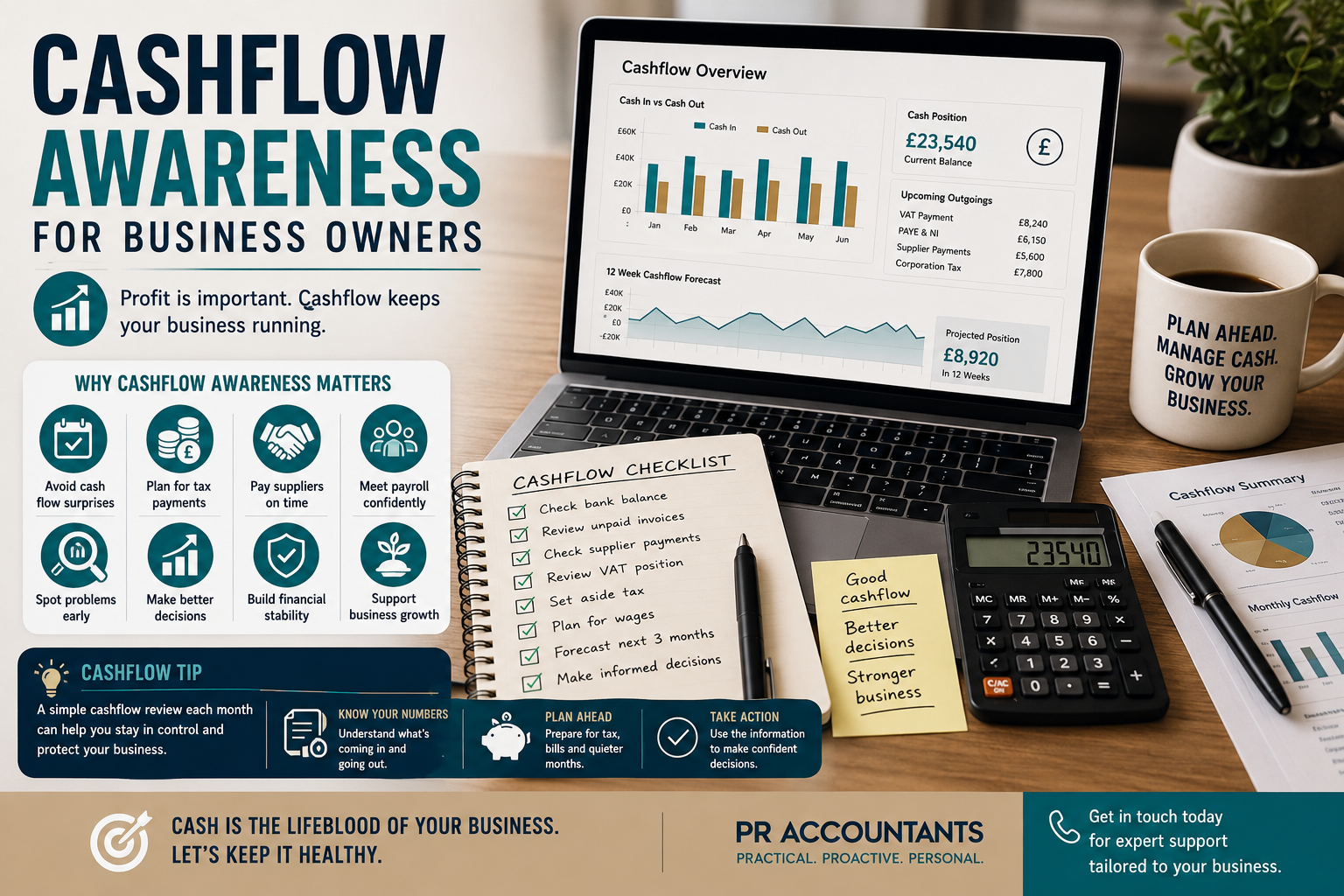
Cashflow Awareness for Business Owners: Why Profit Alone Is Not Enough
Many business owners focus on sales and profit.
Those numbers matter, but they do not tell the full story.
A business can have good turnover, strong demand and even healthy profit on paper but still struggle to pay VAT, wages, suppliers, Corporation Tax or loan repayments.
This is usually a cashflow issue.
Cashflow awareness means understanding how money moves in and out of the business, when payments are due, what cash is available and whether the business can meet its obligations without unnecessary stress.
It is not just about checking the bank balance.
It is about knowing what that bank balance needs to cover.
What Is Cashflow?
Cashflow is the movement of money in and out of a business.
Money coming in may include:
- customer payments
- sales receipts
- loan funds
- director investment
- refunds
- grants or funding
- rental income
- platform payouts
- deposits
Money going out may include:
- supplier payments
- wages
- PAYE and National Insurance
- VAT
- Corporation Tax
- rent
- software
- insurance
- loan repayments
- stock
- materials
- subcontractors
- director withdrawals
- dividends
- repairs and maintenance
A positive cashflow means more money is coming in than going out over a period.
A negative cashflow means the business is spending more cash than it is receiving.
Negative cashflow is not always a problem if it is planned. It becomes a problem when it is unexpected or unmanaged.
Cashflow Is Not the Same as Profit
This is one of the most important points for business owners to understand.
Profit is based on income and expenses.
Cashflow is based on money actually received and paid.
A business can be profitable but still cash-poor.
Practical Example
A business completes £30,000 of work in June.
The customer does not pay until August.
The profit may appear in the accounts in June, but the cash does not arrive until later.
In the meantime, the business still needs to pay:
- staff
- suppliers
- VAT
- rent
- software
- subcontractors
- director pay
- loan repayments
This is why looking only at profit can be misleading.
Why Bank Balance Alone Can Be Dangerous
Many business owners use the bank balance as their main financial guide.
This can be risky.
The bank balance does not show:
- VAT that will be due soon
- Corporation Tax building up
- unpaid supplier invoices
- wages due at month-end
- PAYE and pension liabilities
- customer invoices that may not be paid on time
- upcoming rent or insurance payments
- loan repayments
- money already committed to future costs
Practical Example
A company has £25,000 in the bank.
That feels comfortable.
But the business also has:
- £8,000 VAT due
- £5,000 payroll due
- £4,000 supplier payments due
- £3,000 rent due
- £6,000 Corporation Tax building up
The bank balance is not as strong as it first appears.
Cashflow awareness helps the owner understand what cash is genuinely available.
Why Cashflow Awareness Matters
Cashflow awareness helps business owners make better decisions.
It can help answer questions such as:
- Can we afford to hire?
- Can we afford to pay dividends?
- Can we take on a new contract?
- Can we buy equipment?
- Are customers paying on time?
- Are we setting enough aside for tax?
- Are costs rising too quickly?
- Will we have enough cash next month?
- Do we need to chase debts earlier?
- Should we review pricing?
- Is the business growing sustainably?
Without cashflow awareness, business decisions are often based on instinct rather than evidence.
1. Cashflow Awareness Helps You Plan for Tax
Tax is one of the biggest causes of cashflow pressure.
Business owners may need to plan for:
- VAT
- Corporation Tax
- PAYE and National Insurance
- Self Assessment
- dividend tax
- CIS deductions
- student loan deductions
- pension contributions
The problem is that tax often becomes payable after the income has already been received and spent.
Practical Example
A limited company has a profitable year.
The director sees money building in the bank and withdraws funds regularly.
Later, the company has to pay Corporation Tax and VAT.
The business made profit, but the cash was not protected.
Cashflow awareness helps business owners set aside money for tax before it becomes urgent.
2. Cashflow Awareness Helps With VAT
VAT can create cashflow pressure because the VAT collected from customers belongs to HMRC, not the business.
A business may receive VAT-inclusive payments and feel cash-rich, but part of that money will need to be paid over on the VAT return.
Practical Example
A VAT-registered business receives £12,000 from a customer.
Part of that may be VAT due to HMRC.
If the business spends the full amount as though it all belongs to the business, the VAT payment may become stressful later.
Good cashflow planning helps business owners separate trading cash from tax cash.
3. Cashflow Awareness Helps Control Director Withdrawals
For limited company directors, cashflow awareness is essential.
Directors may take money from the company as:
- salary
- dividends
- expense reimbursements
- pension contributions
- director’s loan repayments
- director’s loans
The company may have money in the bank, but that does not mean all of it can be withdrawn.
Before taking dividends or large withdrawals, the company should consider:
- available profit
- VAT due
- Corporation Tax provision
- payroll costs
- supplier payments
- director’s loan account balance
- future cash needs
Practical Example
A director takes regular dividends because the business bank account looks healthy.
Later, the company accounts show profits were lower than expected and tax liabilities were higher than planned.
This can create dividend and director’s loan account issues.
Regular management accounts and cashflow reviews help avoid this.
4. Cashflow Awareness Helps You Spot Late-Paying Customers
Late customer payments can damage cashflow quickly.
A business may issue invoices on time, but if customers delay payment, the business may struggle to meet its own obligations.
This is especially common where businesses offer credit terms.
Warning Signs
You may have a debtor problem if:
- customers regularly pay late
- you are always chasing the same clients
- large invoices remain unpaid for weeks
- you are relying on one customer to pay before you can pay suppliers
- the business is profitable but cash is always tight
An aged debtors report can help show who owes money and how overdue the balances are.
5. Cashflow Awareness Helps Manage Supplier Payments
Cashflow is not just about money coming in.
It is also about money going out.
If supplier payments are not planned properly, the business may face pressure even when sales are strong.
Business owners should understand:
- when supplier bills are due
- which suppliers are critical
- whether payment terms are realistic
- whether large costs are coming up
- whether the business is relying too heavily on credit
- whether overdue supplier balances are building
Aged creditors reports can be useful for monitoring what the business owes.
6. Cashflow Awareness Helps With Payroll
Payroll is one of the most important payments a business makes.
Once staff are employed, payroll becomes a regular commitment.
The business must plan for:
- net wages
- PAYE
- employee National Insurance
- employer National Insurance
- pension contributions
- holiday pay
- statutory payments
- payroll processing costs
Practical Example
A growing business hires two employees.
Sales increase, but so do monthly payroll commitments.
If customer payments are delayed, payroll can become difficult even where the business is profitable.
Before hiring, the business should review whether cashflow can support the extra cost.
7. Cashflow Awareness Helps With Growth
Growth often requires cash before it creates profit.
A growing business may need to spend money on:
- staff
- stock
- equipment
- marketing
- software
- premises
- vehicles
- subcontractors
- training
- professional advice
- deposits
- insurance
- finance costs
This means growth can create pressure if it is not planned.
Practical Example
A business wins a large contract.
The contract is profitable, but the business must pay staff, materials and subcontractors before the customer pays.
Without a cashflow forecast, the business may struggle to deliver the work despite the contract being commercially attractive.
8. Cashflow Awareness Helps Avoid Overtrading
Overtrading happens when a business grows faster than its cash can support.
This is common in growing businesses.
The business may have:
- increasing sales
- more customers
- more projects
- more staff
- higher supplier bills
- more VAT exposure
- more unpaid invoices
But cash does not keep up.
Warning Signs of Overtrading
These may include:
- sales increasing but bank balance falling
- constant pressure to pay suppliers
- relying on customer deposits to cover old bills
- increasing overdraft use
- late VAT or PAYE payments
- directors delaying their own pay
- staff or supplier payment stress
Growth should strengthen the business, not put it under pressure.
9. Cashflow Awareness Helps With Pricing
Poor pricing can create cashflow problems.
A business may be busy but still struggle because prices do not properly cover:
- labour
- materials
- overheads
- tax
- VAT
- finance costs
- admin time
- software
- mistakes or rework
- owner time
Practical Example
A service business charges £1,500 for a project.
The owner focuses on the sales value.
But after staff time, software, revisions, admin, VAT and overheads, the real profit is much lower.
Cashflow awareness helps business owners understand whether pricing is supporting the business properly.
10. Cashflow Awareness Helps Seasonal Businesses
Some businesses have strong and weak periods.
This can affect:
- retail
- hospitality
- construction
- serviced accommodation
- tourism
- events
- property maintenance
- education-related services
A strong month can create a false sense of security if weaker months are not planned.
Practical Example
A serviced accommodation operator has strong summer bookings.
The business looks profitable during peak season.
But winter occupancy is lower, while rent, utilities, cleaning, insurance and finance costs continue.
Cashflow awareness helps the operator use stronger months to prepare for quieter periods.
Common Cashflow Warning Signs
Business owners should pay attention to these warning signs:
- tax bills feel like a surprise
- customers regularly pay late
- supplier balances are building
- payroll is becoming stressful
- VAT money is being used for general spending
- directors are withdrawing money without checking profit
- there is no cash reserve
- the business relies heavily on one customer
- sales are growing but cash is not improving
- bookkeeping is behind
- decisions are based mainly on bank balance
- loan or finance repayments are becoming tight
- there is no forecast
These are signs that the business needs better cashflow visibility.
What Should Business Owners Review Each Month?
A monthly cashflow review does not need to be complicated.
Useful areas to review include:
- current bank balance
- unpaid customer invoices
- supplier bills due
- VAT due or building up
- payroll commitments
- tax provisions
- loan repayments
- expected income next month
- expected costs next month
- director withdrawals
- upcoming large expenses
- cash reserve position
The aim is not to create unnecessary paperwork.
The aim is to avoid surprises.
Cashflow Forecasting: Why It Matters
A cashflow forecast estimates what money is expected to come in and go out over a future period.
It may cover:
- the next 4 weeks
- the next 3 months
- the next 6 months
- the next 12 months
A forecast can help identify future cash shortfalls before they happen.
Practical Example
A forecast shows that cash may become tight in three months because VAT, rent and supplier payments fall close together.
The business can then take action early, such as:
- chasing invoices sooner
- reducing non-essential spending
- delaying a purchase
- arranging finance
- reviewing dividends
- negotiating payment terms
- increasing prices
- building a cash reserve
Early action gives the business more options.
Cashflow and Management Accounts
Cashflow awareness works best when the bookkeeping is up to date.
Management accounts can help business owners see:
- profit
- cashflow
- debtors
- creditors
- VAT position
- payroll costs
- tax provision
- director’s loan account
- trends over time
This is far more useful than waiting until year-end.
Year-end accounts tell you what happened.
Management accounts help you understand what is happening now.
Cashflow and Bookkeeping
Poor bookkeeping creates poor cashflow visibility.
If the records are behind, the business owner may not know:
- who owes money
- what bills are due
- whether VAT is accurate
- whether expenses are posted correctly
- whether tax is being provided for
- whether director withdrawals are properly recorded
- whether profit is real
Good bookkeeping is the foundation of cashflow awareness.
Software can help, but the records still need to be reviewed and reconciled properly.
Practical Scenario: Cashflow Awareness Done Well
A growing limited company reviews its cashflow monthly.
Each month, the owner checks:
- bank balance
- unpaid invoices
- supplier bills
- VAT estimate
- payroll costs
- Corporation Tax provision
- director withdrawals
- forecast for the next three months
The owner notices that cash may become tight in two months due to VAT and supplier payments.
Because the issue is spotted early, the business can chase invoices, pause non-essential spending and adjust withdrawals.
This is proactive cashflow management.
Practical Scenario: Cashflow Awareness Done Poorly
Another business only checks the bank balance.
Sales are increasing, but bookkeeping is behind.
The owner assumes the business is doing well and continues spending.
Later, the business faces:
- VAT due
- unpaid supplier bills
- payroll pressure
- Corporation Tax building up
- customer invoices overdue
- no cash reserve
The business may be profitable, but cashflow is under pressure.
The problem was not lack of sales. It was lack of visibility.
How to Improve Cashflow Awareness
Business owners can improve cashflow awareness by:
- keeping bookkeeping up to date
- reviewing debtors regularly
- monitoring supplier payments
- setting aside money for tax
- separating VAT funds where possible
- reviewing director withdrawals
- preparing a cashflow forecast
- checking profit margins
- reviewing pricing
- tracking large upcoming costs
- using management accounts
- getting advice before cashflow becomes urgent
The goal is to make better decisions earlier.
Frequently Asked Questions
What is cashflow awareness?
Cashflow awareness means understanding what money is coming in, what money is going out, what payments are due and whether the business has enough cash to meet future obligations.
Why is cashflow important for small businesses?
Cashflow is important because a business needs cash to pay wages, suppliers, tax, rent, loans and day-to-day costs. Profit alone does not guarantee that cash is available.
Can a profitable business still have cashflow problems?
Yes. A profitable business can still struggle with cash if customers pay late, costs rise, tax is not planned or money is tied up in stock, projects or unpaid invoices.
Is checking the bank balance enough?
No. The bank balance does not show future VAT, tax, payroll, supplier payments or unpaid invoices. It should not be the only measure of financial health.
How often should business owners review cashflow?
Many growing businesses should review cashflow monthly. Businesses with tight cashflow, seasonal income or large projects may need to review it more often.
How can management accounts help cashflow?
Management accounts help show profit, cashflow, debtors, creditors, VAT, tax provisions and other key figures during the year, rather than waiting until year-end.
What causes cashflow problems?
Common causes include late-paying customers, poor pricing, weak bookkeeping, high overheads, tax surprises, overtrading, excessive withdrawals and lack of forecasting.
Can PR Accountants help with cashflow forecasting?
Yes. PR Accountants can help business owners review their numbers, prepare cashflow forecasts, understand tax liabilities and improve financial visibility.
How PR Accountants Can Help
At PR Accountants, we help business owners move beyond simply checking the bank balance.
We support clients with:
- cashflow reviews
- bookkeeping reviews
- management accounts
- cashflow forecasting
- VAT planning
- Corporation Tax forecasting
- payroll cost planning
- director salary and dividend reviews
- director’s loan account monitoring
- debtor and creditor reviews
- business performance reporting
- property and serviced accommodation reporting
Our aim is to help business owners understand their numbers, avoid cashflow surprises and make better decisions with confidence.
Final Thoughts
Cashflow awareness is not just for businesses in difficulty.
It is for any business owner who wants better control.
A strong business should understand:
- what money is coming in
- what money is going out
- what tax is building up
- what cash is genuinely available
- what risks may appear in the next few months
Profit matters, but cash keeps the business running.
The earlier business owners understand their cashflow, the better decisions they can make.
Strong Call to Action
Want Better Control Over Your Business Cashflow?
A healthy bank balance today does not always mean your business is financially secure tomorrow.
PR Accountants can help you review your cashflow, understand upcoming tax liabilities and build clearer financial visibility through bookkeeping, management accounts and forecasting.
👉 Contact PR Accountants today for practical accounting support tailored to your business. Contact Us