Flat Rate VAT Scheme – Is It Worth It in 2026?
The Flat Rate VAT Scheme can sound attractive to small business owners.
Instead of calculating VAT on every sale and reclaiming VAT on most purchases, the business pays HMRC a fixed percentage of its VAT-inclusive turnover.
This can make VAT feel simpler.
However, simpler does not always mean cheaper.
For some businesses, the Flat Rate VAT Scheme may reduce admin and improve predictability.
For others, it may increase the amount of VAT paid, especially where the business has significant VATable costs, is classed as a limited cost business, or has mixed income streams.
In 2026, small businesses should not join the Flat Rate Scheme just because it sounds easier. They should review the numbers properly.
What Is the Flat Rate VAT Scheme?
The Flat Rate VAT Scheme is a VAT accounting scheme for eligible small businesses.
Under standard VAT accounting, a VAT-registered business usually:
- charges VAT on taxable sales
- reclaims VAT on eligible business purchases
- pays the difference to HMRC
Under the Flat Rate Scheme, the calculation is different.
The business still charges VAT to customers in the normal way.
However, instead of reclaiming VAT on most purchases, the business pays HMRC a fixed flat rate percentage of VAT-inclusive turnover.
The flat rate percentage depends on the type of business, unless the limited cost trader rules apply.
How Does the Flat Rate Scheme Work?
A business using the Flat Rate Scheme still issues VAT invoices where required and still charges VAT on taxable sales.
The difference is how the VAT payable to HMRC is calculated.
Standard VAT Accounting
A business calculates:
- VAT charged on sales
- less VAT reclaimed on purchases
- equals VAT payable to HMRC
Flat Rate Scheme
A business calculates:
- VAT-inclusive turnover
- multiplied by the flat rate percentage
- equals VAT payable to HMRC
The business keeps the difference between the VAT charged to customers and the VAT paid to HMRC under the flat rate calculation.
However, the business usually cannot reclaim VAT on most purchases.
Practical Example: Standard VAT Accounting vs Flat Rate Scheme
A small business invoices customers:
- Sales excluding VAT: £10,000
- VAT charged at 20%: £2,000
- Total charged to customers: £12,000
The business has VATable purchases:
- Purchases excluding VAT: £1,500
- VAT on purchases: £300
Under Standard VAT Accounting
The business may pay HMRC:
- Output VAT: £2,000
- Less input VAT: £300
- VAT payable: £1,700
Under Flat Rate Scheme
If the business flat rate percentage is 12%, the calculation may be:
- VAT-inclusive turnover: £12,000
- Flat rate percentage: 12%
- VAT payable to HMRC: £1,440
In this example, the Flat Rate Scheme may look beneficial.
But that does not mean it will always be better.
If the business has higher VATable costs, or if the limited cost trader rate applies, the result could be very different.
Who Can Join the Flat Rate VAT Scheme?
A business may be able to join the Flat Rate VAT Scheme if:
- it is VAT registered
- it expects VAT taxable turnover to be within the joining threshold
- it is not excluded by the scheme rules
The Flat Rate Scheme is aimed at smaller VAT-registered businesses.
It is not available to every business.
Some businesses cannot join, for example where they have recently left the scheme, have certain VAT compliance issues, are closely associated with another business, or are involved in certain VAT arrangements.
The eligibility position should be checked before applying.
Flat Rate Scheme Thresholds in 2026
The Flat Rate Scheme has separate thresholds from the general VAT registration threshold.
A business may be able to join the scheme where expected VAT taxable turnover is £150,000 or less, excluding VAT.
A business must leave the scheme if it no longer meets the eligibility conditions, including where the relevant turnover limit is exceeded.
The general VAT registration threshold is different. A business must register for VAT if taxable turnover goes over the VAT registration threshold.
This means the questions are separate:
- Do I need to register for VAT?
- If I am VAT registered, can I use the Flat Rate Scheme?
- If I can use it, is it actually worth it?
Why Businesses Like the Flat Rate Scheme
The Flat Rate Scheme may be attractive because it can:
- simplify VAT calculations
- reduce the need to analyse input VAT on every purchase
- make VAT payments easier to estimate
- improve predictability
- reduce admin for businesses with simple transactions
- help some businesses with low VATable costs
- provide a first-year discount for newly VAT-registered businesses
However, the scheme should still be reviewed carefully.
A simple calculation can still produce the wrong result if the business is using the wrong sector rate, has misunderstood turnover, or is actually a limited cost business.
The First-Year 1% Discount
A business in its first year of VAT registration may be entitled to a 1% reduction in its flat rate percentage.
This can make the scheme more attractive in the first year.
Practical Example
If a business sector flat rate percentage is 12%, the first-year discount may reduce this to 11% during the relevant first-year period.
However, the discount should not be the only reason for joining the scheme.
A business should still compare the Flat Rate Scheme against standard VAT accounting, especially if it has meaningful VATable costs.
The Limited Cost Trader Rules
The limited cost trader rules are one of the biggest reasons the Flat Rate Scheme may not be worthwhile.
A business may be classed as a limited cost business if it spends only a small amount on relevant goods.
If the limited cost trader rules apply, the business must usually use the higher flat rate percentage of 16.5%, regardless of its normal business sector.
This can remove most of the financial benefit of the scheme.
Why 16.5% Can Be Costly
The flat rate percentage is applied to VAT-inclusive turnover.
For example, if a business charges £10,000 plus VAT, the VAT-inclusive turnover is £12,000.
At a flat rate of 16.5%, the VAT payable would be:
- £12,000 × 16.5% = £1,980
The business charged £2,000 VAT to the customer.
So the difference retained is only £20 before considering the VAT that cannot usually be reclaimed on purchases.
For many limited cost businesses, the Flat Rate Scheme may be worse than standard VAT accounting.
What Counts as Relevant Goods?
The limited cost trader test focuses on relevant goods, not services.
This is important.
Some business costs do not count as relevant goods for this test.
For example, the following may not help a business avoid the limited cost trader rate:
- accountancy fees
- advertising costs
- rent
- downloaded software
- most services
- food and drink for staff
- fuel for cars, unless specific transport-sector rules apply
- capital items such as laptops or mobile phones
This catches many service-based businesses.
A business may have real expenses, but if those expenses are services rather than relevant goods, it may still be treated as a limited cost trader.
Service Businesses Need to Be Especially Careful
The Flat Rate Scheme may be less attractive for many service-based businesses.
This can include businesses such as:
- consultants
- contractors
- IT consultants
- marketing consultants
- business advisers
- designers
- coaches
- freelancers
- professional service providers
These businesses may have low levels of relevant goods.
They may spend money on software, professional fees, advertising, subcontractors and home office costs, but many of these costs may not count as relevant goods for the limited cost trader test.
Practical Scenario
A consultant has VAT-inclusive turnover of £60,000.
They spend money on:
- software subscriptions
- accountancy fees
- advertising
- broadband
- professional training
The business has costs, but many are services.
If relevant goods are low, the limited cost trader rate may apply.
The scheme may not provide a saving.
When the Flat Rate Scheme May Be Worth Considering
The Flat Rate Scheme may be worth considering where:
- the business is VAT registered
- turnover is within the scheme threshold
- transactions are simple
- VATable purchases are low
- the business is not a limited cost trader
- the correct sector percentage is favourable
- customers are VAT registered and can recover VAT
- admin simplicity is valuable
- the first-year discount applies
- the business wants more predictable VAT payments
Practical Example
A business with simple sales, low purchases and a favourable sector rate may find that the scheme reduces admin and possibly results in a lower VAT payment.
But the calculation should be reviewed properly before joining.
When the Flat Rate Scheme May Not Be Worth It
The scheme may not be suitable where:
- the business is a limited cost trader
- VATable costs are significant
- the business regularly buys equipment, stock or materials
- input VAT recovery is important
- the business has large setup costs
- the business has mixed income streams
- the business has zero-rated or exempt income
- the business is growing quickly
- the wrong sector rate could be applied
- the business needs detailed VAT recovery
- VAT cashflow is already under pressure
Practical Example
A business has regular equipment purchases, software costs, materials and supplier costs with VAT.
Under standard VAT accounting, it could reclaim input VAT.
Under the Flat Rate Scheme, it may not be able to reclaim most of that VAT.
The scheme may therefore cost more overall.
The Flat Rate Scheme and Capital Assets
Under the Flat Rate Scheme, a business usually cannot reclaim VAT on purchases.
However, there is an exception for certain capital assets over £2,000.
This rule can be useful, but it should not be misunderstood.
The exception is limited and does not mean a business can reclaim VAT on all normal purchases.
Businesses making major purchases should review the VAT treatment before joining or remaining in the scheme.
Choosing the Correct Flat Rate Percentage
If the limited cost trader rate does not apply, the business must choose the flat rate percentage that matches its business type.
This should be based on the sector that most closely describes the business.
Choosing the wrong rate can create problems.
If the percentage is too low, the business may underpay VAT and later face an unexpected bill.
If the percentage is too high, the business may overpay VAT.
Practical Example
A business provides consultancy and some training.
It chooses a flat rate percentage without reviewing which activity represents the main business.
Later, HMRC questions whether the correct sector was used.
The business should keep a record of why the chosen sector was reasonable.
Businesses With More Than One Activity
Some businesses do more than one thing.
For example:
- consultancy and software sales
- property management and cleaning
- construction and project management
- retail and repair services
- training and consultancy
Under the Flat Rate Scheme, the business generally does not split turnover between multiple percentages.
It normally applies the rate for the main business activity.
The main activity should be reviewed carefully, especially if the business changes.
Flat Rate Scheme and Zero-Rated or Exempt Income
A key risk with the Flat Rate Scheme is that flat rate turnover can include more than business owners expect.
Certain zero-rated and exempt supplies may be included in the flat rate turnover calculation.
This can mean the business pays VAT under the Flat Rate Scheme on income where it did not charge VAT at the standard rate.
This is one reason the scheme can be unsuitable for some businesses with mixed income.
Practical Scenario
A business has a mix of taxable and exempt income.
Under standard VAT accounting, input VAT recovery may need to be reviewed carefully.
Under the Flat Rate Scheme, exempt income may still affect the flat rate calculation.
The business should compare the results before choosing the scheme.
Flat Rate Scheme and Cashflow
The Flat Rate Scheme may make VAT payments easier to estimate because the business applies a percentage to VAT-inclusive turnover.
However, this does not automatically mean cashflow will improve.
Cashflow can still be affected by:
- late-paying customers
- seasonal income
- large purchases
- VAT payments due before customers pay
- director withdrawals
- weak bookkeeping
- unexpected VAT adjustments
The Flat Rate Scheme has its own methods for calculating turnover, including a cash-based method, but the business must apply the rules properly.
Flat Rate Scheme vs Cash Accounting Scheme
The Flat Rate Scheme and the Cash Accounting Scheme are different.
A business cannot use the Flat Rate Scheme with the normal Cash Accounting Scheme.
However, the Flat Rate Scheme has its own cash-based turnover method.
This can be helpful for businesses with slow-paying customers, but it needs to be applied correctly.
Businesses should not assume they are using cash accounting just because cashflow is tight.
The scheme and calculation method should be confirmed.
Flat Rate Scheme vs Standard VAT Accounting
The key comparison is usually this:
Flat Rate Scheme
- simpler VAT calculation
- fixed percentage applied to VAT-inclusive turnover
- usually no input VAT recovery on most purchases
- limited cost trader rules may apply
- may be useful for simple businesses with low costs
- can be less beneficial where costs are high
Standard VAT Accounting
- VAT charged on sales is declared
- VAT on eligible purchases can usually be reclaimed
- more detailed bookkeeping required
- may be better where the business has significant VATable costs
- may provide a more accurate VAT position
The best option depends on the business.
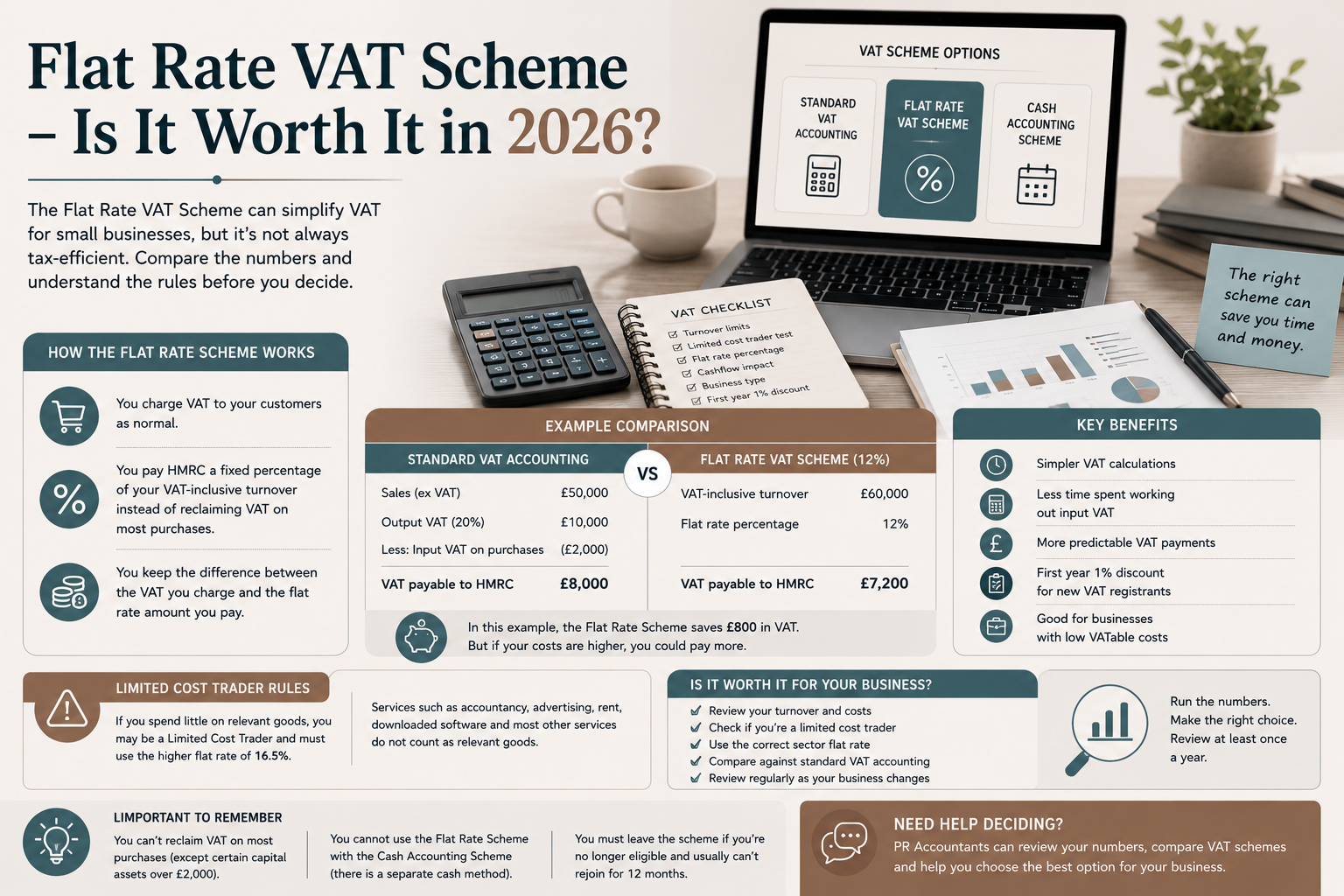
Simple Comparison Example
A business has:
- sales excluding VAT: £50,000
- VAT charged at 20%: £10,000
- VAT-inclusive turnover: £60,000
- VATable purchases excluding VAT: £10,000
- VAT on purchases: £2,000
Standard VAT Accounting
VAT payable may be:
- £10,000 output VAT
- less £2,000 input VAT
- VAT payable: £8,000
Flat Rate Scheme at 12%
VAT payable may be:
- £60,000 × 12%
- VAT payable: £7,200
In this simplified example, the Flat Rate Scheme looks better.
But if the business had higher VATable costs, or the limited cost trader rate applied, the answer could change.
Limited Cost Trader Example
A business has:
- sales excluding VAT: £50,000
- VAT charged at 20%: £10,000
- VAT-inclusive turnover: £60,000
- VATable purchases excluding VAT: £5,000
- VAT on purchases: £1,000
- limited cost trader rate: 16.5%
Standard VAT Accounting
VAT payable may be:
- £10,000 output VAT
- less £1,000 input VAT
- VAT payable: £9,000
Flat Rate Scheme at 16.5%
VAT payable may be:
- £60,000 × 16.5%
- VAT payable: £9,900
In this simplified example, the Flat Rate Scheme may cost more than standard VAT accounting.
This is why the limited cost trader test is so important.
Common Flat Rate Scheme Mistakes
1. Assuming It Is Always Cheaper
The scheme may be simpler, but it is not always financially better.
2. Ignoring the Limited Cost Trader Rules
Many businesses overlook the 16.5% rate.
3. Counting Services as Relevant Goods
Services such as accountancy, advertising, rent and downloaded software do not usually count as relevant goods for the limited cost trader test.
4. Choosing the Wrong Sector Rate
The correct sector rate matters.
5. Forgetting the Percentage Applies to VAT-Inclusive Turnover
The flat rate percentage is applied to the gross amount, including VAT.
6. Reclaiming VAT on Purchases Incorrectly
Under the scheme, VAT usually cannot be reclaimed on most purchases.
7. Not Reviewing the Scheme as the Business Changes
A scheme that worked when the business was small may become unsuitable later.
8. Not Leaving the Scheme When Required
Businesses must monitor eligibility and leave the scheme when the rules require it.
Should You Join the Flat Rate Scheme in 2026?
The answer depends on the numbers.
Before joining, a business should review:
- expected VAT-inclusive turnover
- sector flat rate percentage
- whether the limited cost trader rate applies
- expected VATable purchases
- whether major equipment or setup costs are planned
- customer type
- pricing model
- cashflow
- admin time saved
- first-year discount
- future growth plans
- whether income includes zero-rated or exempt supplies
The scheme should not be chosen based only on simplicity.
Who Might Benefit?
The Flat Rate Scheme may be more suitable for:
- simple service businesses with low costs
- businesses with mainly VAT-registered customers
- businesses with a favourable sector percentage
- businesses without major VATable purchases
- businesses not caught by the limited cost trader rate
- newly VAT-registered businesses that can use the first-year discount
Who Should Be Careful?
The scheme should be reviewed carefully by:
- consultants with low relevant goods
- businesses with high VATable costs
- retailers with stock purchases
- construction businesses
- property businesses
- serviced accommodation operators
- businesses with mixed income
- businesses with significant equipment purchases
- businesses with exempt or zero-rated income
- businesses growing close to the leaving threshold
Flat Rate Scheme for Property Businesses
Property businesses should be careful with the Flat Rate Scheme.
Property and VAT can be complex.
Standard residential rent is usually exempt, while serviced accommodation or holiday accommodation may be taxable.
Commercial property and option to tax rules can create further complexity.
If a property business has mixed income, exempt income or large refurbishment costs, the Flat Rate Scheme may not be suitable.
VAT should be reviewed before joining the scheme.
Flat Rate Scheme for Serviced Accommodation
Serviced accommodation operators should also be careful.
Short-term accommodation may create taxable turnover for VAT purposes.
However, serviced accommodation businesses often have costs such as:
- cleaning
- laundry
- utilities
- platform fees
- furniture
- repairs
- maintenance
- software
- professional fees
Some of these costs may carry VAT, and the ability to reclaim input VAT under standard accounting may be valuable.
A comparison should be prepared before choosing the Flat Rate Scheme.
Flat Rate Scheme for Construction Businesses
Construction businesses may need to consider:
- standard VAT
- domestic reverse charge VAT
- CIS
- subcontractor costs
- materials
- plant hire
- project costs
The Flat Rate Scheme may not suit every construction business.
VAT and CIS should be reviewed together because mistakes can affect both cashflow and compliance.
How Often Should the Scheme Be Reviewed?
The Flat Rate Scheme should be reviewed:
- before joining
- at each VAT return if limited cost trader status may change
- when turnover increases
- when business activities change
- when costs increase
- before major purchases
- when pricing changes
- if the business takes on new income streams
- before the business reaches the leaving threshold
- at least annually
A business should not stay on the scheme simply because it has always used it.
What If the Flat Rate Scheme Is No Longer Suitable?
If the scheme is no longer beneficial, the business may choose to leave.
A business must leave if it is no longer eligible.
After leaving, the business usually cannot rejoin for 12 months.
Before leaving, the business should review:
- timing
- VAT return period
- future input VAT recovery
- cashflow impact
- bookkeeping processes
- software setup
- whether standard VAT accounting is ready
- whether HMRC needs to be notified
Switching schemes should be planned properly.
Practical Scenario: The Scheme Works Well
A small business has simple services, low VATable costs and a favourable sector percentage.
It mainly works with VAT-registered customers, so charging VAT does not affect pricing significantly.
The business is not a limited cost trader and has no major equipment purchases planned.
In this case, the Flat Rate Scheme may reduce admin and potentially save VAT.
The business still reviews the position each year.
Practical Scenario: The Scheme Costs More
Another business is a consultant with low relevant goods.
It spends money on services such as software, accountancy, advertising and training.
The limited cost trader rate applies.
The business pays almost all the VAT it charges to HMRC but cannot reclaim VAT on most purchases.
In this case, standard VAT accounting may be better.
The business should review whether remaining on the Flat Rate Scheme makes sense.
Frequently Asked Questions
What is the Flat Rate VAT Scheme?
The Flat Rate VAT Scheme is a simplified VAT scheme where eligible businesses pay HMRC a fixed percentage of VAT-inclusive turnover instead of calculating VAT due by deducting input VAT from output VAT in the usual way.
Is the Flat Rate VAT Scheme worth it in 2026?
It depends on the business. It may be useful for simple businesses with low costs and favourable sector rates, but it may not be beneficial for limited cost traders or businesses with significant VATable purchases.
What is the limited cost trader rate?
A limited cost trader usually pays a flat rate percentage of 16.5%, regardless of business sector. This can make the scheme less attractive.
Can I reclaim VAT on purchases under the Flat Rate Scheme?
Usually, no. VAT on most purchases cannot be reclaimed under the Flat Rate Scheme, except for certain capital assets over £2,000.
Does the flat rate percentage apply to net or gross sales?
The flat rate percentage is applied to VAT-inclusive turnover.
Can I use the Flat Rate Scheme with Cash Accounting?
You cannot use the Flat Rate Scheme with the normal Cash Accounting Scheme, but the Flat Rate Scheme has its own cash-based method for calculating turnover.
Can I leave the Flat Rate Scheme?
Yes. A business can choose to leave, and it must leave if it is no longer eligible. After leaving, it usually has to wait 12 months before rejoining.
Should I ask an accountant before joining?
Yes. The Flat Rate Scheme should be compared against standard VAT accounting using your actual figures, expected costs and business model.
How PR Accountants Can Help
At PR Accountants, we help small businesses choose the right VAT approach rather than simply choosing the easiest option.
We can support with:
- Flat Rate Scheme reviews
- VAT scheme comparisons
- limited cost trader checks
- VAT registration reviews
- VAT return preparation
- VAT bookkeeping reviews
- VAT code checks
- Making Tax Digital setup
- Cash Accounting Scheme reviews
- Annual Accounting Scheme reviews
- VAT cashflow planning
- property VAT reviews
- serviced accommodation VAT reviews
- construction VAT and domestic reverse charge support
- HMRC VAT correspondence support
Our aim is to help business owners understand their VAT position, avoid common mistakes and choose a VAT scheme that fits their business.
Final Thoughts
The Flat Rate VAT Scheme can be useful, but it is not automatically the best option.
It may work well for some small businesses with simple transactions and low costs.
However, it can be costly for businesses caught by the limited cost trader rules or businesses that would otherwise reclaim significant input VAT.
In 2026, the best approach is to compare the numbers before joining or staying on the scheme.
VAT should support the business, not create unexpected cashflow pressure.
Strong Call to Action
Unsure Whether the Flat Rate VAT Scheme Is Right for Your Business?
The Flat Rate VAT Scheme can simplify VAT, but it can also cost more if the wrong rate is used or the limited cost trader rules apply.
PR Accountants can review your VAT position, compare VAT schemes and help you choose the most suitable approach for your business.
👉 Contact PR Accountants today for clear, practical VAT advice tailored to your business. Contact Us