Should You Register a Limited Company?
Starting a limited company is often seen as the natural next step once a business begins to grow.
For some business owners, incorporation can be the right decision. It may support growth, create a clearer separation between personal and business finances, improve commercial credibility and provide more flexibility around how profits are retained or taken from the business.
However, becoming a limited company is not automatically more tax-efficient, lower risk or better for every business.
A limited company brings additional legal duties, filing requirements and administration. It also changes how money is taxed when it moves from the company to you personally.
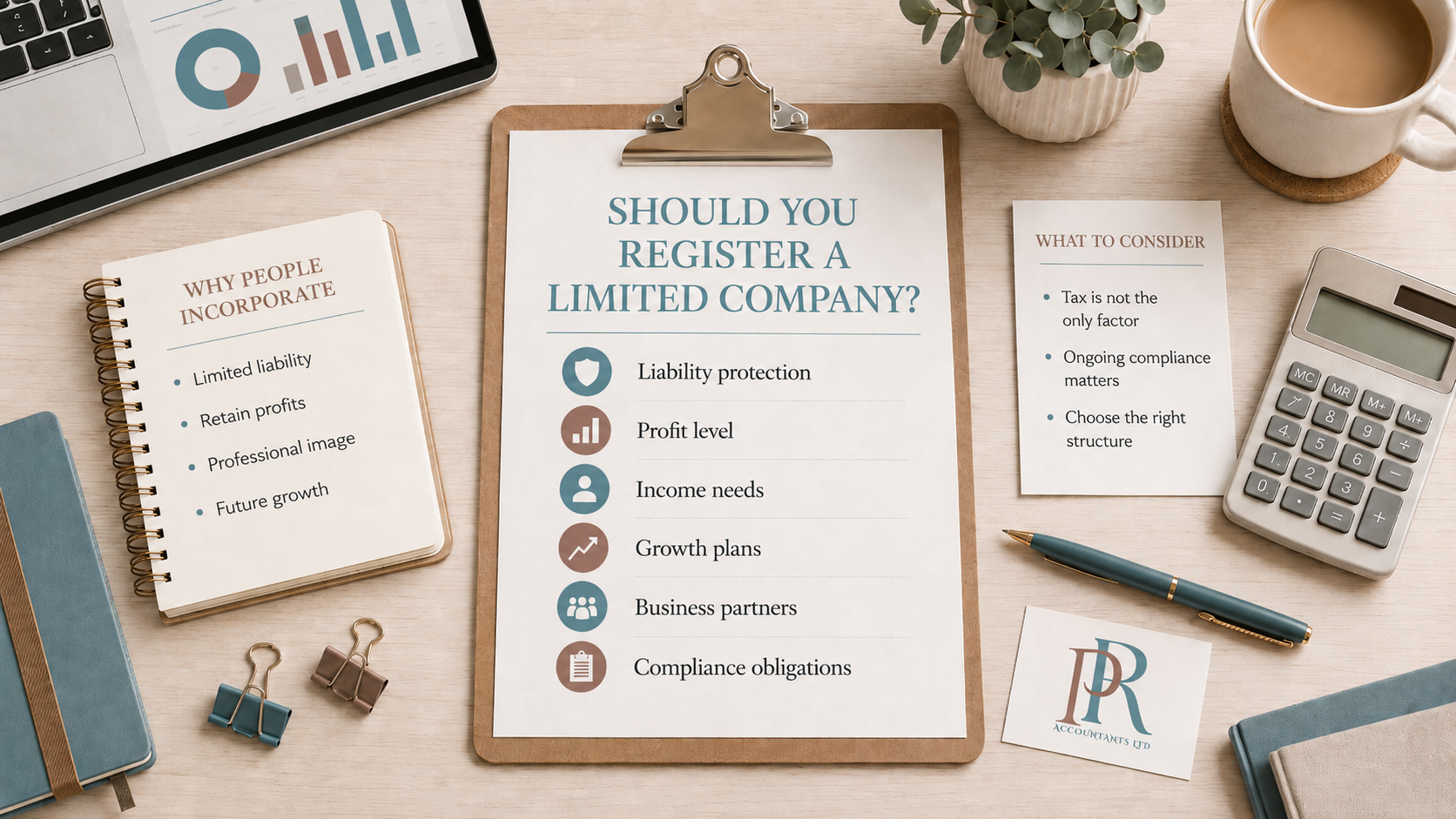
The right structure depends on your profits, personal income needs, business risk, future plans and willingness to manage company compliance properly.
What is a limited company?
A limited company is a separate legal entity from its owners and directors.
This means the company can enter into contracts, own assets, employ staff, borrow money and earn income in its own name.
This differs from operating as a sole trader.
As a sole trader, you and the business are legally the same person. You report business profits through Self Assessment and pay Income Tax and National Insurance personally on those profits.
The main distinction is:
• A limited company pays Corporation Tax on its taxable profits.
• Directors and shareholders may pay personal tax when they receive salary, dividends, benefits or other value from the company.
• A sole trader pays personal Income Tax and National Insurance on business profit, rather than operating through a separate legal entity.
There is no fixed turnover level where you must incorporate
A business does not have to become a limited company simply because turnover reaches a certain level.
VAT registration is based on taxable turnover, but it is separate from the decision to incorporate. A sole trader, partnership or limited company may all need to register for VAT where their taxable turnover exceeds the registration threshold.
The decision to incorporate should not be based on turnover alone.
The following questions are usually more relevant:
• How much profit does the business make?
• How much money do you need to take personally?
• Can profits remain in the business for growth or investment?
• Does the business carry commercial risk?
• Do you plan to bring in a business partner or investor?
A business with high turnover but low profit may not obtain a meaningful tax benefit from incorporation.
Equally, a business with modest turnover but strong retained profit, commercial risk or growth plans may benefit from using a company structure.
The more useful question is not, “Has my turnover reached a certain amount?”
It is, “Does a limited company now support my financial, commercial and long-term business objectives?”
When registering a limited company may be suitable
A limited company may be worth considering where one or more of the following apply.
You want clearer separation between personal and business finances
A company creates a legal separation between you and the business.
This can help you keep business income, expenses, liabilities and contracts separate from personal finances.
You should still maintain proper records and avoid using the company bank account for personal spending. However, the company structure can provide a more disciplined framework for managing business finances.
Your business is becoming more profitable
Incorporation may become more attractive where the business generates profits that you do not need to spend personally straight away.
A company may retain profits after Corporation Tax for:
• Future investment.
• Business growth.
• Marketing.
• Recruitment.
• New equipment.
• Cashflow reserves.
• Expansion into new services or locations.
This can create a tax deferral opportunity where profits are left in the company rather than withdrawn personally.
However, retained profit is not tax-free profit. Corporation Tax is still payable by the company, and personal tax may apply later when funds are extracted.
You have commercial risk
A limited company can offer a level of protection by separating the company’s liabilities from your personal finances.
This may be particularly relevant where your business:
• Signs significant contracts.
• Takes on employees.
• Holds customer deposits.
• Buys stock or equipment on credit.
• Enters into leases.
• Provides professional or technical services.
• Has the potential for contractual disputes or claims.
Limited liability is not absolute protection.
Directors may still face personal exposure where they provide personal guarantees, breach their legal duties, act improperly or continue trading in circumstances where the company cannot meet its obligations.
Professional indemnity insurance, public liability insurance and well-managed contracts can remain important regardless of your business structure.
Clients or suppliers expect you to operate through a company
Some customers, agencies, suppliers and commercial partners prefer or require businesses to operate through a limited company.
This can be more common in sectors such as:
• Consultancy.
• Construction.
• Technology.
• Property.
• Recruitment.
• Professional services.
A company structure can sometimes improve commercial perception, but it should not be the only reason for incorporating.
The legal and tax responsibilities need to remain proportionate to the size and needs of the business.
You plan to bring in another owner or investor
Companies can issue shares and create different ownership arrangements.
This can make it easier to:
• Bring in a business partner.
• Allocate ownership between family members where appropriate.
• Raise investment.
• Sell part of the business in the future.
• Create a structured succession plan.
Ownership arrangements should be considered carefully. Share transfers, dividend rights, voting rights and shareholder agreements can have legal and tax implications.
Corporation Tax does not automatically mean lower overall tax
A common assumption is that a limited company always pays less tax than a sole trader.
This is not necessarily correct.
For 2026:
• Companies with taxable profits of £50,000 or less generally pay Corporation Tax at 19%.
• Companies with taxable profits above £250,000 generally pay Corporation Tax at 25%.
• Marginal Relief may apply where taxable profits fall between £50,000 and £250,000.
However, Corporation Tax is only one part of the overall tax position.
If you take money from the company, you may also need to consider:
• Income Tax on salary.
• Employee National Insurance.
• Employer National Insurance.
• Dividend tax.
• Taxable benefits.
• Director’s loan account implications.
• Pension contributions.
• Your other personal income.
A company can be tax-efficient in the right circumstances, especially where profits are retained for future use. It is not automatically tax-efficient where you need to withdraw most or all of the company’s profits each year for personal spending.
The tax position should be reviewed based on the full picture, not simply the Corporation Tax rate.
Salary and dividends need proper planning
Many company directors take a combination of salary and dividends.
Salary is generally a deductible cost for the company, although it may create PAYE and National Insurance obligations.
Dividends are paid from available distributable profits after Corporation Tax. They are not a deductible business expense.
Before paying dividends, the company needs sufficient available profits and the correct paperwork should be prepared.
It is not enough for a director to transfer money from the company bank account and later decide to call it a dividend.
Money withdrawn from the company must be recorded correctly. It may be:
• Salary.
• Dividends.
• Reimbursement of genuine business expenses.
• Repayment of money you lent to the company.
• A director’s loan.
When remaining a sole trader may be better
A sole trader structure may be more appropriate where:
• Your profits are low or unpredictable.
• You need to withdraw most business income personally.
• The business has limited commercial risk.
• You want the simplest possible compliance position.
• You are testing a business idea before committing to a company structure.
• The additional accountancy, payroll and Companies House responsibilities are not proportionate to the business.
As a sole trader, you do not need to prepare statutory accounts for Companies House or file a Company Tax Return.
You will still need proper bookkeeping and may need to complete a Self Assessment tax return, but the compliance requirements are generally simpler.
Remaining self-employed is not a sign that a business is less professional or less successful. It can be the most appropriate structure for many businesses.
What are the extra responsibilities of a limited company?
A limited company brings ongoing responsibilities that should be understood before incorporation.
Company directors are responsible for ensuring that the company meets its legal and reporting obligations.
This normally includes:
• Maintaining company records.
• Preparing annual statutory accounts.
• Filing accounts with Companies House.
• Filing a Company Tax Return with HMRC.
• Paying Corporation Tax on time.
• Filing an annual confirmation statement.
• Reporting changes to directors, shareholders, registered office details or share capital.
• Operating payroll where salaries are paid.
• Registering for VAT where required.
• Keeping records of dividends and director’s loan transactions.
Once a company becomes active, HMRC must normally be notified for Corporation Tax purposes within three months.
Companies House identity verification requirements have begun and existing directors and people with significant control are being phased into the process. The timing and action required depend on the person’s role and the company’s circumstances.
Your company information may be public
A limited company is more transparent than a sole trader business.
Certain company information is available on the public Companies House register. This can include:
• The company’s registered office.
• Director details.
• People with significant control.
• Filed accounts.
• Confirmation statement information.
• Share capital and shareholding information.
For some business owners, this is a practical consideration when deciding whether incorporation is suitable.
Using a professional registered office service may help protect your home address from appearing as the company’s public registered office, although it does not remove all public filing requirements.
VAT applies regardless of whether you incorporate
VAT is sometimes confused with limited company status.
You do not need to form a limited company to register for VAT.
Equally, forming a limited company does not allow you to avoid VAT registration where your taxable turnover exceeds the relevant threshold.
The current compulsory VAT registration threshold is £90,000 of taxable turnover over a rolling 12-month period.
VAT should be considered separately from the decision to incorporate.
You may choose to register voluntarily below the threshold in some circumstances, but this should be reviewed carefully because VAT can affect pricing, administration and cashflow.
Do not transfer a business into a company without advice
Moving an existing sole trader business into a limited company can be more complicated than simply opening a new company bank account.
You may need to consider:
• Existing business assets.
• Stock.
• Equipment.
• Vehicles.
• Customer contracts.
• Supplier arrangements.
• VAT registration.
• Employees.
• Business debts.
• Intellectual property.
• Property or goodwill.
• Insurance policies.
• Finance agreements.
There may also be tax implications when assets or a business are transferred into the company.
The right process depends on the individual circumstances. It is important to plan the transition before trading through the company.
Questions to ask before registering a limited company
Before deciding, consider the following questions.
What level of profit do I expect to make?
Profit is more relevant than turnover when considering whether a company may offer tax planning opportunities.
How much money do I need to take personally?
If you need to withdraw most of the available profit each year, the tax advantages of a company may be limited.
Do I need to retain funds for growth?
A company may be more attractive where profits can stay in the business for investment, expansion or working capital.
What commercial risk does the business carry?
A business that signs contracts, employs staff or takes on larger financial commitments may benefit from a company structure and appropriate insurance.
Do I expect to add a business partner or investor?
A company structure can make ownership and investment arrangements more straightforward.
Am I prepared for the additional compliance?
A company needs regular bookkeeping, annual accounts, tax returns, Companies House filings and director-level record keeping.
Do I have a longer-term plan for the business?
The right structure should support your expected growth, future sale, succession plans and personal financial objectives.
Common mistakes to avoid
Before incorporating, avoid the following assumptions:
“My turnover is high, so I must become a limited company.”
Turnover alone does not determine whether incorporation is suitable.
“A company always pays less tax.”
The overall tax position depends on profits, drawings, salary, dividends and personal circumstances.
“I can take money from the company whenever I need it.”
Money must be correctly treated as salary, dividends, expense reimbursement, loan repayment or a director’s loan.
“Every withdrawal can be treated as a dividend.”
Dividends require sufficient distributable profits and correct paperwork.
“The company bank balance is the same as available profit.”
Cash in the bank does not always equal distributable profit.
“VAT only applies to limited companies.”
VAT can apply to sole traders, partnerships and companies.
“I can move my existing business assets into a company without tax consequences.”
Tax consequences may arise and should be reviewed before transferring the business.
“Limited liability means I can never be personally responsible.”
Directors can still face personal exposure in certain circumstances.
“I can deal with the company compliance at the year-end.”
Company compliance needs ongoing record keeping and regular review.
The best decisions are made with up-to-date bookkeeping, realistic forecasts and a clear understanding of both company and personal tax.
How PR Accountants Ltd can help
Registering a limited company should be a planned decision, not simply a reaction to turnover or a suggestion seen online.
At PR Accountants Ltd, we help business owners compare sole trader and limited company structures based on profit, drawings, tax, commercial risk and future plans.
We can also support with company formation, registered office services, bookkeeping, payroll, VAT, statutory accounts, Corporation Tax and director tax planning.
Contact us to discuss whether a limited company is suitable for your business and what the transition would involve.
Related articles
• How Much Tax Does a Limited Company Pay in the UK?
• What Expenses Can a Limited Company Claim?
• Self Assessment for Company Directors: What Income Needs Reporting?