What Happens If Your Company Cannot Pay Its Tax Bill?
Tax bills can put serious pressure on a business.
A company may be profitable on paper but still struggle to pay HMRC on time because cash is tied up in unpaid invoices, stock, wages, supplier payments, loan repayments or director withdrawals.
This can happen with:
- Corporation Tax
- VAT
- PAYE and National Insurance
- CIS deductions
- penalties and interest
- other HMRC liabilities
The most important thing is not to ignore the problem.
HMRC is usually more difficult to deal with when a company fails to communicate, misses deadlines, or allows arrears to build without any plan.
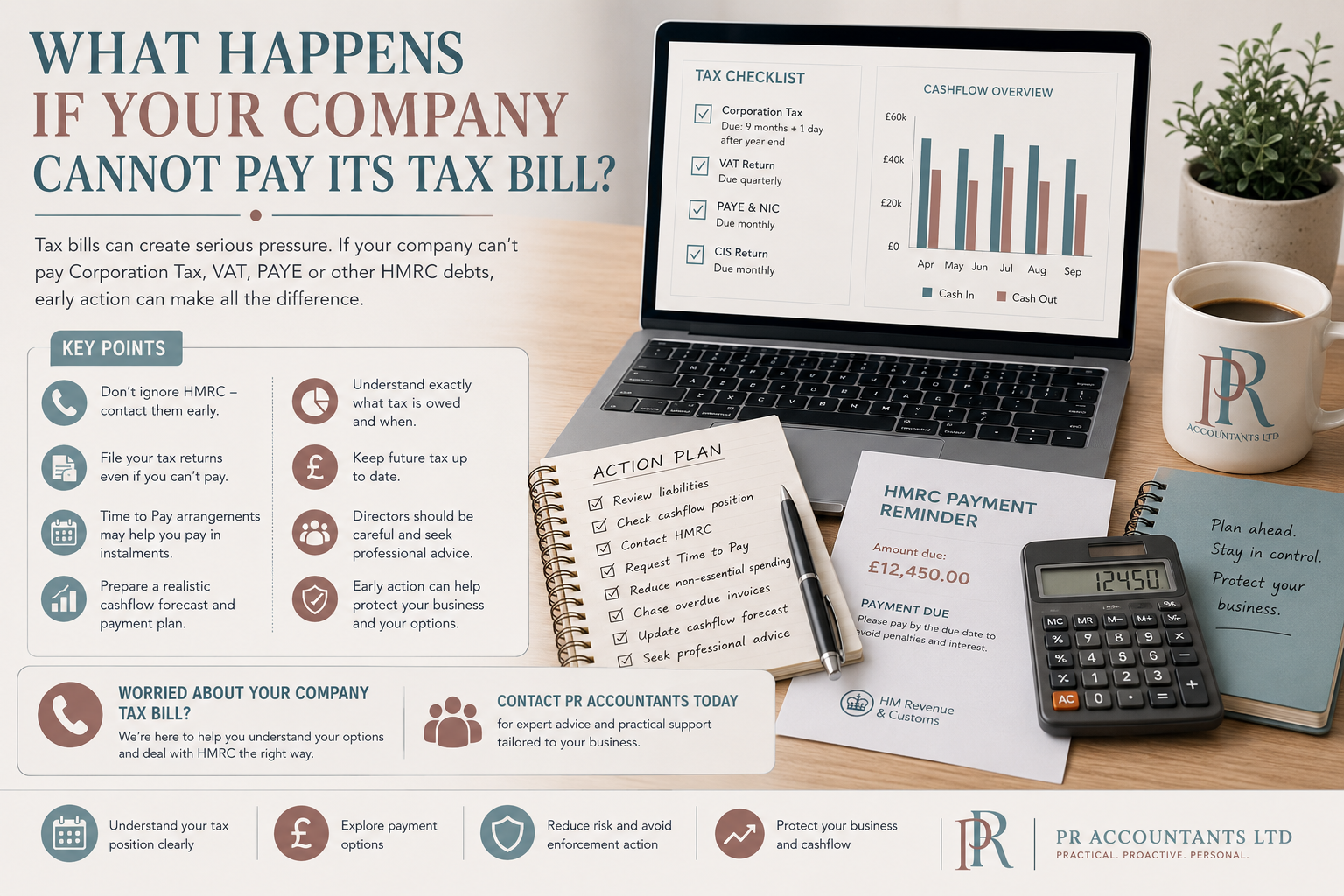
If your company cannot pay its tax bill, early action can make a significant difference.
First Point: Do Not Ignore HMRC
If your company cannot pay a tax bill, the worst response is silence.
Ignoring HMRC can lead to:
- interest
- penalties or charges, depending on the tax involved
- debt collection action
- enforcement visits
- pressure on company cashflow
- difficulty agreeing a payment plan later
- increased risk if the company is insolvent
HMRC will usually expect the company to engage, explain the position and make a realistic proposal.
A company that contacts HMRC early is usually in a stronger position than one that waits until enforcement action begins.
What Tax Bills Might a Company Struggle to Pay?
A company may fall behind with different types of tax.
Corporation Tax
Corporation Tax is based on company profits.
For many small companies, Corporation Tax is usually payable 9 months and 1 day after the end of the accounting period.
The issue is that the tax is based on past profits, but the cash may already have been spent.
VAT
VAT can create cashflow pressure because VAT collected from customers belongs to HMRC.
If a business treats VAT-inclusive income as fully available business cash, the VAT payment can become difficult when the return is due.
PAYE and National Insurance
If the company employs staff or pays directors through payroll, PAYE and National Insurance must be paid to HMRC.
Falling behind with payroll taxes is serious because deductions have often already been made from employees’ pay.
CIS Deductions
Construction companies operating as contractors may deduct CIS from subcontractors and need to pay those deductions to HMRC.
This money should not be treated as normal business cash.
Why Companies Struggle to Pay Tax Bills
A tax bill problem does not always mean the business is failing.
Common reasons include:
- customers paying late
- poor cashflow forecasting
- VAT money being spent
- Corporation Tax not being set aside
- rapid growth creating cash pressure
- high supplier costs
- unexpected repairs or one-off costs
- director withdrawals being too high
- weak bookkeeping
- seasonal trading patterns
- large payroll commitments
- loss of a major customer
- relying too much on the bank balance
- no regular management accounts
The cause matters because HMRC may want to understand why the company cannot pay and how the business intends to bring the debt under control.
Profit Does Not Always Mean Cash Is Available
Many directors are surprised when a profitable company cannot pay tax.
This is because profit and cashflow are not the same.
Practical Example
A company makes £80,000 profit for the year.
The director expects the business to be in a strong position.
However, the company also has:
- £30,000 owed by customers
- £12,000 VAT due
- £8,000 supplier bills
- £6,000 payroll costs due
- loan repayments
- regular director withdrawals
The company may show profit in the accounts but still have limited cash available.
This is why tax forecasting and cashflow planning are so important.
What Should Directors Do First?
If your company cannot pay its tax bill, the first step is to understand the position clearly.
Directors should review:
- how much tax is due
- what type of tax is owed
- when the payment was due
- whether returns have been submitted
- what cash is currently available
- what customers owe the company
- what supplier bills are due
- whether payroll can still be paid
- what other HMRC liabilities exist
- whether the company can afford instalments
- whether the business is still solvent
Do not contact HMRC with a vague promise.
A realistic payment proposal should be based on the company’s actual cashflow.
File the Tax Return Even If You Cannot Pay
A common mistake is delaying the return because the company cannot afford the tax.
This can make the situation worse.
Where a return is due, it should usually still be filed on time, even if payment cannot be made immediately.
This applies to areas such as:
- Corporation Tax returns
- VAT returns
- PAYE submissions
- CIS returns
Filing late can create separate penalties from paying late.
It also makes it harder to show HMRC that the company is trying to comply.
Contact HMRC Early
If the company cannot pay in full, it may be possible to ask HMRC for a payment plan.
This is often called a Time to Pay arrangement.
A Time to Pay arrangement allows the company to pay tax arrears in instalments over an agreed period.
HMRC will usually want to check that the proposal is realistic and affordable.
They may ask about:
- company income
- company spending
- cash available
- other tax debts
- other creditors
- assets
- what the company can pay now
- how much can be paid each month
- whether future tax bills can be paid on time
The earlier the company contacts HMRC, the better.
What Is a Time to Pay Arrangement?
A Time to Pay arrangement is an agreement with HMRC to clear tax debt by instalments.
It is not automatic.
HMRC will assess whether the company can afford the proposed payments and whether the arrangement is realistic.
Practical Example
A company owes £18,000 in VAT.
It cannot pay in full immediately, but it can pay £3,000 now and £2,500 per month after that.
The company contacts HMRC, explains its cashflow position and proposes a structured repayment plan.
If HMRC agrees, the company must keep to the arrangement.
Missing payments or failing to keep future taxes up to date can cause the arrangement to fail.
What Information Should You Have Before Contacting HMRC?
Before speaking to HMRC, it helps to prepare:
- tax reference numbers
- amount owed
- tax period involved
- reason the company cannot pay
- current bank balance
- list of expected customer receipts
- list of upcoming payments
- what the company can pay immediately
- affordable monthly instalment proposal
- cashflow forecast
- details of other HMRC debts
- details of other creditors
- whether future tax payments can be kept up to date
This makes the conversation more productive and shows that the company has taken the issue seriously.
Will HMRC Always Agree to a Payment Plan?
No.
HMRC does not have to agree to a Time to Pay arrangement.
They will usually consider whether:
- the company is being honest and realistic
- the repayment offer is affordable
- the debt can be cleared in a reasonable timeframe
- the company has a history of compliance
- future tax liabilities can be paid on time
- the company has assets or funds available
- the company is continuing to build up new tax debt
If HMRC believes the proposal is not realistic, they may ask for a different arrangement or require payment in full.
Interest and Penalties May Still Apply
A payment plan does not necessarily remove interest.
Late payment interest may continue to accrue until the tax is paid.
Depending on the tax involved, late payment penalties or charges may also apply.
This is why early action matters.
The longer the debt remains unpaid, the more expensive the position can become.
What Happens If You Do Not Contact HMRC?
If the company does not engage with HMRC, the position can escalate.
HMRC may take steps such as:
- sending reminders
- contacting the company by letter or phone
- using debt collection agencies
- visiting the business premises
- taking enforcement action
- using overpaid tax to reduce other tax debts
- taking insolvency action in serious cases
The exact action depends on the circumstances.
However, doing nothing usually reduces the company’s options.
Can HMRC Use Debt Collection Agencies?
Yes, HMRC can use debt collection agencies to contact taxpayers about unpaid tax.
This does not mean the debt has disappeared or been sold in the usual commercial sense.
The debt is still owed to HMRC.
The agency may contact the company to discuss payment or a Time to Pay arrangement.
The company should still take the matter seriously and make sure any communication is genuine.
Can HMRC Visit the Business?
HMRC can take further action where debts remain unpaid and there is no agreement in place.
This may include visits to a business address.
The aim may be to understand the company’s circumstances, take payment, agree a payment plan, or consider enforcement action.
This is another reason to contact HMRC early instead of waiting for matters to escalate.
What If the Company Also Owes Suppliers?
Tax debt often appears alongside other debts.
For example, the company may owe:
- suppliers
- landlords
- lenders
- employees
- subcontractors
- HMRC
- directors
- finance providers
If the company cannot pay debts as they fall due, directors need to be careful.
At that point, the company may be insolvent or approaching insolvency.
This changes the directors’ duties.
When Does Tax Debt Become an Insolvency Concern?
A company may be insolvent if it cannot pay its debts when they become due or if its liabilities are greater than its assets.
If the company is insolvent, directors must be careful about continuing to trade, taking new credit, paying some creditors ahead of others, or worsening the position for creditors.
This is no longer just a tax issue.
It becomes a director responsibility and insolvency risk issue.
In that situation, directors should consider taking advice from a licensed insolvency practitioner.
Directors Should Be Careful With Company Money
When a company is struggling to pay tax, directors should review withdrawals carefully.
This includes:
- dividends
- salary
- expenses
- director’s loan repayments
- personal costs through the company
- transfers to connected parties
If the company cannot pay HMRC but directors continue extracting funds, this may create problems.
Practical Example
A company cannot pay VAT and Corporation Tax.
At the same time, the director continues taking large dividends.
If the company does not have sufficient profits or cash to support this, the withdrawals could create director’s loan account issues and wider concerns.
Directors should take advice before making further withdrawals where the company is under financial pressure.
Can Directors Be Personally Liable for Company Tax Debt?
A limited company is a separate legal entity, so directors are not normally personally liable for company debts simply because the company cannot pay.
However, there are situations where directors can become personally exposed.
This may include:
- personal guarantees
- wrongful trading
- fraudulent trading
- misfeasance
- deliberate tax avoidance or evasion
- certain HMRC joint and several liability notices
- misuse of company funds
- poor conduct while insolvent
This is why directors should not ignore tax arrears or continue trading without understanding the company’s position.
Should the Company Keep Trading?
This depends on the facts.
A company with a short-term cashflow problem may be able to continue trading, especially where customers are expected to pay and the business can realistically clear the tax debt.
However, if the company cannot pay debts as they fall due and has no realistic plan to recover, continuing to trade may be risky.
Directors should consider:
- whether the company can pay future taxes
- whether new debts are being created
- whether customers will pay on time
- whether the company is relying on unrealistic income
- whether supplier credit is being used to fund old debt
- whether HMRC arrears are increasing
- whether payroll can be met
- whether the company is insolvent
Where insolvency is possible, directors should seek specialist advice quickly.
What If the Company Cannot Afford the Proposed Instalments?
Do not agree to a payment plan the company cannot keep.
A failed arrangement can make matters worse.
Before agreeing instalments, review:
- actual cash available
- expected income
- customer payment history
- supplier commitments
- payroll
- rent
- finance repayments
- future tax bills
- seasonal changes
- director withdrawals
A realistic lower monthly payment may be better than an unrealistic higher payment that fails after one or two months.
Do Not Let New Tax Debt Build Up
HMRC will usually expect the company to keep future tax payments up to date while paying off old debt.
For example, if a VAT debt is being paid by instalments, the company should not allow new VAT arrears to build.
This means the business needs a plan for:
- old tax debt
- current trading costs
- future VAT
- future PAYE
- future Corporation Tax
- director pay
- supplier payments
- working capital
A Time to Pay arrangement should be part of a wider cashflow plan.
What Can the Business Do to Improve the Position?
Practical steps may include:
- chasing overdue invoices
- reviewing customer payment terms
- reducing non-essential spending
- pausing director dividends
- reviewing payroll affordability
- selling unused assets
- negotiating supplier terms
- improving bookkeeping
- preparing management accounts
- forecasting VAT and Corporation Tax
- reviewing pricing
- reducing stock levels
- considering finance options
- seeking insolvency advice where needed
The aim is to stabilise the business, not just delay the tax problem.
The Role of Bookkeeping
Accurate bookkeeping is essential when a company cannot pay its tax bill.
Without up-to-date records, the directors may not know:
- the true profit position
- VAT owed
- PAYE owed
- Corporation Tax provision
- unpaid customer invoices
- supplier liabilities
- director’s loan account balance
- cash available
- whether the company is solvent
Poor records make it harder to agree a realistic plan with HMRC.
The Role of Management Accounts
Management accounts can help directors understand the position before it becomes urgent.
They can show:
- profit and loss
- balance sheet position
- cashflow
- VAT liability
- PAYE liability
- Corporation Tax estimate
- aged debtors
- aged creditors
- director’s loan account
- upcoming payment pressure
This is especially useful where the company is growing, VAT registered, employing staff or relying on customer credit terms.
How to Avoid the Same Problem Happening Again
Once the immediate issue is dealt with, the company should put systems in place to avoid repeat tax pressure.
This may include:
- setting aside money for tax monthly
- separating VAT funds from trading cash
- preparing regular cashflow forecasts
- reviewing management accounts monthly or quarterly
- monitoring debtors
- reviewing pricing
- reducing unnecessary overheads
- planning director withdrawals
- tracking Corporation Tax during the year
- keeping bookkeeping up to date
- reviewing profitability before taking on new work
A company tax bill should not come as a surprise.
Practical Scenario: Early Action
A company owes £12,000 in Corporation Tax.
The directors know the company cannot pay in full by the deadline because two large customers are paying late.
The company:
- files the Corporation Tax return
- reviews cashflow
- chases overdue invoices
- prepares a realistic repayment proposal
- contacts HMRC early
- agrees a payment plan
- reduces director withdrawals temporarily
- starts setting aside tax monthly
The issue is still serious, but it is managed.
Practical Scenario: Late Action
Another company owes VAT and PAYE.
The directors ignore HMRC letters because they hope cashflow will improve.
Meanwhile:
- new VAT arrears build up
- supplier debts increase
- director withdrawals continue
- bookkeeping falls behind
- HMRC passes the debt for collection
- penalties and interest increase
- the company may be insolvent
By the time advice is sought, there are fewer options.
Early action would have helped.
Common Mistakes to Avoid
1. Ignoring HMRC Letters
This is one of the fastest ways for matters to escalate.
2. Filing Late Because You Cannot Pay
Late filing can create extra penalties and make the company look less compliant.
3. Agreeing Unrealistic Instalments
A payment plan must be affordable.
4. Continuing Director Withdrawals Without Review
This can create tax and director’s loan account problems.
5. Spending VAT Money
VAT collected from customers should be protected.
6. Not Forecasting Corporation Tax
Corporation Tax should be estimated during the year, not discovered after year-end.
7. Allowing New Arrears to Build
A repayment plan is unlikely to solve the problem if new tax debts continue to arise.
8. Ignoring Insolvency Warning Signs
If the company cannot pay debts as they fall due, directors should take specialist advice.
Frequently Asked Questions
Can HMRC give my company more time to pay tax?
HMRC may agree a Time to Pay arrangement if the company cannot pay in full and the proposal is realistic and affordable.
Should I still file the tax return if the company cannot pay?
Yes. Filing late can create separate penalties. It is usually better to file the return and then deal with the payment issue.
Will interest still be charged if HMRC agrees a payment plan?
Interest may still be charged until the tax is paid. A payment plan does not always remove interest.
Can HMRC refuse a payment plan?
Yes. HMRC can refuse if they believe the proposal is unrealistic, unaffordable or the company is not engaging properly.
What happens if the company ignores HMRC?
HMRC may use debt collection agencies, enforcement action or other recovery powers. Ignoring the issue usually makes the position worse.
Can directors be personally liable for company tax?
Directors are not normally personally liable just because a company cannot pay its debts, but personal liability can arise in certain circumstances, especially where there is misconduct, personal guarantees or insolvency-related issues.
Is unpaid tax a sign of insolvency?
It can be. If the company cannot pay debts as they fall due, it may be insolvent or approaching insolvency. Directors should take advice quickly.
Can PR Accountants help with HMRC payment issues?
Yes. PR Accountants can help review the company’s records, prepare cashflow information, assess tax liabilities and support discussions with HMRC. Where insolvency advice is needed, directors should also speak to a licensed insolvency practitioner.
How PR Accountants Can Help
At PR Accountants, we help business owners understand their tax position before it becomes a crisis.
We can support with:
- Corporation Tax reviews
- VAT liability reviews
- PAYE and payroll tax checks
- cashflow forecasting
- management accounts
- bookkeeping reviews
- director’s loan account reviews
- tax payment planning
- HMRC correspondence support
- Time to Pay preparation
- tax liability forecasting
- practical next-step advice
Our aim is to help directors understand the numbers, communicate clearly with HMRC and make informed decisions.
Where a company may be insolvent, we can help identify the accounting and tax position, but directors should also seek advice from a licensed insolvency practitioner.
Final Thoughts
If your company cannot pay its tax bill, the situation should be dealt with quickly and carefully.
The key steps are:
- do not ignore HMRC
- file returns on time
- understand exactly what is owed
- review cashflow
- contact HMRC early
- propose realistic payments
- avoid building new tax debt
- review director withdrawals
- seek advice if insolvency is possible
A tax debt problem does not always mean the business cannot recover.
But the earlier it is addressed, the more options the company is likely to have.
Strong Call to Action
Worried Your Company Cannot Pay Its Tax Bill?
Tax arrears can quickly become stressful, especially where VAT, PAYE, Corporation Tax or director withdrawals are involved.
PR Accountants can help you review your numbers, understand your tax position and prepare a practical plan before the issue escalates.
👉 Contact PR Accountants today for clear, proactive support with company tax and cashflow planning. Contact Us