
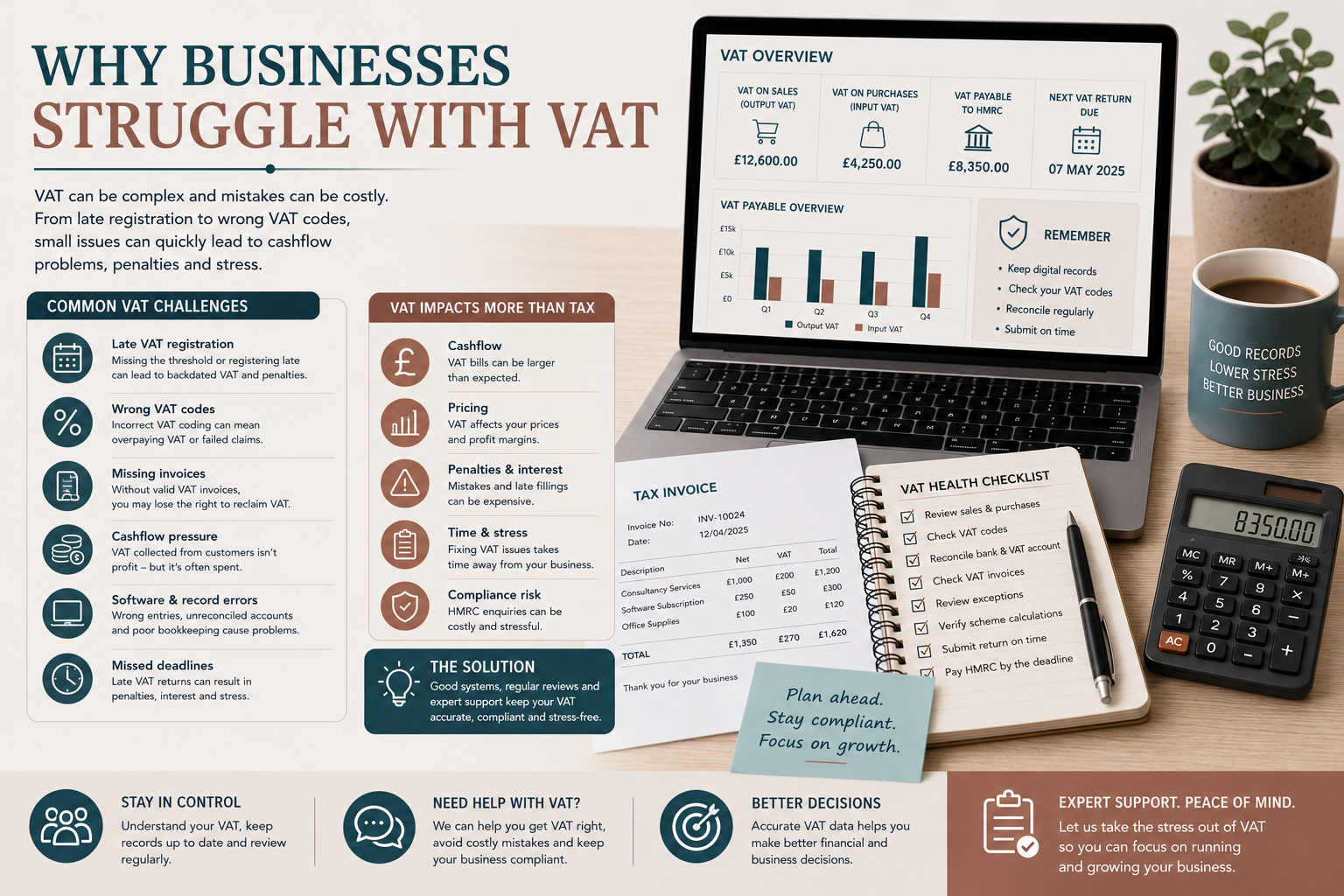
Why Businesses Struggle With VAT
VAT is one of the most common areas where small businesses make mistakes.
For many business owners, VAT starts off sounding simple:
charge VAT on sales, reclaim VAT on purchases, pay the difference to HMRC.
In practice, it is not always that straightforward.
Businesses struggle with VAT because it affects pricing, cashflow, bookkeeping, software, invoices, deadlines and business decisions.
The problem is rarely just one VAT return. It is usually a combination of small issues building up over time.
A business may struggle because:
- it registered late
- it chose the wrong VAT scheme
- VAT codes were applied incorrectly
- VAT was treated as available cash
- platform income was recorded incorrectly
- invoices were missing
- VAT was reclaimed on restricted costs
- VAT returns were rushed
- bookkeeping was behind
- the owner did not understand the VAT position until the deadline
VAT mistakes can be expensive, but many of them are avoidable with better systems and regular review.
1. Businesses Do Not Monitor the VAT Threshold Properly
One of the biggest VAT problems is late registration.
A business must monitor taxable turnover carefully.
The VAT registration threshold is not checked only at the end of the tax year or accounting year.
Businesses need to monitor taxable turnover on a rolling 12-month basis.
This means the VAT threshold can be crossed during the year without the business realising.
Practical Example
A business looks at its accounts for the year to 31 March and sees turnover of £86,000.
The owner assumes VAT registration is not needed.
However, when checking the rolling 12 months to the end of May, taxable turnover is £92,000.
The business may already have passed the VAT registration threshold.
This can lead to backdated VAT, interest and penalties if the correct registration date is missed.
2. Businesses Confuse Turnover With Taxable Turnover
Not all income is treated the same way for VAT.
Some income may be:
- standard-rated
- reduced-rated
- zero-rated
- exempt
- outside the scope of VAT
This matters because VAT taxable turnover is not always the same as total money received into the bank.
A business may wrongly include income that should be excluded, or wrongly exclude income that should count.
Practical Example
A business has £95,000 total income.
Some of that income may be exempt, outside the scope or not relevant for UK VAT purposes.
Another business has £82,000 income showing in the bank, but the true gross taxable income is higher because platform fees were deducted before payout.
The VAT position depends on the facts.
This is why VAT should be reviewed properly rather than guessed.
3. Businesses Record Platform Payouts Incorrectly
This is a common issue for businesses using platforms such as:
- Airbnb
- Booking.com
- Amazon
- Etsy
- eBay
- Stripe
- PayPal
- card processors
- delivery apps
- marketplace platforms
Many platforms deduct fees before paying the business.
If the business records only the bank payout, income may be understated.
Practical Example
A serviced accommodation operator receives £4,500 into the bank from a booking platform.
The platform statement shows:
- guest booking income: £5,000
- platform fees: £500
- payout to host: £4,500
If only £4,500 is recorded as sales, the VAT and profit records may be wrong.
The correct approach is usually to record the gross income and the platform fee separately.
This is important for VAT threshold monitoring and VAT return accuracy.
4. VAT Is Treated as Business Cash
VAT collected from customers is not the same as profit.
A business may receive VAT-inclusive income into the bank and feel cash-rich, but part of that money may need to be paid to HMRC.
Practical Example
A VAT-registered business invoices £12,000 including VAT.
The owner sees £12,000 in the bank and uses it for wages, suppliers, stock and director withdrawals.
When the VAT return is due, the business does not have enough cash available to pay HMRC.
This is one of the most common VAT cashflow problems.
A good system should help the business understand how much of the bank balance is really available after VAT is considered.
5. The VAT Return Is Left Until the Deadline
VAT returns are often rushed when bookkeeping is behind.
This creates problems because the business may not have time to:
- find missing receipts
- check VAT codes
- reconcile bank accounts
- review invoices
- confirm platform income
- check imports and reverse charge entries
- review unusual transactions
- confirm whether VAT can be reclaimed
- understand whether cash is available to pay HMRC
A rushed VAT return is more likely to contain errors.
VAT should be reviewed during the quarter, not only at the end.
6. VAT Codes Are Applied Incorrectly in Software
Accounting software is helpful, but it does not remove the need for judgement.
Software may suggest VAT codes, but it does not always know the correct treatment.
Common VAT coding mistakes include:
- standard-rating something that should be zero-rated
- treating exempt income as outside the scope
- reclaiming VAT where there is no valid VAT invoice
- reclaiming VAT on restricted costs
- using the wrong code for imports
- missing reverse charge VAT
- applying VAT to bank transfers incorrectly
- coding personal costs as business expenses
- treating loan receipts or capital introductions as income
Practical Example
A business owner uploads receipts into software.
The software reads the VAT amount automatically.
The owner accepts the entries without checking whether VAT can actually be reclaimed.
The VAT return may then include incorrect input VAT claims.
Software can speed up bookkeeping, but it does not replace review.
7. Businesses Reclaim VAT Without Valid Evidence
A business cannot reclaim VAT simply because it spent money.
There usually needs to be valid VAT evidence.
In many cases, this means a proper VAT invoice.
A card receipt or bank statement may not be enough.
Practical Example
A business pays £600 to a supplier.
The bank statement shows the payment, but there is no VAT invoice.
The owner assumes VAT can be reclaimed because the supplier is a business.
Without proper VAT evidence, the input VAT claim may not be valid.
Keeping VAT invoices is essential.
8. Businesses Reclaim VAT on Restricted Costs
Some costs require extra care.
VAT recovery may be restricted or disallowed depending on the type of expense and how it is used.
Examples include:
- business entertaining
- cars
- fuel
- mixed-use costs
- personal expenditure
- certain property costs
- expenses linked to exempt income
- costs not incurred for business purposes
Practical Example
A director takes a client out for a meal.
The receipt shows VAT.
The director assumes the VAT can be reclaimed.
However, VAT on business entertainment is restricted in many cases.
This type of error can happen easily when VAT returns are prepared without proper review.
9. Businesses Choose the Wrong VAT Scheme
VAT schemes can affect cashflow and overall VAT cost.
Common schemes include:
- standard VAT accounting
- cash accounting
- flat rate scheme
- annual accounting
The right scheme depends on the business.
A scheme that works well for one business may be unsuitable for another.
Flat Rate Scheme Example
The Flat Rate Scheme may look simple because VAT is calculated using a fixed percentage of VAT-inclusive turnover.
However, it may not be beneficial where the business has significant VATable costs, equipment purchases or setup costs.
Cash Accounting Example
Cash accounting can help businesses that invoice customers and wait to be paid, because VAT is usually accounted for when money is received and paid.
However, it may not suit every business.
Before choosing a VAT scheme, the business should compare the numbers properly.
10. Businesses Do Not Understand VAT and Pricing
VAT can affect pricing, especially where customers are individuals or non-VAT registered businesses.
If the business adds VAT on top of existing prices, customers may see a price increase.
If the business absorbs VAT within existing prices, profit margins may fall.
Practical Example
A business charges £120 to consumers before VAT registration.
After VAT registration, it keeps the price at £120 VAT-inclusive.
This means part of the £120 may now be VAT payable to HMRC.
The net income retained by the business may be lower than before.
This is why pricing should be reviewed before VAT registration becomes urgent.
11. Businesses Do Not Understand Zero-Rated and Exempt Supplies
Zero-rated and exempt supplies are often confused.
They both involve no VAT being charged to the customer, but they are not the same.
Zero-rated supplies are taxable supplies charged at 0%.
Exempt supplies are outside the taxable VAT system in a different way and may restrict input VAT recovery.
This distinction matters for:
- VAT registration
- VAT returns
- input VAT recovery
- partial exemption
- business planning
Practical Example
A business assumes that because it does not charge VAT on a certain supply, the income does not matter for VAT.
That may be wrong if the supply is zero-rated.
Zero-rated income can still count towards taxable turnover.
This is a common misunderstanding.
12. Property and VAT Create Confusion
Property VAT can be complicated.
Different rules can apply to:
- residential rent
- serviced accommodation
- holiday accommodation
- commercial property
- property development
- option to tax
- rent-to-rent arrangements
- mixed-use buildings
- refurbishment projects
A landlord moving from standard residential letting to serviced accommodation should not assume the VAT treatment stays the same.
Practical Example
A landlord previously received exempt residential rent.
They then start using the property for short-term serviced accommodation.
The VAT treatment may be different because short-term accommodation can be taxable.
This can affect VAT registration, pricing and bookkeeping.
13. Construction VAT and CIS Are Confused
Construction businesses often have to deal with VAT and CIS at the same time.
They are separate systems.
VAT deals with tax on supplies.
CIS deals with deductions from payments to subcontractors.
A construction business may also need to consider domestic reverse charge VAT.
Common mistakes include:
- confusing CIS deductions with VAT
- applying the wrong VAT code to subcontractor invoices
- missing domestic reverse charge VAT
- treating materials incorrectly
- failing to reconcile CIS and VAT records separately
Practical Example
A contractor receives an invoice from a subcontractor.
The invoice involves labour, materials, CIS and possibly reverse charge VAT.
If the bookkeeping is not reviewed carefully, VAT and CIS can both be reported incorrectly.
Construction businesses need strong records and clear invoice treatment.
14. Businesses Do Not Reconcile VAT Properly
VAT returns should not be submitted without checks.
A proper VAT review should consider whether:
- bank accounts are reconciled
- all sales invoices are included
- all purchase invoices are included
- VAT codes look reasonable
- VAT control accounts agree
- platform income has been recorded gross
- VAT on restricted costs has been reviewed
- imports and reverse charges are correct
- old unpaid invoices have been treated correctly
- the return makes sense compared with business activity
Practical Example
A business submits VAT returns from software without reviewing the VAT control account.
Over several quarters, small coding errors build up.
Eventually, the VAT balance in the accounts does not agree with what has been submitted to HMRC.
This creates extra work and possible corrections.
15. Businesses Ignore VAT Cashflow Until the Return Is Due
VAT should be planned throughout the quarter.
A business should know:
- estimated VAT due
- when the return is due
- when payment is due
- whether cash is available
- whether customers have paid
- whether large supplier bills affect the position
- whether a repayment is expected
- whether VAT funds have been set aside
Waiting until the deadline creates unnecessary pressure.
VAT is easier to manage when it is reviewed monthly.
16. Businesses Miss VAT Deadlines
VAT returns are usually due one calendar month and 7 days after the end of the VAT period.
The payment deadline is usually the same date.
Missing deadlines can lead to penalties and interest.
Late VAT submissions can also result in penalty points.
Once the penalty point threshold is reached, financial penalties can apply.
Repeated lateness is more serious than a one-off mistake.
Practical Example
A business submits VAT returns late for several quarters.
The owner assumes it is not a major issue because the VAT is eventually paid.
However, penalty points can build up, and repeated late submissions can lead to financial penalties.
Good VAT systems help prevent this.
17. Businesses Do Not Correct VAT Errors Properly
VAT mistakes should not be ignored.
If an error is found after a VAT return has been submitted, the business needs to consider how it should be corrected.
Some errors can be corrected on a later VAT return if they meet the conditions.
Other errors may need to be disclosed to HMRC separately.
The correct treatment depends on the size and nature of the error.
Practical Example
A business realises that VAT was wrongly reclaimed on several large purchases.
The business should not simply ignore the issue.
It should review the amount, period and correction method.
Correcting errors properly helps reduce future risk.
18. Businesses Assume VAT Advice Is Only Needed Once
VAT is not something to review only at registration.
VAT should be reviewed when the business changes.
This may include:
- new services
- new products
- new income streams
- imports
- exports
- platform selling
- property activity
- construction work
- change in customer type
- change in VAT scheme
- large purchases
- expansion
- deregistration planning
A business can start with a simple VAT position and become more complex over time.
19. VAT Problems Often Start With Bookkeeping Problems
VAT returns depend on accurate bookkeeping.
If bookkeeping is weak, VAT returns are likely to be weak.
Common bookkeeping issues include:
- unreconciled bank accounts
- missing invoices
- duplicated transactions
- incorrect VAT codes
- personal costs mixed in
- platform fees not separated
- supplier bills not entered
- payroll journals missing
- old transactions left unreconciled
- director withdrawals miscategorised
A VAT return is only as reliable as the records behind it.
20. VAT Problems Affect More Than Tax
VAT errors can affect the whole business.
They can create:
- cashflow pressure
- pricing issues
- HMRC penalties
- interest charges
- bookkeeping corrections
- management account errors
- inaccurate profit figures
- difficulty planning tax
- extra accountancy fees
- stress for business owners
VAT should be treated as part of wider financial control, not just a quarterly submission.
Common Signs Your Business Is Struggling With VAT
You may need VAT support if:
- you are unsure whether you should register
- your VAT return is always rushed
- you do not understand the VAT payable figure
- you are not confident with VAT codes
- VAT payments regularly cause cashflow stress
- platform payouts are not reconciled properly
- invoices and receipts are missing
- you do not know which VAT scheme you are using
- you are unsure what VAT can be reclaimed
- your software shows old VAT balances
- you have construction, property or overseas transactions
- HMRC has sent VAT reminders or penalties
These issues are easier to fix early.
How Businesses Can Improve VAT Control
A stronger VAT process may include:
- reviewing VAT registration threshold monthly
- using proper accounting software
- keeping digital VAT records
- checking VAT codes regularly
- saving valid VAT invoices
- reconciling bank accounts
- recording platform income gross
- reviewing VAT before submission
- setting aside VAT funds
- reviewing VAT schemes annually
- planning for pricing changes
- checking property and construction VAT carefully
- using management accounts to monitor cashflow
- getting advice before VAT problems become urgent
The goal is to make VAT predictable and manageable.
Practical Scenario: VAT Managed Well
A business monitors turnover monthly.
It registers for VAT on time.
It uses accounting software properly, keeps VAT invoices, reviews VAT codes and sets aside VAT funds throughout the quarter.
Before each VAT return is submitted, the business reviews:
- sales
- purchases
- VAT codes
- platform fees
- cash available
- unusual transactions
The VAT return is accurate, and the payment is planned.
This is proactive VAT management.
Practical Scenario: VAT Managed Poorly
Another business only checks VAT at the deadline.
The bookkeeping is behind.
Some income is recorded from bank receipts only.
VAT invoices are missing.
VAT codes are accepted automatically from software.
The business has spent the VAT collected from customers.
When the VAT return is prepared, the figure is higher than expected and cashflow is tight.
This creates stress, risk and avoidable correction work.
Frequently Asked Questions
Why do small businesses struggle with VAT?
Small businesses often struggle with VAT because of threshold monitoring, VAT codes, software errors, cashflow, missing invoices, pricing issues, scheme choices and deadline pressure.
Is VAT based on profit?
No. VAT is based on taxable supplies and VATable purchases, not profit. A business can have low profit but still owe VAT.
Why does VAT cause cashflow problems?
VAT causes cashflow problems when businesses spend VAT collected from customers instead of setting it aside for HMRC.
Can accounting software get VAT wrong?
Yes. Software can help process VAT, but incorrect coding, missing invoices and wrong assumptions can still lead to VAT errors.
What is the most common VAT mistake?
Common mistakes include missing VAT registration, using wrong VAT codes, reclaiming VAT without valid invoices and recording platform payouts incorrectly.
Is the Flat Rate Scheme always better?
No. The Flat Rate Scheme may simplify VAT, but it is not always cheaper. Businesses should compare schemes before deciding.
Do VAT returns need to be submitted digitally?
Most VAT-registered businesses need digital records and compatible software under Making Tax Digital rules, unless exempt.
Can PR Accountants help if VAT records are messy?
Yes. PR Accountants can review VAT records, correct bookkeeping issues, check VAT codes and help prepare accurate VAT returns.
How PR Accountants Can Help
At PR Accountants, we help small businesses make VAT clearer and more manageable.
We can support with:
- VAT registration reviews
- VAT return preparation
- VAT bookkeeping reviews
- VAT code checks
- VAT scheme comparisons
- Flat Rate Scheme reviews
- Cash Accounting Scheme reviews
- Making Tax Digital setup
- VAT cashflow planning
- platform income reconciliation
- property VAT reviews
- serviced accommodation VAT reviews
- construction VAT and domestic reverse charge support
- VAT deregistration advice
- HMRC VAT correspondence support
Our aim is to help business owners understand their VAT position, avoid common mistakes and stay compliant.
Final Thoughts
Businesses often struggle with VAT because VAT touches so many areas of the business.
It affects:
- pricing
- cashflow
- sales invoices
- purchase invoices
- bookkeeping
- software
- deadlines
- VAT schemes
- HMRC compliance
VAT becomes much easier when it is reviewed regularly and supported by accurate records.
The key is not to wait until the VAT return deadline.
Good VAT management means knowing your position before the deadline, setting aside cash and making sure the figures are right.
Strong Call to Action
Struggling With VAT Returns or VAT Cashflow?
VAT can quickly become stressful when records are unclear, software codes are wrong or the payment due is higher than expected.
PR Accountants can help you review your VAT position, prepare accurate VAT returns and put better systems in place.
👉 Contact PR Accountants today for practical VAT support tailored to your business. Contact Us