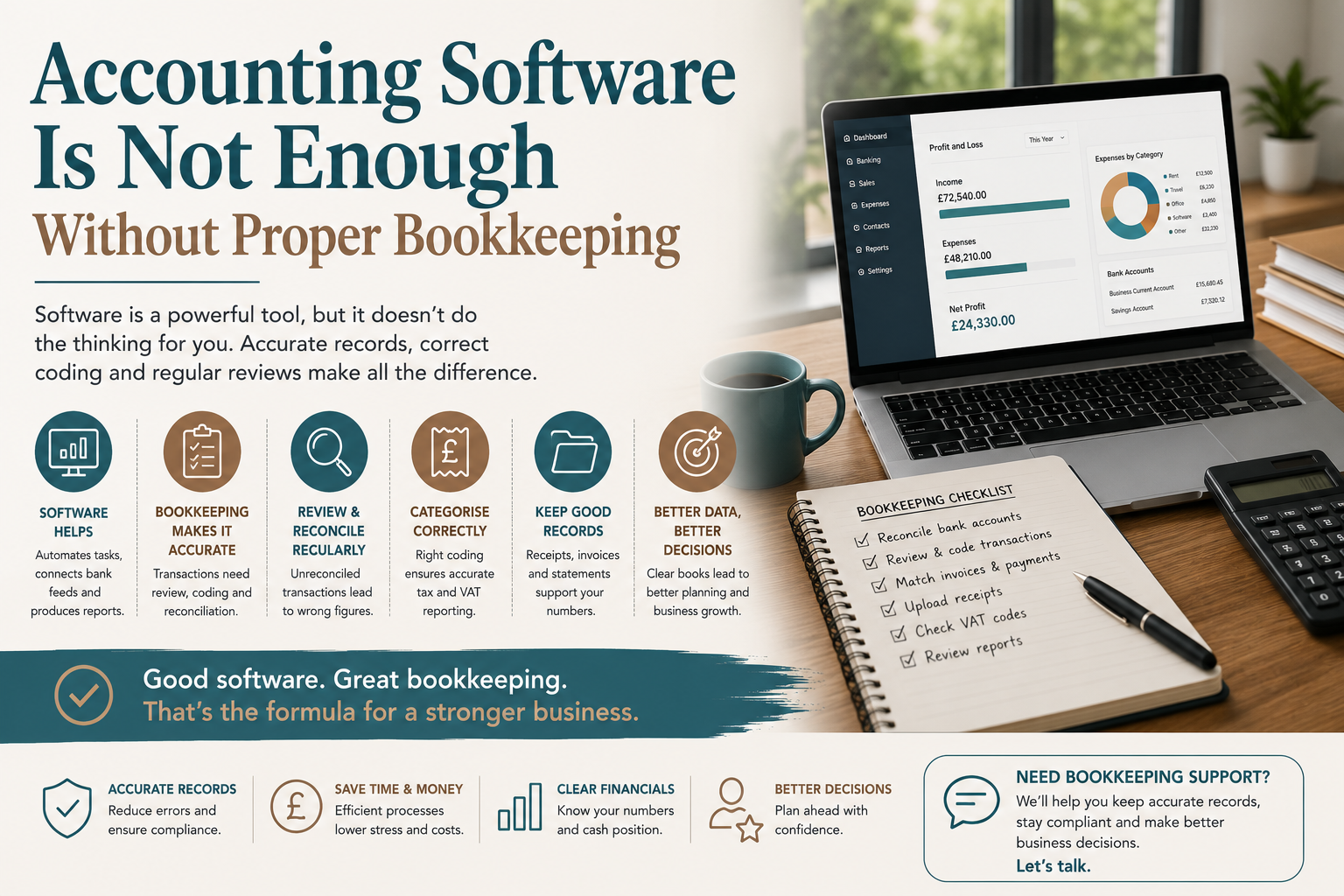
Accounting Software Is Not Enough Without Proper Bookkeeping
Cloud accounting software has changed the way small businesses manage their finances.
Tools such as Xero, QuickBooks, FreeAgent and other bookkeeping systems can connect to bank feeds, store receipts, produce reports, calculate VAT and make it easier to share records with your accountant.
Used properly, accounting software can save time and improve financial visibility.
However, software alone is not bookkeeping.
A business can have good software and still have poor records.
The software can only work with the information entered into it. If transactions are coded incorrectly, invoices are missing, bank feeds are not reconciled or personal spending is mixed with business costs, the reports can be misleading.
This is why proper bookkeeping remains essential.
What accounting software can do well
Accounting software can be very useful for small businesses.
It can help with:
• Recording sales invoices.
• Tracking purchase invoices.
• Connecting bank feeds.
• Matching payments to invoices.
• Uploading receipts.
• Producing profit and loss reports.
• Preparing VAT information.
• Tracking unpaid customer invoices.
• Monitoring supplier bills.
• Sharing records with your accountant.
• Keeping digital records for Making Tax Digital.
These features are valuable, but they do not remove the need for judgement, review and accuracy.
Software can speed up bookkeeping, but it cannot automatically understand every business transaction correctly.
What accounting software cannot do by itself
Accounting software does not automatically know the full story behind a transaction.
For example, it may not know whether:
• A payment is business or personal.
• A cost is allowable for tax.
• A transaction should be treated as a loan.
• A payment to a director is salary, dividend, expense reimbursement or director’s loan.
• A property cost is a repair or an improvement.
• A VAT code is correct.
• A bank transfer is income, a loan, capital introduced or movement between accounts.
• A receipt relates to one business or another.
• A subscription is wholly business related or partly private.
• A cost should be capitalised rather than expensed.
Software may suggest a category based on previous transactions, supplier names or automation rules.
That does not mean the suggestion is correct.
Bank feeds are not bookkeeping
Bank feeds are helpful because they bring bank transactions into the software automatically.
However, a bank feed simply imports the bank activity. It does not explain what each transaction is or whether it has been treated correctly.
Common bank feed issues include:
• Duplicate transactions.
• Missing bank feed periods.
• Transfers treated as income.
• Loan repayments treated entirely as expenses.
• Personal spending coded as business expenses.
• Customer receipts not matched to sales invoices.
• Supplier payments not matched to purchase bills.
• VAT coded incorrectly.
• Old unreconciled items left unresolved.
• Bank balances in the software not agreeing to the actual bank statement.
A bank feed is only reliable if it is reconciled properly.
Reconciliation is the process of checking that the transactions in the software agree to the actual bank account and are coded correctly.
Receipt uploads are useful, but they still need review
Receipt capture tools can save time.
They can read supplier names, dates, amounts and VAT information from invoices and receipts.
However, receipt capture is not perfect.
The software may misread:
• The invoice date.
• The supplier name.
• The VAT amount.
• The gross total.
• The currency.
• The expense category.
• Whether the cost is business or personal.
• Whether the cost relates to a particular project, property or customer.
This is particularly important where a business has multiple activities.
For example, a landlord may need to know which property an expense relates to. A serviced accommodation operator may need to split costs by unit. A limited company director may need to separate company costs from personal spending.
Uploading a receipt is only the first step.
The transaction still needs to be reviewed, coded and matched correctly.
Automation can repeat mistakes
Automation rules are useful when they are set up properly.
For example, a monthly software subscription may be coded automatically to computer software. A recurring insurance payment may be coded to business insurance.
However, automation can also repeat errors.
If a rule is set up incorrectly, the same mistake may be made every month.
Examples include:
• All Amazon purchases being coded to office expenses, even where some are personal.
• All loan payments being coded to bank charges, even where part of the payment is capital repayment.
• All card payments to a fuel station being coded as motor expenses, even where some relate to food or personal items.
• All payments to a director being coded as wages, even where some are dividends or director’s loans.
• All income from a platform being recorded net of fees instead of gross.
Automation should be reviewed regularly.
It should not be treated as a substitute for bookkeeping knowledge.
Why correct coding matters
Correct coding matters because it affects your accounts, tax return and business decisions.
If transactions are coded incorrectly, the business may:
• Overstate income.
• Understate income.
• Miss allowable expenses.
• Claim expenses that are not allowable.
• Use the wrong VAT treatment.
• Misstate profit.
• Misstate director’s loan account balances.
• Misstate customer or supplier balances.
• Produce unreliable management reports.
• Make poor decisions based on inaccurate figures.
Incorrect bookkeeping can also create more work at the year-end.
The longer errors are left, the more time-consuming they can be to correct.
VAT makes bookkeeping even more important
VAT-registered businesses need accurate records because VAT errors can create direct tax consequences.
The software may help calculate VAT, but only if the transactions have been recorded correctly.
VAT errors can arise where:
• The wrong VAT rate is selected.
• Exempt and zero-rated sales are confused.
• Reverse charge transactions are missed.
• Imports are not treated correctly.
• Supplier invoices without VAT are coded as if VAT was charged.
• VAT is claimed on non-VAT receipts.
• Private or non-business costs are included.
• Mixed-use expenses are not adjusted.
• Deposits and prepayments are not treated correctly.
• Flat Rate Scheme rules are misunderstood.
The VAT return is only as reliable as the bookkeeping behind it.
Making Tax Digital does not remove the need for bookkeeping
Making Tax Digital increases the importance of proper bookkeeping.
For businesses within MTD, digital records and compatible software are required.
However, MTD does not mean HMRC checks every transaction before a return is submitted.
It also does not mean that software automatically makes the figures correct.
For small businesses and landlords, MTD means records need to be maintained regularly rather than pulled together once a year.
This makes bookkeeping habits more important, not less important.
To be ready for MTD, businesses should make sure:
• Income is recorded correctly.
• Expenses are categorised properly.
• Bank feeds are reconciled.
• Receipts and invoices are stored digitally.
• VAT codes are reviewed where applicable.
• Property and trading income are separated.
• Business and personal spending are not mixed.
• Quarterly figures are reviewed before submission.
Good bookkeeping helps you understand profit
One of the biggest benefits of proper bookkeeping is that it gives you a clearer view of profit.
Business owners often look at the bank balance and assume it shows how well the business is doing.
That can be misleading.
The bank balance does not always show:
• Unpaid customer invoices.
• Supplier bills still due.
• Tax liabilities building up.
• VAT owed to HMRC.
• PAYE and pension obligations.
• Loan balances.
• Capital expenditure.
• Director’s loan account movements.
• Future costs already committed.
• Whether income is seasonal or recurring.
Proper bookkeeping gives you a more accurate picture of what the business has earned, what it owes and what cash is genuinely available.
Why bookkeeping matters for limited companies
Limited companies need particularly careful bookkeeping because the company is separate from its directors and shareholders.
Money paid from the company bank account must be recorded correctly.
It may be:
• Salary.
• Dividends.
• Repayment of money lent to the company.
• Reimbursement of genuine business expenses.
• Employer pension contributions.
• A director’s loan.
Poor bookkeeping can cause problems with:
• Director’s loan accounts.
• Dividend planning.
• Corporation Tax calculations.
• Payroll records.
• VAT returns.
• Statutory accounts.
• Company Tax Returns.
• Cashflow forecasting.
A company bank account should not be treated as a personal bank account.
Clear bookkeeping helps maintain that separation.
Why bookkeeping matters for sole traders
Sole traders also need proper bookkeeping.
Although a sole trader is not separate from the business in the same way as a limited company, business income and expenses still need to be recorded accurately.
A sole trader should keep clear records of:
• Sales and income.
• Business expenses.
• Mileage.
• Use of home costs where claimed.
• Stock and materials.
• Equipment purchases.
• Business bank transactions.
• Cash income.
• Personal drawings.
• VAT records where registered.
• PAYE records where employees are paid.
Good records make Self Assessment easier and reduce the risk of missed income or unsupported expenses.
Why bookkeeping matters for landlords
Landlords need clear records because property income has its own tax rules.
For landlords, bookkeeping should identify:
• Rental income by property.
• Letting agent statements.
• Repairs and maintenance.
• Insurance.
• Mortgage interest.
• Service charges.
• Ground rent.
• Legal and professional fees.
• Replacement domestic items.
• Capital improvements.
• Ownership percentages.
• Property finance costs carried forward.
• Rental losses.
Mortgage payments need particular care because capital repayments are not treated in the same way as mortgage interest.
Repairs and improvements also need to be reviewed carefully because they can have different tax treatment.
Common bookkeeping mistakes small businesses make
Relying only on the bank balance
A healthy bank balance does not always mean the business is profitable.
You may still have VAT, Corporation Tax, PAYE, supplier bills or loan repayments to deal with.
Not reconciling the bank
If the bank in the software does not agree to the real bank statement, the accounts may be unreliable.
Mixing personal and business spending
This creates unnecessary confusion and increases the risk of errors.
A separate business bank account is usually much cleaner.
Using the wrong VAT codes
VAT errors can lead to underpayments, overclaims or unnecessary corrections later.
Treating all income as the same
Different types of income may need different tax, VAT or accounting treatment.
Ignoring unpaid invoices and bills
Cash received and profit earned are not always the same thing.
Leaving bookkeeping until the year-end
This increases the risk of missing records, forgotten transactions and rushed corrections.
Not reviewing reports
Reports are only useful if they are accurate and reviewed regularly.
What good bookkeeping should include
Good bookkeeping should include regular review and control.
For most small businesses, this means:
• Recording sales promptly.
• Keeping purchase invoices and receipts.
• Reconciling bank accounts.
• Checking payment processors and platform statements.
• Reviewing VAT codes.
• Separating business and personal costs.
• Reviewing unpaid invoices.
• Reviewing supplier balances.
• Checking loan and finance balances.
• Monitoring payroll journals where applicable.
• Reviewing director’s loan account balances.
• Reviewing profit and cashflow regularly.
• Keeping records digitally where required.
The frequency depends on the size and complexity of the business.
For many small businesses, monthly bookkeeping is a sensible minimum.
VAT-registered businesses and businesses with high transaction volumes may need more frequent review.
How proper bookkeeping improves tax planning
Tax planning is much harder when the bookkeeping is incomplete.
Accurate bookkeeping helps identify:
• Estimated profit.
• Corporation Tax exposure.
• Income Tax exposure.
• VAT liabilities.
• Dividend availability.
• Director’s loan issues.
• Payments on account.
• Allowable expenses.
• Capital allowance opportunities.
• Pension planning opportunities.
• Cash available for tax.
This allows decisions to be made before deadlines rather than after the year has ended.
For example, a limited company director may want to review salary, dividends, pension contributions and Corporation Tax before the company year-end.
That is only possible if the bookkeeping is up to date.
Software and bookkeeping should work together
The best result comes when software and bookkeeping are used together.
Software provides the system.
Bookkeeping provides the accuracy.
A good bookkeeping process should make the software useful for:
• Compliance.
• Tax returns.
• VAT returns.
• Management accounts.
• Cashflow planning.
• Profit review.
• Debt chasing.
• Business decisions.
• Year-end accounts.
The software is the tool. The bookkeeping is the control process that makes the tool reliable.
When should you get bookkeeping support?
You may need bookkeeping support if:
• Your bank reconciliation is behind.
• Your software reports do not match the bank.
• You are unsure how to code transactions.
• VAT returns are stressful or unclear.
• You have many unreconciled transactions.
• You mix business and personal spending.
• You have director’s loan account issues.
• Your accountant has to correct many items at year-end.
• You do not know your profit during the year.
• You are preparing for Making Tax Digital.
• You want better management information.
Good bookkeeping support can reduce errors, improve reporting and make year-end accounts easier.
How PR Accountants Ltd can help
Accounting software is useful, but it is not a replacement for proper bookkeeping.
If the records are not reviewed, reconciled and coded correctly, the reports can be misleading and the tax position can be wrong.
PR Accountants Ltd helps sole traders, landlords and limited companies with bookkeeping, cloud accounting software, VAT returns, payroll, management reports, statutory accounts and tax returns.
We can help you set up the right bookkeeping process, review your current software records and keep your accounts accurate throughout the year.
Contact us if you want reliable bookkeeping support rather than software that simply stores transactions. Contact Us
Related articles
• Getting Ready for Making Tax Digital: Practical Steps for Small Businesses
• What Expenses Can You Claim as a Sole Trader?